

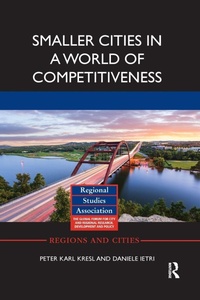
Smaller Cities in a World of Competitiveness
1st Edition
Published on 12. December 2019
Book
Paperback/Softback
200 pages
978-0-367-87204-5 (ISBN)
Description
Much recent research in Urban Studies has concentrated on the notion of the 'global city' but discussion has also covered a larger set of mega cities, with populations in excess of 10 million. This analysis has begged the question of the optimal size for a city - is larger always better?
Smaller Cities explores the advantages and disadvantages of different sized cities, trying to determine their place in the global economy and hierarchy. How can smaller cities gain or retain their competitiveness in a world of large cities? In a globalized world, the nation has perhaps been diminished as an economic actor, with fiscal shortcomings and political gridlock leaving cities more or less on their own in the task of enhancing their competitiveness and improving the economic lives of their residents. This book argues that smaller cities of varying population can be important actors in competitiveness and aims to bring attention to an area often overlooked by researchers. In short, are Pittsburgh, San Diego and Austin less competitive than London and Mumbai?
This volume will be of interest to students, researchers, and city professionals who work in urban economy and urban geography.
Smaller Cities explores the advantages and disadvantages of different sized cities, trying to determine their place in the global economy and hierarchy. How can smaller cities gain or retain their competitiveness in a world of large cities? In a globalized world, the nation has perhaps been diminished as an economic actor, with fiscal shortcomings and political gridlock leaving cities more or less on their own in the task of enhancing their competitiveness and improving the economic lives of their residents. This book argues that smaller cities of varying population can be important actors in competitiveness and aims to bring attention to an area often overlooked by researchers. In short, are Pittsburgh, San Diego and Austin less competitive than London and Mumbai?
This volume will be of interest to students, researchers, and city professionals who work in urban economy and urban geography.
Reviews / Votes
'Most scholarly research on cities is focused on the great metropolitan areas of the world system. This book takes a refreshingly different approach by concentrating on small cities and what makes them attractive to large numbers of people. In doing so, the book reveals that these cities are marked by enormous diversity and often display surprisingly robust forms of economic, social and cultural life.' - Allen J. Scott, Research Professor, UCLA, USAMore details
Series
Language
English
Place of publication
London
United Kingdom
Publishing group
Taylor & Francis Ltd
Target group
College/higher education
Postgraduate
Dimensions
Height: 234 mm
Width: 156 mm
Weight
370 gr
ISBN-13
978-0-367-87204-5 (9780367872045)
Copyright in bibliographic data and cover images is held by Nielsen Book Services Limited or by the publishers or by their respective licensors: all rights reserved.
Schweitzer Classification
Other editions
Additional editions

Peter Karl Kresl | Daniele Ietri
Smaller Cities in a World of Competitiveness
E-Book
04/2016
Routledge
€59.49
Available for download

Peter Karl Kresl | Daniele Ietri
Smaller Cities in a World of Competitiveness
E-Book
04/2016
Routledge
€59.49
Available for download
Peter Karl Kresl | Daniele Ietri
Smaller Cities in a World of Competitiveness
Book
04/2016
1st Edition
Routledge
€232.90
Shipment within 10-20 days
Persons
Peter Karl Kresl was Professor of Economics at Bucknell University in the US for almost 40 years. He co-founded the Global Urban Competitiveness Project fifteen years ago, and remains its President today.
Daniele Ietri is Asssociate Professor of Geography at the eCampus University, Italy, where he is responsible for the Geography courses at the Faculty of Education and the Faculty of Literature.
Daniele Ietri is Asssociate Professor of Geography at the eCampus University, Italy, where he is responsible for the Geography courses at the Faculty of Education and the Faculty of Literature.
Content
1. Introduction to small cities - how to describe/define them? 2. Small cities in a world of Mega-cities 3. What are the strengths and weaknesses of smaller cities? 4. Is size important? 5. Public policy and small cities in North America 6. Public policies and small cities in the European Union 7. Small cities and competitiveness in North America 8. Small cities and competitiveness in Europe 9. Summing it up: options for smaller cities