

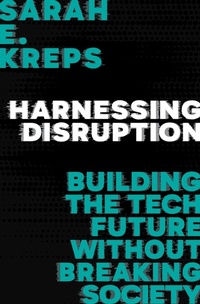
Harnessing Disruption
Building the Tech Future Without Breaking Society
Will be published approx. on 5. January 2027
Book
Hardback
184 pages
978-0-19-780376-9 (ISBN)
Description
A timely and thought-provoking exploration of technological disruption, drawing on history's most transformative innovations-from nuclear power to AI-to offer a vital roadmap for navigating the future of technology.
In Harnessing Disruption, Sarah E. Kreps-a national security expert and military veteran-offers a fresh, clear-eyed framework for understanding the social and political dynamics that shape technological change. From nuclear weapons to AI, cryptocurrency, and social media, breakthrough innovations rarely arrive without backlash. Disruption is not collapse. History shows it is part of a recurring pattern.
With unmatched insight and authority, Kreps traces a five-stage cycle that technologies follow: emergence, early warnings, crisis, agenda-setting, and institutional response. Drawing on decades of research and real-world policy experience, she argues that disruption is neither inherently dangerous nor inherently self-correcting. Rather, it's a process we can steer, if we learn to see the signs and act decisively.
Harnessing Disruption challenges fatalistic narratives that cast AI and other technologies as uncontrollable forces. It makes the case for cautious optimism: that institutions can adapt, societies can recalibrate, and technologies can be governed in ways that protect both innovation and the public good. Timely, incisive, and grounded in both historical precedent and contemporary case studies, this book provides the tools for anyone, including policymakers, entrepreneurs, and citizens, to understand where we are in the cycle of disruption and how to shape what comes next.
In Harnessing Disruption, Sarah E. Kreps-a national security expert and military veteran-offers a fresh, clear-eyed framework for understanding the social and political dynamics that shape technological change. From nuclear weapons to AI, cryptocurrency, and social media, breakthrough innovations rarely arrive without backlash. Disruption is not collapse. History shows it is part of a recurring pattern.
With unmatched insight and authority, Kreps traces a five-stage cycle that technologies follow: emergence, early warnings, crisis, agenda-setting, and institutional response. Drawing on decades of research and real-world policy experience, she argues that disruption is neither inherently dangerous nor inherently self-correcting. Rather, it's a process we can steer, if we learn to see the signs and act decisively.
Harnessing Disruption challenges fatalistic narratives that cast AI and other technologies as uncontrollable forces. It makes the case for cautious optimism: that institutions can adapt, societies can recalibrate, and technologies can be governed in ways that protect both innovation and the public good. Timely, incisive, and grounded in both historical precedent and contemporary case studies, this book provides the tools for anyone, including policymakers, entrepreneurs, and citizens, to understand where we are in the cycle of disruption and how to shape what comes next.
Reviews / Votes
Sarah Kreps has written an absolute gem on the way emerging technologies reshape the world, arising to solve urgent problems while then generating problems of their own as poorly understood risks can spiral into crises. Kreps helps us understand everything from crypto to artificial intelligence, and her five-stage framework makes clear the patterns that arise again and again, and the options governments and societies have as they attempt to gain the benefits of emerging technologies while avoiding the downsides. Highly recommend! * Michael C. Horowitz, Richard Perry Professor, University of Pennsylvania * At a time when the world of tech commentary seems dominated by 'Doomers' and 'Utopians', rarely does one find a sober-minded assessment that situates the current race of artificial intelligence into the history of technological development. Sarah Kreps provides such an assessment in Harnessing Disruption. Anyone wishing to understand the trajectory of technology governance-past and present-will appreciate Kreps' rigorous and level-headed analysis of one of the most important governance challenges of our time. * Nathaniel Persily, James B. McClatchy Professor of Law, Stanford Law School * Harnessing Disruption is a thoughtful and provocative exploration that helps put into perspective the consequences new technology is imposing on twenty-first century lives. The more I read, the more engrossed I became with its five-step look to both the future and history as the basis for cautious optimism rather than fear. * Tom Wheeler, former Chairman, Federal Communications Commission (FCC) *More details
Language
English
Place of publication
New York
United States
Target group
College/higher education
Dimensions
Height: 235 mm
Width: 156 mm
ISBN-13
978-0-19-780376-9 (9780197803769)
Copyright in bibliographic data and cover images is held by Nielsen Book Services Limited or by the publishers or by their respective licensors: all rights reserved.
Schweitzer Classification
Person
Sarah E. Kreps is the John L. Wetherill Professor in the Department of Government, Adjunct Professor of Law, and Director of the Tech Policy Institute at Cornell University. Her research focuses on the intersection of emerging technology, national security, and public policy, and is the subject of seven books and dozens of academic and policy articles. She previously served as an officer in the United States Air Force, where she worked in the area of intelligence, surveillance, and reconnaissance.
Content
Acknowledgments Introduction 1. Technological Emergence 2. Early Warning 3. The Crisis 4. Agenda-Setting 5. Response Formation Conclusion Notes Index