

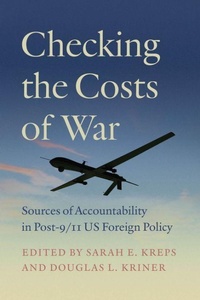
Checking the Costs of War
Sources of Accountability in Post-9/11 US Foreign Policy
Will be published approx. on 1. April 2026
Book
Hardback
400 pages
978-0-226-83414-6 (ISBN)
Description
A thorough reassessment of how domestic factors do and do not constrain the use of American military force abroad in the early twenty-first century.
More than two decades have passed since the September 11th terrorist attacks resuscitated debates about the "imperial presidency" within the United States. During that same time, the United States has fought costly and inconclusive wars in Iraq and Afghanistan, pivoted to the Pacific to counter China, and pulled its gaze back to Europe and the Middle East in response to wars in Ukraine and Gaza. Moreover, new technologies and ways of funding and staffing wars have made the costs of war less visible to the public while polarization has increased and a new legal doctrine of presidential power has gained force.
Against this backdrop, Checking the Costs of War reassesses how domestic factors have both constrained and failed to constrain the use of military power across different contexts and over time. Richly empirical chapters explore the varying effects of different kinds of potential checks: legislative, public opinion, and bureaucratic. Collectively, chapters offer new insight into the prospects for war and peace today.
More than two decades have passed since the September 11th terrorist attacks resuscitated debates about the "imperial presidency" within the United States. During that same time, the United States has fought costly and inconclusive wars in Iraq and Afghanistan, pivoted to the Pacific to counter China, and pulled its gaze back to Europe and the Middle East in response to wars in Ukraine and Gaza. Moreover, new technologies and ways of funding and staffing wars have made the costs of war less visible to the public while polarization has increased and a new legal doctrine of presidential power has gained force.
Against this backdrop, Checking the Costs of War reassesses how domestic factors have both constrained and failed to constrain the use of military power across different contexts and over time. Richly empirical chapters explore the varying effects of different kinds of potential checks: legislative, public opinion, and bureaucratic. Collectively, chapters offer new insight into the prospects for war and peace today.
Reviews / Votes
"Checking the Costs of War examines the factors influencing the ability of US leaders to engage in a range of fiscally and politically costly foreign policy and military actions in the absence of effective constraints on the part of groups such as the legislature, the federal bureaucracy, and/or the public." * Choice * "An illuminating, empirically grounded collection of essays by leading scholars of U.S. foreign policy decision making, Checking the Costs of War investigates the ability of domestic actors to constrain the war-making powers of the president. . .. The volume advances scholarship at the intersection of U.S. domestic politics and international relations-a literature that has been overshadowed by the vast body of work which employs theories of state behavior based on a unitary actor assumption or, in the case of the United States, claims an imperial presidency. For experts in U.S. foreign policy decision making, Checking the Costs of War is a must-read, as each chapter pushes the boundaries of current knowledge about how actors at home operate in an evolving domestic political context to shape the executive's actions abroad. . .. Taking this work seriously will make projects on current or future U.S. foreign policy not only richer but also arguably more accurate."* Perspectives on Politics * "Checking the Costs of War is an excellent volume by the leading scholars in the study of American institutions and foreign policy. By assessing the state of political division in the United States and the evolving nature of military conflict, the book provides an innovative framework with which to understand checks on presidential power after 9/11. The book is a must-read for scholars of American foreign policy." -- Jon C.W. Pevehouse | University of Wisconsin-Madison "When presidents craft foreign policy and contemplate military action abroad, what domestic forces stand in their way? Quite a few, the essays in this important volume show. In different ways and under varying conditions, partisan opponents, intra-party factions, a recalcitrant bureaucracy, and a public weary of war periodically impede presidential ambitions to refashion international relations. Two presidencies-one domestic, the other foreign-may still exist. But the evidence and arguments herein leave the distinct impression that their differences are collapsing." -- William Howell | coauthor of "Presidents, Populism, and the Crisis of Democracy"
More details
Language
English
Place of publication
Chicago
United States
Publishing group
The University of Chicago Press
Target group
Professional and scholarly
College/higher education
Illustrations
20 halftones, 20 line drawings, 21 tables
Dimensions
Height: 229 mm
Width: 152 mm
Thickness: 30 mm
Weight
680 gr
ISBN-13
978-0-226-83414-6 (9780226834146)
Copyright in bibliographic data and cover images is held by Nielsen Book Services Limited or by the publishers or by their respective licensors: all rights reserved.
Schweitzer Classification
Persons
Sarah E. Kreps is the John L. Wetherill Professor in the Department of Government at Cornell University, where she is also an adjunct professor of law and the Director of the Cornell Tech Policy Institute. She is the author of five books, including, most recently, Social Media and International Relations. Douglas L. Kriner is the Clinton Rossiter Professor in American Institutions in the Department of Government at Cornell University. He is the author of five books, including, most recently, The Myth of the Imperial Presidency: How Public Opinion Checks the Unilateral Executive.
Content
List of Illustrations
Chapter 1. Unfettered Foreign Policy? Domestic Checks on Presidential Powers after 9/11
Sarah E. Kreps and Douglas L. Kriner
Chapter 2. Purely Partisan Warriors? Legislative Rhetoric in the Afghanistan and Iraq Wars
Sarah E. Kreps and Douglas L. Kriner
Chapter 3. Varieties of Bipartisanship: How Democrats and Republicans Align on Foreign and Domestic Policy
Jordan Tama
Chapter 4. Cassandra's Reward: The Electoral Benefits of Early Opposition to an Unpopular War
Benjamin O. Fordham
Chapter 5. Congressional Midterms, Presidential Reelection, and US Foreign Policy
Christopher Dictus and Philip B. K. Potter
Chapter 6. Modern Day Minutemen? Public Opinion and Reserve Component Mobilization
Jessica D. Blankshain and Lindsay P. Cohn
Chapter 7. Gender and the Political Costs of War: Partisan Cues, Gender Heuristics, and the Politics of Public Opposition to War
Aaron Childree, Katherine Krimmel, Max Palmer, and Douglas L. Kriner
Chapter 8. Nondominant Communal Groups and Casualty Sensitivity: Evidence from Israel, the United Kingdom, and the United States
Ronald R. Krebs and Robert Ralston
Chapter 9. "Hand to Hand Combat": Bureaucratic Politics and National Security
Andrew Rudalevige
Chapter 10. War Powers, the "Deep State," and Insurrection
Rebecca Ingber
Chapter 11. A Post-GWOT Syndrome? Institutional Response, Public Opinion, and the Future of US Foreign Policy
Sarah E. Kreps and Douglas L. Kriner
Acknowledgments
Index
Chapter 1. Unfettered Foreign Policy? Domestic Checks on Presidential Powers after 9/11
Sarah E. Kreps and Douglas L. Kriner
Chapter 2. Purely Partisan Warriors? Legislative Rhetoric in the Afghanistan and Iraq Wars
Sarah E. Kreps and Douglas L. Kriner
Chapter 3. Varieties of Bipartisanship: How Democrats and Republicans Align on Foreign and Domestic Policy
Jordan Tama
Chapter 4. Cassandra's Reward: The Electoral Benefits of Early Opposition to an Unpopular War
Benjamin O. Fordham
Chapter 5. Congressional Midterms, Presidential Reelection, and US Foreign Policy
Christopher Dictus and Philip B. K. Potter
Chapter 6. Modern Day Minutemen? Public Opinion and Reserve Component Mobilization
Jessica D. Blankshain and Lindsay P. Cohn
Chapter 7. Gender and the Political Costs of War: Partisan Cues, Gender Heuristics, and the Politics of Public Opposition to War
Aaron Childree, Katherine Krimmel, Max Palmer, and Douglas L. Kriner
Chapter 8. Nondominant Communal Groups and Casualty Sensitivity: Evidence from Israel, the United Kingdom, and the United States
Ronald R. Krebs and Robert Ralston
Chapter 9. "Hand to Hand Combat": Bureaucratic Politics and National Security
Andrew Rudalevige
Chapter 10. War Powers, the "Deep State," and Insurrection
Rebecca Ingber
Chapter 11. A Post-GWOT Syndrome? Institutional Response, Public Opinion, and the Future of US Foreign Policy
Sarah E. Kreps and Douglas L. Kriner
Acknowledgments
Index