

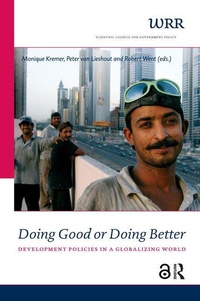
Doing Good or Doing Better
Development Policies in a Globalising World
Published on 20. May 2009
Book
Paperback/Softback
378 pages
978-90-8964-107-6 (ISBN)
Description
The world is changing, and so is the unquestioning belief that development policies are always right. Instead of focusing on the rather limited notion of poverty, this book aims to deepen our understanding of the broad issue of development. What are the drivers of development? What new issues have arisen due to globalization? And what kind of policies contribute to development in a world that is changing rapidly? The articles in this book provide insight into the muddled trajectories of development on various continents and rethink the notion of development in a globalizing, interdependent world. Taken together, the still fuzzy contours of a paradigm shift emerge from the 'Washington Confusion'. Development can no longer be the ambitious, moral project based on a standard model of economic European or American modernization. 'Doing better' means being less moralistic, more modest and pragmatic, and taking seriously the path dependencies and social realities that exist in each country.
Reviews / Votes
This volume provides the most comprehensive analysis available of the core issues on the global development agenda. All of the most difficult challenges are addressed - including the problems of development orthodoxy; the potential for corporate, NGO and civil society partnerships; the impact of the rise of China and India on aid, trade and investment; how best to engage in postwar peace and state building - and in each case novel answers provided. Both beginners and veterans in this field will benefit enormously from its insights. Martin Rhodes, Professor and Co-Director, Joseph Korbel School of International Relations, University of Denver, ColoradoMore details
Series
Language
English
Place of publication
Oxford
Netherlands
Target group
Professional and scholarly
Academic
Product notice
Paperback (trade)
Unsewn / adhesive bound
Dimensions
Height: 234 mm
Width: 152 mm
Thickness: 25 mm
Weight
635 gr
ISBN-13
978-90-8964-107-6 (9789089641076)
DOI
10.5117/9789089641076
Copyright in bibliographic data and cover images is held by Nielsen Book Services Limited or by the publishers or by their respective licensors: all rights reserved.
Schweitzer Classification
Other editions
Additional editions
E-Book
10/2025
Routledge
€0.00
Available for download
E-Book
10/2025
Routledge
€0.00
Available for download
Persons
Monique Kremer is researcher affiliated to the Netherlands Scientific Council for Government Policy (WRR). Please switch to the Dutch version of our website for the full Dutch description.
Content
contents - 6 about the authors - 10 preface - 14 1 towards development policies based onlesson learning: an introduction - 16 1.1 paradigm shifts - 17 1.2 globalization - 20 1.3 at the beginning of the 21st century: elements fordevelopment policies based on lesson learning - 23 2 twenty-first century globalization,paradigm shifts in development - 28 2.1 twenty-first century globalization - 28 2.2 turning points - 30 2.3 new development era - 31 2.4 international development cooperation - 41 3 does foreign aid work? - 48 3.1 introduction - 48 3.2 what aid are we talking about? - 49 3.3 challenges in trying to assess the impact of aid - 52 3.4 does aid work? the evidence - 55 3.5 constraining aid's greater impact and how theseconstraints might be addressed - 66 3.6 concluding comments: aid and the wider perspective - 71 4 under-explored treasure troves ofdevelopment lessons: lessons from thehistories of small rich european countries - 82 4.1 introduction: lessons from history, or rather the'secret history' - 82 4.2 agriculture - 87 4.3 industrial development - 90 4.4 corporate governance and the concentration ofeconomic power - 96 4.5 social and political factors - 98 4.6 concluding remarks - 100 5 stagnation in africa: disentanglingfigures, facts and fiction - 108 5.1 stagnation in sub-saharan africa - 109 5.2 the low social development cause - 112 5.3 the not-a-nation-state cause - 114 5.4 the dependence on raw material exports cause - 116 5.5 the greedy politicians cause - 117 5.6 the weak states and weak policies cause - 119 5.7 the washington consensus cause - 120 5.8 other traps and curses - 124 5.9 conclusions and consequences - 126 6 including the middle classes?latin american social policies after thewashington consensus - 138 6.1 the isi period and the origins of social policy regimes - 139 6.2 the debt crisis and the washington consensus - 140 6.3 neoliberalism and its failures - 141 6.4 turn to the left and basic universalism? - 145 6.5 the role of the middle classes - 149 6.6 lessons for development policy and external support - 151 7 imaginary institutions: state-building inafghanistan - 158 7.1 the afghan state and the dynamics that affect it - 159 7.2 the nature of the state-building effort inafghanistan - 164 7.3 how the 'international community' responds - 166 7.4 some concluding remarks - 171 8 beyond development orthodoxy:chinese lessons in pragmatism andinstitutional change - 178 8.1 buried under development? - 178 8.2 on land and institutions - 181 8.3 chinese pragmatism: colored cats or the demise ofideology? - 184 8.4 implications of chinese development: someconcluding observations - 194 9 business and sustainable development:from passive involvement to activepartnerships - 212 9.1 introduction: from uniform to pluriformdevelopment thinking - 212 9.2 from a traditional to a new development paradigm - 214 9.3 from macro to micro: the role of multinationals insustainable development - 217 9.4 from general to specific: strategic management ofcorporations and poverty alleviation - 220 9.5 from passive to active: the search for partnerships - 227 9.6 conclusion: the challenges ahead - 229 10 why 'philanthrocapitalism' is notthe answer: private initiatives andinternational development - 238 10.1 private initiatives - what kind and how much? - 240 10.2 ngo initiatives - 242 10.3 institutional philanthropy - 245 10.4 common problems: impact and accountability - 249 10.5 conclusions and implications for development policy - 250 11 the trouble with participation:assessing the new aid paradigm - 256 11.1 participation: on the main menu or just a side dish? - 256 11.2 what the new aid approach sets out to do: somebackground on the failure of ai