

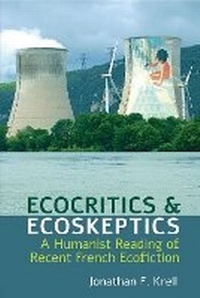
Ecocritics and Ecoskeptics
A Humanist Reading of Recent French Ecofiction
Published on 1. September 2020
Book
Hardback
280 pages
978-1-78962-205-8 (ISBN)
Description
In France, the fundamental intellectual debate over ecology might best be summarized by the contrasting views of Michel Serres and Luc Ferry. In The Natural Contract, Serres calls for an end to humans' war on nature: Our world view must turn from anthropocentric to ecocentric, and our relationship to the earth must become symbiotic instead of parasitic. Luc Ferry's response to Serres in The New Ecological Order ridicules the metaphor of a natural contract, by which humans (and humanism) would no longer reign over the earth. Ferry accuses Serres and other ecological thinkers of being "premodern" and "prehumanistic"; valuing nonhuman life as much as human life evokes the ridiculous trials of five centuries ago when beetles and rats were threatened with excommunication if they did not cease their antihuman activities.
After analyzing the Serres-Ferry debate, Ecocritics and Ecoskeptics examines environmental themes in novels by Michel Tournier, Stephane Audeguy, and Chantal Chawaf. It then considers the complex and evolving relationship between humans and animals as expressed in novels by Vercors and Olivia Rosenthal, and in philosophical works by Jacques Derrida, Elisabeth de Fontenay, and Peter Singer, among others. Two novels each by the humanist J.-C. Rufin and the humorist Iegor Gran provide a dose of healthy skepticism. Rufin's stories reveal the potential dark side of extreme environmentalism-authoritarianism and terrorism-while Gran's hilarious satires critique some environmentalists' piousness, opportunism, humorlessness, and antihumanism. The book concludes that environmentalism and humanism are not incompatible, if we proceed beyond the traditional humanism of Ferry and other modernists. Essays by philosophers such as Claude Levi-Strauss, Pierre Rabhi, Edgar Morin, and Michel Maffesoli demonstrate that an inclusive, ecological humanism is not only possible but necessary for our survival.
After analyzing the Serres-Ferry debate, Ecocritics and Ecoskeptics examines environmental themes in novels by Michel Tournier, Stephane Audeguy, and Chantal Chawaf. It then considers the complex and evolving relationship between humans and animals as expressed in novels by Vercors and Olivia Rosenthal, and in philosophical works by Jacques Derrida, Elisabeth de Fontenay, and Peter Singer, among others. Two novels each by the humanist J.-C. Rufin and the humorist Iegor Gran provide a dose of healthy skepticism. Rufin's stories reveal the potential dark side of extreme environmentalism-authoritarianism and terrorism-while Gran's hilarious satires critique some environmentalists' piousness, opportunism, humorlessness, and antihumanism. The book concludes that environmentalism and humanism are not incompatible, if we proceed beyond the traditional humanism of Ferry and other modernists. Essays by philosophers such as Claude Levi-Strauss, Pierre Rabhi, Edgar Morin, and Michel Maffesoli demonstrate that an inclusive, ecological humanism is not only possible but necessary for our survival.
Reviews / Votes
"This pioneering study provides eco-humanist insights into a broad spectrum of contemporary French fiction. Professor Krell contributes richly to discussions around the green agenda that are more and more urgent because of the intensity of manmade changes in our planet's climate."Daniel Finch-Race, Research Fellow in Environmental Humanities at Universita Ca' Foscari 'This book belongs to a recent current of expanding criticism exploring environmental issues in French Literature. [...] Ecocritics and Ecoskeptics intends to portray the diverse landscape of French environmental literature. [...] It succeeds in doing so, with theoretical references ranging from the anthropological to the philosophical, and from Antiquity to today [...] offer[ing] a rich perspective to the emergent field of French eco-criticism.'
Lucile Desblache, L'Esprit Createur 'Krell's study clears an ambitious path into the genealogy of humanism and its historical tensions with ecocriticism, [...] inviting readers into longstanding philosophical meditations about what it means to be human in the age of ecological vulnerability. [...] Krell deftly weaves together close readings and extensive forays into humanistic and ecocritical theory and situates the texts he brings together within the specificities of French ecological thought. [...] Krell seeks out diverse approaches to ecological questions without obscuring his overarching argument about the compatibility of environmentalism and humanism. [...] The book provides a rich resource for both established and new scholars of ecocriticism. Perhaps more importantly, though, his work exemplifies not only ho w the humanities intervene in pressing questions about life in the Anthropocene epoch, but also why the humanities can, and must, continue to reflect on deeply crucial questions about what it means to value simultaneously human ingenuity and the environment.'Lisa Connell, Studies in 20th & 21st Century Literature
More details
Series
Language
English
Place of publication
Liverpool
United Kingdom
Illustrations
3 Illustrations, black and white
Dimensions
Height: 239 mm
Width: 163 mm
ISBN-13
978-1-78962-205-8 (9781789622058)
Copyright in bibliographic data and cover images is held by Nielsen Book Services Limited or by the publishers or by their respective licensors: all rights reserved.
Schweitzer Classification
Person
Jonathan F. Krell is a Professor of French at the University of Georgia.
Content
Acknowledgements
Introduction: The Fundamental Debate: Michel Serres the ecocritic vs. Luc Ferry the critic
Part 1: Three French Ecofictions
Chapter 1
Time, Weather, and Waste: Michel Tournier's Gemini
Chapter 2
Cloud Erotica: Stephane Audeguy's The Theory of Clouds
Chapter 3
A Fairy in the Age of Prometheus: Chantal Chawaf's Melusine des detritus
Part 2: The Animal Question
Chapter 4
Ethical Humanism and the Animal Question: Vercors's You Shall Know Them
Chapter 5
Marginality and Animality: Olivia Rosenthal's Que font les rennes apres Noel?
Part 3: Two Ecoskeptics: The Humanist and the Humorist
Chapter 6
Deep Ecology Gone Wrong: J.-C. Rufin's Globalia and Le Parfum d'Adam
Chapter 7
From Ecohumor to Ecohumanism: Iegor Gran's O.N.G! and L'Ecologie en bas de chez moi
Conclusion: Environmentalism is a Humanism
Appendix: Interviews with Stephane Audeguy and Iegor Gran
Bibliography
Index
Introduction: The Fundamental Debate: Michel Serres the ecocritic vs. Luc Ferry the critic
Part 1: Three French Ecofictions
Chapter 1
Time, Weather, and Waste: Michel Tournier's Gemini
Chapter 2
Cloud Erotica: Stephane Audeguy's The Theory of Clouds
Chapter 3
A Fairy in the Age of Prometheus: Chantal Chawaf's Melusine des detritus
Part 2: The Animal Question
Chapter 4
Ethical Humanism and the Animal Question: Vercors's You Shall Know Them
Chapter 5
Marginality and Animality: Olivia Rosenthal's Que font les rennes apres Noel?
Part 3: Two Ecoskeptics: The Humanist and the Humorist
Chapter 6
Deep Ecology Gone Wrong: J.-C. Rufin's Globalia and Le Parfum d'Adam
Chapter 7
From Ecohumor to Ecohumanism: Iegor Gran's O.N.G! and L'Ecologie en bas de chez moi
Conclusion: Environmentalism is a Humanism
Appendix: Interviews with Stephane Audeguy and Iegor Gran
Bibliography
Index