

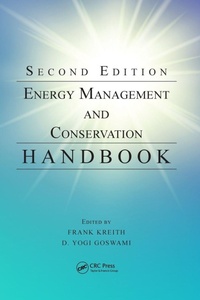
Energy Management and Conservation Handbook
2nd Edition
Published on 1. September 2016
Book
Hardback
438 pages
978-1-4665-8516-4 (ISBN)
Description
Energy is the mainstay of industrial societies, and without an adequate supply of energy the social, political and economic stability of nations is put into jeopardy. With supplies of inexpensive fossil fuels decreasing, and climate change factors becoming more threatening, the need to conserve energy and move steadily to more sustainable energy sources is more urgent than ever before. The updated Second Edition of this successful handbook includes chapters from leading experts on the economics and fiscal management of energy, with a focus on the tools available to advance efficiency and conservation measures. Updated coverage of renewable energy sources, energy storage technologies, energy audits for buildings and building systems, and demand-side management is provided. The appendix of the handbook provides extensive data resources for analysis and calculation.
Reviews / Votes
"The book describes sustainable energy efficient technologies and processes in buildings and in the industry as well as in electrical systems to achieve desirable levels of energy savings. This helps in green development mechanism. The economics methods can adequately be used to calculate the cost of energy saving methods and technologies and manage the same in an environment friendly manner."-Professor N. K. Bansal, Indian Institute of Technology Delhi
"A book for the Design Community at Project Level, presented to meet Post Kyoto scenario. An excellent decision supporting guide in Energy Efficiency and Conservation for those who will be instrumental in heralding the new economic order."
- Ajith P. de Alwis, University of Moratuwa, Moratuwa, Sri Lanka
"It covers the main aspects of what is needed to be known for energy management in buildings. The fact that chapters are presented by different authors according with their expertise makes the content to be strong and updated. The demand-side management (Chapter 13) is a relevant topic."
-Nelson Fumo, The University of Texas at Tyler, USA
"The Energy Management and Conservation Handbook is a necessary component of the "toolbox" that all the energy engineering students, researchers and practitioners should have."
- Vincenzo Bianco, University of Genoa, Italy "The book describes sustainable energy efficient technologies and processes in buildings and in the industry as well as in electrical systems to achieve desirable levels of energy savings. This helps in green development mechanism. The economics methods can adequately be used to calculate the cost of energy saving methods and technologies and manage the same in an environment friendly manner."
-Professor N. K. Bansal, Indian Institute of Technology Delhi
"A book for the Design Community at Project Level, presented to meet Post Kyoto scenario. An excellent decision supporting guide in Energy Efficiency and Conservation for those who will be instrumental in heralding the new economic order."
- Ajith P. de Alwis, University of Moratuwa, Moratuwa, Sri Lanka
"It covers the main aspects of what is needed to be known for energy management in buildings. The fact that chapters are presented by different authors according with their expertise makes the content to be strong and updated. The demand-side management (Chapter 13) is a relevant topic."
-Nelson Fumo, The University of Texas at Tyler, USA
"The Energy Management and Conservation Handbook is a necessary component of the "toolbox" that all the energy engineering students, researchers and practitioners should have."
- Vincenzo Bianco, University of Genoa, Italy
More details
Series
Edition
2nd edition
Language
English
Place of publication
Bosa Roca
United States
Publishing group
Taylor & Francis Inc
Target group
College/higher education
Professional and scholarly
Illustrations
144 s/w Abbildungen, 60 s/w Tabellen
60 Tables, black and white; 144 Illustrations, black and white
Dimensions
Height: 260 mm
Width: 183 mm
Thickness: 28 mm
Weight
1014 gr
ISBN-13
978-1-4665-8516-4 (9781466585164)
Copyright in bibliographic data and cover images is held by Nielsen Book Services Limited or by the publishers or by their respective licensors: all rights reserved.
Schweitzer Classification
Other editions
Additional editions
Frank Kreith | D. Yogi Goswami
Energy Management and Conservation Handbook
E-Book
10/2016
2nd Edition
CRC Press
€291.99
Available for download
Frank Kreith | D. Yogi Goswami
Energy Management and Conservation Handbook
E-Book
10/2016
2nd Edition
CRC Press
€291.99
Available for download
Previous edition
Frank Kreith | D. Yogi Goswami
Energy Management and Conservation Handbook
Book
05/2007
1st Edition
CRC Press
€174.10
Article exhausted; check for reprint
Persons
D. Yogi Goswami is a distinguished university professor and director of the Clean Energy Research Center at the University of South Florida. He conducts fundamental and applied research on solar thermal power and cooling, photocatalytic detoxification and disinfection, thermodynamics, third-generation photovoltaics, and hydrogen production and storage. Professor Goswami is the editor in chief of Solar Energy and Progress in Solar Energy. He has published as an author or editor 19 books and more than 375 refereed technical papers. He also holds 17 patents, some of which have been successfully commercialized.
Frank Kreith
is professor emeritus of engineering at the University of Colorado, Boulder, USA. He received his MS in engineering from the University of California, Los Angeles, USA and his doctorate from the University of Paris in 1964. From 1953 to 1959, he was associate professor of mechanical engineering at Lehigh University, Bethlehem, Pennsylvania, USA. In 1959, he joined the University of Colorado, where he held appointments as professor of mechanical and chemical engineering. He was senior research fellow at the Solar Energy Research Institute, and has consulted for NATO, the U.S. Agency of International Development, and the United Nations.
Frank Kreith
is professor emeritus of engineering at the University of Colorado, Boulder, USA. He received his MS in engineering from the University of California, Los Angeles, USA and his doctorate from the University of Paris in 1964. From 1953 to 1959, he was associate professor of mechanical engineering at Lehigh University, Bethlehem, Pennsylvania, USA. In 1959, he joined the University of Colorado, where he held appointments as professor of mechanical and chemical engineering. He was senior research fellow at the Solar Energy Research Institute, and has consulted for NATO, the U.S. Agency of International Development, and the United Nations.
Content
Preface. Editors. Contributors. Planning for Sustainability. Transportation. Economics Methods. Analysis Methods for Building Energy Auditing. Electrical Energy Management in Buildings. Heating, Ventilating, and Air-Conditioning Control Systems. Energy-Efficient Lighting Technologies and Their Applications in the Residential and Commercial Sectors. Energy-Efficient Technologies: Major Appliances and Space Conditioning Equipment. Heat Pumps. Industrial Energy Efficiency and Energy Management. Electric Motor Systems Efficiency. Energy Storage Technologies. Demand-Side Management. Index.