

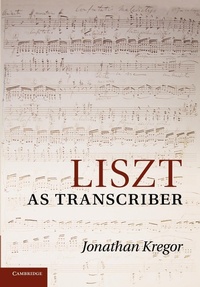
Liszt as Transcriber
Published on 25. October 2012
Book
Paperback/Softback
314 pages
978-1-107-41138-8 (ISBN)
Description
Franz Liszt's colleagues considered him to be one of the most accomplished and innovative practitioners in the field of musical reproduction, a reputation for which he is still admired today. Yet, while his transcriptions are widely performed, few studies have investigated the role that transcriptions played in Liszt's artistry, to say nothing of the impact they had on the music-making experience of his day. Using a host of interdisciplinary methods and primary source materials, this book provides a comprehensive survey of Liszt's lifelong involvement with the transcription, in which he assumed the roles of composer, collaborator, propagandist, commemorator, philosopher, and artist while simultaneously disseminating - often critically - the music of Beethoven, Berlioz, Schubert, Wagner, and other eighteenth- and nineteenth-century composers. By recognizing transcription as an extraordinarily flexible tool for Liszt and his contemporaries, Liszt as Transcriber provides numerous musical, cultural, and historical contexts for this fundamentally important practice of the period.
Reviews / Votes
Review of the hardback: 'An excellent new book ...' The New York Review of BooksMore details
Language
English
Place of publication
Cambridge
United Kingdom
Target group
Professional and scholarly
Product notice
Paperback (trade)
Dimensions
Height: 244 mm
Width: 170 mm
Thickness: 18 mm
Weight
545 gr
ISBN-13
978-1-107-41138-8 (9781107411388)
Copyright in bibliographic data and cover images is held by Nielsen Book Services Limited or by the publishers or by their respective licensors: all rights reserved.
Schweitzer Classification
Other editions
Additional editions
Jonathan Kregor
Liszt as Transcriber
Book
11/2010
Cambridge University Press
€129.70
Shipment within 15-20 days
Person
Content
Introduction: the visible transcriber; 1. Models and methods; 2. Collaboration and content; 3. Compositional fantasies; 4. Monuments and mythologies; 5. Opera and drama; 6. Stylistic reconstructions; Bibliography.