

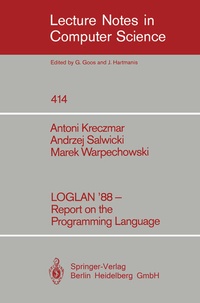
LOGLAN '88 - Report on the Programming Language
Foreword by Hans Langmaack
Published on 7. March 1990
Book
Paperback/Softback
X, 135 pages
978-3-540-52325-3 (ISBN)
Description
LOGLAN '88
belongs to the family of object oriented programming languages. It embraces all important known tools and characteristics of OOP, i.e. classes, objects, inheritance, coroutine sequencing, but it does not get rid of traditional imperative programming: primitive types do not need to be objects; records, static arrays, subtypes and other similar type contructs are admitted. LOGLAN has non-traditional memory model which accepts programmed deallocation but avoids dangling reference. The LOGLAN semantic model provides multi-level inheritance, which properly cooperates with module nesting. Parallelism in LOGLAN has an object oriented nature. Processes are treated like objects of classes and communication between processes is provided by alien calls similar to remote calls.
More details
Series
Edition
1990 ed.
Language
English
Place of publication
Berlin
Germany
Publishing group
Springer Berlin
Target group
Professional and scholarly
Research
Illustrations
X, 135 p.
Dimensions
Height: 235 mm
Width: 155 mm
Thickness: 9 mm
Weight
236 gr
ISBN-13
978-3-540-52325-3 (9783540523253)
DOI
10.1007/BFb0024097
Schweitzer Classification
Persons
Content
Terminology and notation rules.- Lexical and textual structure.- Units.- Types.- Variables and constants.- Names and expressions.- Statements.- Unit specification, unit body and entities accessibility.- Unit parameterization.- Subprograms.- Classes.- Inheritance.- Blocks.- Identifier binding rules.- Coroutines.- Processes.- Exception handling.- File processing.