

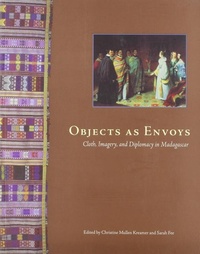
Objects As Envoys
Cloth, Imagery, and Diplomacy in Madagascar
Will be published approx. on 1. March 2002
Book
Paperback/Softback
208 pages
978-0-295-98196-3 (ISBN)
Description
In 1886, Queen Ranavalona III of the African island nation of Madagascar offered U.S. President Grover Cleveland two striking handwoven silk textiles. The American government later reciprocated with an autographed photographic portrait of the president. Although on the surface a straightforward diplomatic exchange, the objects used--and the ideas behind them--reveal a wealth of information about the culture and history of Madagascar, and its relations with the West.
The essays in Objects as Envoys contextualize and explain the broader significance of this exchange, deftly interweaving discussions of cloth production, international diplomacy, and popular representations of Madagascar and the Malagasy people in Europe and the United States. Together they tell a fascinating story of the people and history of this island country.
The first two essays provide a comprehensive survey of Madagascar's textiles, past and present. They examine the importance of cloth to the Malagasy, both as creative works of art and as objects imbued with great social and cultural significance. From simple cotton wrappers and raffia work shirts to delicately textured, vibrantly colored silk lama, textiles--the quintessential Malagasy gift--have been used in Madagascar to mark ethnic and gender identity, to indicate status and power relations, to create and renegotiate social ties, to serve as tribute to the dead, and to promote diplomatic overtures to foreign nations. When used as envoys, however, objects are likely to acquire new meanings, as recipients re-interpret and use them according to their own cultural understandings.
The little-known history of American-Malagasy ties is explored through the compelling biography of John Lewis Waller, an African American born into slavery who, as the American consul to Madagascar from 1891 to 1894, both supported Madagascar's independence and dreamed of establishing an all-black colony there.
The exchanges--and also the misunderstandings--that have characterized the meetings between Madagascar and Western nations and peoples are further examined through a study of the ways in which 19th-century photographs and other visual images were used by Westerners to create stereotypes of the Malagasy and by the Malagasy themselves to create and project identities of their own choosing.
The essays in Objects as Envoys contextualize and explain the broader significance of this exchange, deftly interweaving discussions of cloth production, international diplomacy, and popular representations of Madagascar and the Malagasy people in Europe and the United States. Together they tell a fascinating story of the people and history of this island country.
The first two essays provide a comprehensive survey of Madagascar's textiles, past and present. They examine the importance of cloth to the Malagasy, both as creative works of art and as objects imbued with great social and cultural significance. From simple cotton wrappers and raffia work shirts to delicately textured, vibrantly colored silk lama, textiles--the quintessential Malagasy gift--have been used in Madagascar to mark ethnic and gender identity, to indicate status and power relations, to create and renegotiate social ties, to serve as tribute to the dead, and to promote diplomatic overtures to foreign nations. When used as envoys, however, objects are likely to acquire new meanings, as recipients re-interpret and use them according to their own cultural understandings.
The little-known history of American-Malagasy ties is explored through the compelling biography of John Lewis Waller, an African American born into slavery who, as the American consul to Madagascar from 1891 to 1894, both supported Madagascar's independence and dreamed of establishing an all-black colony there.
The exchanges--and also the misunderstandings--that have characterized the meetings between Madagascar and Western nations and peoples are further examined through a study of the ways in which 19th-century photographs and other visual images were used by Westerners to create stereotypes of the Malagasy and by the Malagasy themselves to create and project identities of their own choosing.
Reviews / Votes
"Drawing on museum collections and diplomatic correspondence in Madagascar, the US, and Europe, the authors-anthropologists and experts with diplomatic backgrounds-of these five essays focus on Malagasy textiles as gifts that build relationships among sovereigns, their subjects, and outsiders."(Choice) "Objects as Envoys is handsomely laid out and richly illustrated with beautiful figures of textiles, photographs, postcards, and paintings..A glossary of Malagasy terms and the bibliography at the end of the book are a goldmine for anyone wishing to learn more about the material culture of Madagascar..An important and timely contribution to Madagascar studies."
(African Arts)
More details
Series
Language
English
Place of publication
Seattle
United States
Target group
Professional and scholarly
Product notice
Paperback (trade)
Illustrations
112 illus., 68 in color
Dimensions
Height: 279 mm
Width: 220 mm
Thickness: 25 mm
Weight
912 gr
ISBN-13
978-0-295-98196-3 (9780295981963)
Copyright in bibliographic data and cover images is held by Nielsen Book Services Limited or by the publishers or by their respective licensors: all rights reserved.
Schweitzer Classification
Persons
Christine Mullen Kreamer is a curator at the National Museum of African Art, Smithsonian Institution. Sarah Fee , a research collaborator at the National Museum of Natural History, Smithsonian Institution, has been conducting field research on weaving and social life in Madagascar since 1988 and is co-founder of the Tandroy Ethnographic Museum in Berenty, Madagascar. Other contributors include Zina Andrianarivelo, Mary Jo Arnoldi, Shirley E. Barnes, Christraud M. Geary, Edgar Krebs, Jean-Aime Rakotoarisoa, and Wendy Walker.
Content
Foreword by Zina Andrianarivelo-Razafy
Foreword by Shirley E. Barnes
Acknowledgments
Objects as Envoys: an Introduction
Madagascar: Background Notes
Cloth in Motion: Madagascar's Textiles through History
Gifts from the Queen: Two Malagasy Lamba Akotofahana
Madagascar in the Minds of Foreigners: the case of United States Council John Lewis Waller, 1891-1895
Views from Outside and Inside: Representations of madagascar and the Malagsy, 1658-1935
Chronology of Main Events
Glossary of Malagasy Terms
References
Contributors
Index
Foreword by Shirley E. Barnes
Acknowledgments
Objects as Envoys: an Introduction
Madagascar: Background Notes
Cloth in Motion: Madagascar's Textiles through History
Gifts from the Queen: Two Malagasy Lamba Akotofahana
Madagascar in the Minds of Foreigners: the case of United States Council John Lewis Waller, 1891-1895
Views from Outside and Inside: Representations of madagascar and the Malagsy, 1658-1935
Chronology of Main Events
Glossary of Malagasy Terms
References
Contributors
Index