

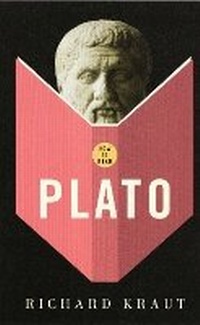
How To Read Plato
Published on 1. August 2008
Book
Paperback/Softback
128 pages
978-1-84708-032-5 (ISBN)
Description
'The unexamined life is not worth living.' Socrates
Plato is the founding thinker of European speculative thought. He was the first Western writer to undertake a comprehensive and rigorous study of the fundamental categories of reality and value, and few philosophers have escaped his influence or rivaled the depth of his works, many of which have remarkable dramatic power and literary beauty. His writings range over ethics, politics, religion, art, the structure of the natural world, mathematics, the human mind, love, sex and friendship. Richard Kraut explores the intellectual milieu that gave rise to Plato's thinking and emphasizes the influence of Socrates, whose devotion to the examined life and death at the hands of Athenian democracy are memorialized in many of Plato's writings, and the full extent of his moral and political thought and its metaphysical underpinning are investigated. Kraut argues that Plato's theory of forms is grounded in common sense, and that his critique of democracy and search for a rational religion continue to be of vital importance.
Plato is the founding thinker of European speculative thought. He was the first Western writer to undertake a comprehensive and rigorous study of the fundamental categories of reality and value, and few philosophers have escaped his influence or rivaled the depth of his works, many of which have remarkable dramatic power and literary beauty. His writings range over ethics, politics, religion, art, the structure of the natural world, mathematics, the human mind, love, sex and friendship. Richard Kraut explores the intellectual milieu that gave rise to Plato's thinking and emphasizes the influence of Socrates, whose devotion to the examined life and death at the hands of Athenian democracy are memorialized in many of Plato's writings, and the full extent of his moral and political thought and its metaphysical underpinning are investigated. Kraut argues that Plato's theory of forms is grounded in common sense, and that his critique of democracy and search for a rational religion continue to be of vital importance.
More details
Series
Language
English
Place of publication
London
United Kingdom
Dimensions
Height: 197 mm
Width: 130 mm
Thickness: 8 mm
Weight
89 gr
ISBN-13
978-1-84708-032-5 (9781847080325)
Copyright in bibliographic data and cover images is held by Nielsen Book Services Limited or by the publishers or by their respective licensors: all rights reserved.
Schweitzer Classification
Other editions
Additional editions
Person
Richard Kraut is Morrison Professor of the Humanities at Northwestern University. He is the author of Socrates and the State, Aristotle on the Human Good, What is Good and Why, and the editor of The Cambridge Companion to Plato.