

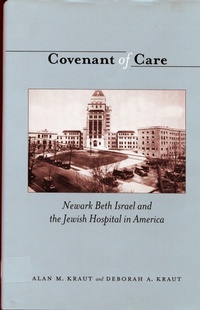
Covenant of Care
Newark Beth Israel and the Jewish Hospital in America
Will be published approx. on 20. December 2006
Book
Hardback
318 pages
978-0-8135-3910-2 (ISBN)
Description
Winner of the 2008 Author's Award from the New Jersey Studies Academic Alliance
Where were you born? Were you born at the Beth? Many thousands of Americans-Jewish and non-Jewish-were born at a hospital bearing the Star of David and named Beth Israel, Mount Sinai, or Montefiore. In the United States, health care has been bound closely to the religious impulse. Newark Beth Israel Hospital is a distinguished modern medical institution in New Jersey whose history opens a window on American health care, the immigrant experience, and urban life. Alan M. and Deborah A. Kraut tell the story of this important institution, illuminating the broader history of voluntary nonprofit hospitals created under religious auspices initially to serve poor immigrant communities. Like so many Jewish hospitals in the early half of the twentieth century, "the Beth" cared not only for its own community's poor and underprivileged, a responsibility grounded in the Jewish traditions of tzedakah ("justice") and tikkun olam ("to heal the world"), but for all Newarkers.
Since it first opened its doors in 1902, the Beth has been an engine of social change. Jewish women activists and immigrant physicians founded an institution with a nonsectarian admissions policy and a welcome mat for physicians and nurses seeking opportunity denied them by anti-Semitism elsewhere. Research, too, flourished at the Beth. Here dedicated medical detectives did path-breaking research on the Rh blood factor and pacemaker development. When economic shortfalls and the Great Depression threatened the Beth's existence, philanthropic contributions from prominent Newark Jews such as Louis Bamberger and Felix Fuld, the efforts of women volunteers, and, later, income from well-insured patients saved the institution that had become the pride of the Jewish community.
The Krauts tell the Beth Israel story against the backdrop of twentieth-century medical progress, Newark's tumultuous history, and the broader social and demographic changes altering the landscape of American cities. Today, the United States, in the midst of another great wave of immigration, once again faces the question of how to provide newcomers with culturally sensitive and economically accessible medical care. Covenant of Care will inform and inspire all those working to meet these demands, offering a compelling look at the creative ways that voluntary hospitals navigated similar challenges throughout the twentieth century.
Where were you born? Were you born at the Beth? Many thousands of Americans-Jewish and non-Jewish-were born at a hospital bearing the Star of David and named Beth Israel, Mount Sinai, or Montefiore. In the United States, health care has been bound closely to the religious impulse. Newark Beth Israel Hospital is a distinguished modern medical institution in New Jersey whose history opens a window on American health care, the immigrant experience, and urban life. Alan M. and Deborah A. Kraut tell the story of this important institution, illuminating the broader history of voluntary nonprofit hospitals created under religious auspices initially to serve poor immigrant communities. Like so many Jewish hospitals in the early half of the twentieth century, "the Beth" cared not only for its own community's poor and underprivileged, a responsibility grounded in the Jewish traditions of tzedakah ("justice") and tikkun olam ("to heal the world"), but for all Newarkers.
Since it first opened its doors in 1902, the Beth has been an engine of social change. Jewish women activists and immigrant physicians founded an institution with a nonsectarian admissions policy and a welcome mat for physicians and nurses seeking opportunity denied them by anti-Semitism elsewhere. Research, too, flourished at the Beth. Here dedicated medical detectives did path-breaking research on the Rh blood factor and pacemaker development. When economic shortfalls and the Great Depression threatened the Beth's existence, philanthropic contributions from prominent Newark Jews such as Louis Bamberger and Felix Fuld, the efforts of women volunteers, and, later, income from well-insured patients saved the institution that had become the pride of the Jewish community.
The Krauts tell the Beth Israel story against the backdrop of twentieth-century medical progress, Newark's tumultuous history, and the broader social and demographic changes altering the landscape of American cities. Today, the United States, in the midst of another great wave of immigration, once again faces the question of how to provide newcomers with culturally sensitive and economically accessible medical care. Covenant of Care will inform and inspire all those working to meet these demands, offering a compelling look at the creative ways that voluntary hospitals navigated similar challenges throughout the twentieth century.
Reviews / Votes
"The history of Newark Beth Israel Hospital is a wonderful case study of a hospital founded by a religious denomination and how it changed over time. The Krauts have done an excellent job of placing this institution within a national context." - Gerald N. Grob (author of The Deadly Truth: A History of Disease in America) This skillfully written volume contains two fascinating stories in one: The history of Newark Beth Israel Medical Center and the rise and fall of Jewish hospitals nationwide. A welcome contribution to medical history and Jewish history, it is also a timely and illuminating study of how hospitals change. - Jonathan D. Sarna (Joseph H. & Belle R. Braun Professor of American Jewish History, Brandeis Univer) "Alan and Deborah Kraut render the hospital's story in loving detail while also providing broader contexts. By tracking the vicissitudes of this 'covenant of care,' the authors link the history of one Jewish hospital to a pressing issue of the twenty-first century, the provision of health care in the United States." (Journal of American Ethnic History)More details
Language
English
Place of publication
New Brunswick NJ
United States
Target group
Professional and scholarly
Product notice
sewn/stitched
Cloth over boards
Illustrations
13
Dimensions
Height: 232 mm
Width: 160 mm
Thickness: 24 mm
Weight
553 gr
ISBN-13
978-0-8135-3910-2 (9780813539102)
Copyright in bibliographic data and cover images is held by Nielsen Book Services Limited or by the publishers or by their respective licensors: all rights reserved.
Schweitzer Classification
Other editions
Additional editions
E-Book
12/2006
1st Edition
Rutgers University Press
€132.99
Available for download
Persons
Alan M. Kraut is a professor of history at American University in Washington, D.C. Deborah A. Kraut is an analyst at the National Institutes of Health, Bethesda, M.D.
Content
Introduction
1 "Trouble in the Beth Israel Hospital Association"
2 The formative years
3 From little house on the hill to modern institution
4 A modern hospital surviving depression and war
5 Medicine at the Beth, 1928-1947
6 The modern institution at midcentury
7 Medical research at midcentury
8 Redefining the Beth's community
9 The changing shape of health care
Epilogue
Acknowledgements
Appendix
Notes
A Note on Sources
Index
1 "Trouble in the Beth Israel Hospital Association"
2 The formative years
3 From little house on the hill to modern institution
4 A modern hospital surviving depression and war
5 Medicine at the Beth, 1928-1947
6 The modern institution at midcentury
7 Medical research at midcentury
8 Redefining the Beth's community
9 The changing shape of health care
Epilogue
Acknowledgements
Appendix
Notes
A Note on Sources
Index