


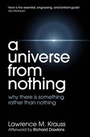
A Universe From Nothing
why there is something rather than nothing
Published on 13. September 2012
Book
Paperback/Softback
224 pages
978-1-4711-1268-3 (ISBN)
Description
Internationally renowned theoretical physicist and bestselling author Lawrence Krauss offers provocative, revelatory answers to the biggest philosophical questions: Where did our universe come from? Why does anything exist? And how is it all going to end? 'Why is there something rather than nothing?' is the question atheists and scientists are always asked,and until now there has not been a satisfying scientific answer. Today, exciting scientific advances provide new insight into this cosmological mystery: not only cansomething arise from nothing, but something willalwaysarise from nothing. A mind-bending trip back to the beginning of the beginning, A Universe from Nothingauthoritatively presents the most recent evidence that explains how our universe evolved - and the implications for how it's going to end. It will provoke, challenge, and delight readers to look at the most basic underpinnings of existence in a whole new way. In the words of Richard Dawkins: this could potentially be the most important scientific book since Darwin's On the Origin of Species.
More details
Language
English
Place of publication
London
United Kingdom
Dimensions
Height: 129 mm
Width: 196 mm
Thickness: 20 mm
Weight
162 gr
ISBN-13
978-1-4711-1268-3 (9781471112683)
Copyright in bibliographic data and cover images is held by Nielsen Book Services Limited or by the publishers or by their respective licensors: all rights reserved.
Schweitzer Classification
Other editions
Additional editions
Lawrence M. Krauss
A Universe From Nothing
Book
09/2012
Simon & Schuster Ltd
€36.11
Article exhausted; check different version
Person
Lawrence M. Krauss is director of the Origins Project at Arizona State University. He is the author of more than 300 scientific publications and nine books, and the recipient of numerous international awards for his research and writing. Hailed by Scientific American as a 'rare scientific public intellectual', he is also a regular columnist for newspapers and magazines and appears frequently on radio and television.