

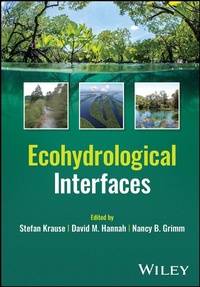
Ecohydrological Interfaces
Description
Summarizing the interdisciplinary investigation of ecohydrological interface function, this book advances the understanding of their dynamics across subject boundaries. Overall, it offers a detailed explanation of the underlying processes and interactions governing ecohydrological interface functioning from the micro scale to the ecosystem and regional scale.
The multidisciplinary team of authors integrates and compares knowledge of the functioning of different ecohydrological interfaces to develop a unifying concept of their functions and process dynamics. The work introduces novel experimental and model-based methods for characterizing and quantifying ecohydrological interface processes, taking account of innovative sensing and tracing technologies as well as microbial and molecular biology approaches.
Key questions addressed in the book include:
Which conditions stimulate the transformative nature of ecohydrological interfaces?
How are ecohydrological interfaces organized in space and time?
How does interface activity propagate from small to large scales?
How do ecohydrological interfaces react to environmental change and what is their role in processes of significant societal value?
As a research level guide on the functionality and performance of ecohydrological interfaces, this book is primarily aimed at academics and postgraduate researchers. It is also appropriate for university libraries as ?further reading? on a range of geographical, environmental, biological, and engineering topics.
<b>Comprehensive overview of the process dynamics and interactions governing ecohydrological interfaces </b>
Summarizing the interdisciplinary investigation of ecohydrological interface function, this book advances the understanding of their dynamics across subject boundaries. Overall, it offers a detailed explanation of the underlying processes and interactions governing ecohydrological interface functioning from the micro scale to the ecosystem and regional scale.
The multidisciplinary team of authors integrates and compares knowledge of the functioning of different ecohydrological interfaces to develop a unifying concept of their functions and process dynamics. The work introduces novel experimental and model-based methods for characterizing and quantifying ecohydrological interface processes, taking account of innovative sensing and tracing technologies as well as microbial and molecular biology approaches.
Key questions addressed in the book include:
<ul><li>Which conditions stimulate the transformative nature of ecohydrological interfaces?</li><li>How are ecohydrological interfaces organized in space and time?</li><li>How does interface activity propagate from small to large scales?</li><li>How do ecohydrological interfaces react to environmental change and what is their role in processes of significant societal value?</li></ul>As a research level guide on the functionality and performance of ecohydrological interfaces, this book is primarily aimed at academics and postgraduate researchers. It is also appropriate for university libraries as ?further reading? on a range of geographical, environmental, biological, and engineering topics.
More details
Other editions
Additional editions
Persons
Nancy B. Grimm, School of Life Sciences, Arizona State University, Tempa, USA
<b>Stefan Krause</b> and <b>David M. Hannah</b>, School of Geography, Earth and Environmental Science, University of Birmingham, UK
<b>Nancy B. Grimm</b>, School of Life Sciences, Arizona State University, Tempa, USA
Content
1. Ecohydrological interfaces as hotspots of ecosystem processes
2. Biological activity as trigger of enhanced ecohydrological interface activity
3. The four interfaces of riparian zones
4. Organizational principles of hyporheic exchange flow and biogeochemical cycling in river networks across scales
5. Groundwater-lake interfaces
6. Coastal-groundwater interfaces
7. Identifying and quantifying water fluxes at ecohydrological interfaces
8. Heat as a hydrological tracer
9. Sampling at groundwater-surface water interfaces
10. Automated sensing methods for dissolved organic matter and inorganic nutrient monitoring in freshwater systems
11. Tracing hydrological connectivity with aerial diatoms
12. Measurement of metabolic rates at the sediment-water interface using experimental ecosystems
13. Using diel solute signals to assess ecohydrological processing in lotic systems
14. Evolving molecular methodologies for monitoring pathogenic viruses in ecohydrological interfaces
15. Global environmental pressures
16. Restoration of interface functions