

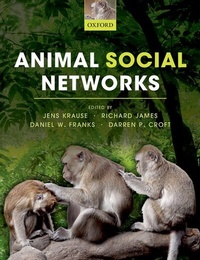
Animal Social Networks
Published on 18. December 2014
Book
Hardback
280 pages
978-0-19-967904-1 (ISBN)
Description
The scientific study of networks - computer, social, and biological - has received an enormous amount of interest in recent years. However, the network approach has been applied to the field of animal behaviour relatively late compared to many other biological disciplines. Understanding social network structure is of great importance for biologists since the structural characteristics of any network will affect its constituent members and influence a range of diverse behaviours. These include finding and choosing a sexual partner, developing and maintaining cooperative relationships, and engaging in foraging and anti-predator behavior.
This novel text provides an overview of the insights that network analysis has provided into major biological processes, and how it has enhanced our understanding of the social organisation of several important taxonomic groups. It brings together researchers from a wide range of disciplines with the aim of providing both an overview of the power of the network approach for understanding patterns and process in animal populations, as well as outlining how current methodological constraints and challenges can be overcome.
Animal Social Networks is principally aimed at graduate level students and researchers in the fields of ecology, zoology, animal behaviour, and evolutionary biology but will also be of interest to social scientists.
This novel text provides an overview of the insights that network analysis has provided into major biological processes, and how it has enhanced our understanding of the social organisation of several important taxonomic groups. It brings together researchers from a wide range of disciplines with the aim of providing both an overview of the power of the network approach for understanding patterns and process in animal populations, as well as outlining how current methodological constraints and challenges can be overcome.
Animal Social Networks is principally aimed at graduate level students and researchers in the fields of ecology, zoology, animal behaviour, and evolutionary biology but will also be of interest to social scientists.
Reviews / Votes
Animal Social Networks is a rich overview of the current state of social network research in animal behavior and provides readers with a strong grounding in theory and a wealth of ideas that could be addressed in future research projects. It serves as a wonderful introduction to network thinking and promotes a shift in perspective from networks as tools to networks as fundamentally underlying much of the social behavior we see in animals. * Elizabeth A. Hobson,TREE * Served by an excellent use of various helpful illustrations (matrices, diagrams, flowcharts, and actual social networks) and a few formulas of mathematical models, this thorough reference book will resonate well with a broad readership, including ethologists, ecologists, and evolutionary biologists. ... Essential. * CHOICE * [A] timely textbook that carefully elucidates the value of the novel approaches currently available to scholars of animal behavior ... This exciting new volume [is] helping to illuminate the bright and richly deserved role of networks in revealing insights about fundamental biological processes. * Jennifer E. Smith, Quarterly Review of Biology * [F]or those curious about how social network analyses might at some future point contribute to a better understanding of complex behavioral interactions among group (however broadly defined) members, Animal Social Networks is a valuable resource. * Harold Gouzoules, Integrative and Comparative Biology *More details
Language
English
Place of publication
Oxford
United Kingdom
Target group
College/higher education
Dimensions
Height: 253 mm
Width: 194 mm
Thickness: 18 mm
Weight
780 gr
ISBN-13
978-0-19-967904-1 (9780199679041)
Copyright in bibliographic data and cover images is held by Nielsen Book Services Limited or by the publishers or by their respective licensors: all rights reserved.
Schweitzer Classification
Other editions
Additional editions
Jens Krause | Richard James | Daniel Franks
Animal Social Networks
E-Book
12/2014
1st Edition
OUP eBook
€63.49
Available for download
Jens Krause | Richard James | Daniel Franks
Animal Social Networks
E-Book
12/2014
1st Edition
OUP eBook
€63.49
Available for download
Persons
Jens Krause is professor of fish biology and ecology at Humboldt University, Germany. He has published over 150 papers and several books on topics such as collective behaviour, social networks and swarm intelligence.
Richard James is a senior lecturer at the University of Bath, UK. His research interests centre around the development and use of computational models and analyses to interpret biological data.
Dan Franks is reader in the department of biology and the department of computer science at the University of York, UK. He has published on topics such as social networks, collective behaviour, life-history evolution, and predator-prey evolution.
Darren Croft is a associate professor of animal behaviour at the University of Exeter, UK. His research focuses on the ecology and evolution of group-living in species raging from fresh water fish to killer whales.
Richard James is a senior lecturer at the University of Bath, UK. His research interests centre around the development and use of computational models and analyses to interpret biological data.
Dan Franks is reader in the department of biology and the department of computer science at the University of York, UK. He has published on topics such as social networks, collective behaviour, life-history evolution, and predator-prey evolution.
Darren Croft is a associate professor of animal behaviour at the University of Exeter, UK. His research focuses on the ecology and evolution of group-living in species raging from fresh water fish to killer whales.
Editor
Professor of Fish Biology and EcologyProfessor of Fish Biology and Ecology, Humboldt University & IGB
Senior LecturerSenior Lecturer, University of Bath
Reader in Complex SystemsReader in Complex Systems, University of York
Associate Professor in Animal BehaviourAssociate Professor in Animal Behaviour University of Exeter
Content
SECTION I: INTRODUCTION; SECTION II: PATTERNS AND PROCESSES; SECTION III: TAXONOMIC OVERVIEWS