

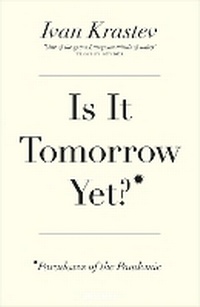
Is It Tomorrow Yet?
Paradoxes of the Pandemic
Published on 29. October 2020
Book
Hardback
96 pages
978-0-241-48345-9 (ISBN)
Description
A FINANCIAL TIMES BOOK OF THE YEAR
One of our most scintillating public intellectuals explores the political paradoxes of the pandemic and helps us think our way through it
'We are able to imagine anything because we are being besieged by something that was considered unimaginable...'
Beneath the panic and bluster, beneath the confusing speeches and the conflicting advice, the Coronavirus pandemic acted, changing our world in the most profound ways. The tragic human cost and the economic devastation will be assessed and calculated for decades to come. But the pandemic also changed things in ways that are less easily expressed and understood. It has made bare the frayed contradictions of modern life. It has distorted things that seemed simple and settled. It has affirmed plain, uncomfortable truths.
In this brilliant, thought-provoking essay, Ivan Krastev, one of our most interesting thinkers today, explores the pandemic's immediate consequences and conceives of its long-term legacy. Will things be different for the communities most harmed, and for those who escaped the worst? Where are we now with the US and China, with the UK and Europe? And how do we think our way through the unthinkable?
One of our most scintillating public intellectuals explores the political paradoxes of the pandemic and helps us think our way through it
'We are able to imagine anything because we are being besieged by something that was considered unimaginable...'
Beneath the panic and bluster, beneath the confusing speeches and the conflicting advice, the Coronavirus pandemic acted, changing our world in the most profound ways. The tragic human cost and the economic devastation will be assessed and calculated for decades to come. But the pandemic also changed things in ways that are less easily expressed and understood. It has made bare the frayed contradictions of modern life. It has distorted things that seemed simple and settled. It has affirmed plain, uncomfortable truths.
In this brilliant, thought-provoking essay, Ivan Krastev, one of our most interesting thinkers today, explores the pandemic's immediate consequences and conceives of its long-term legacy. Will things be different for the communities most harmed, and for those who escaped the worst? Where are we now with the US and China, with the UK and Europe? And how do we think our way through the unthinkable?
Reviews / Votes
One of the great European minds of today -- Timothy Snyder Characteristically thought-provoking ... Krastev's take - from the impact of globalisation and democracy to our sense of 'home' and trust - makes for sobering reading * Financial Times, Books of the Year * A good primer for the first post-pandemic, post-Brexit dinner party. . . big ideas in small doses that are sufficiently intriguing to impress companions but not offend either nationalists or globalists * Financial Times * Elegant and beautifully turned ... this book is daring and challenging in its prognostications - full of sparkling turns of thought, and magical phrasing. Krastev is evidently a natural-born teacher and essayist -- Robert Fox * Reaction * Few people question the conventional wisdom like Ivan Krastev -- George Soros Ivan Krastev is one of Europe's leading thinkers -- Madeleine AlbrightMore details
Language
English
Place of publication
London
United Kingdom
Publishing group
Penguin Books Ltd
Target group
College/higher education
Professional and scholarly
Dimensions
Height: 204 mm
Width: 138 mm
Thickness: 15 mm
Weight
197 gr
ISBN-13
978-0-241-48345-9 (9780241483459)
Copyright in bibliographic data and cover images is held by Nielsen Book Services Limited or by the publishers or by their respective licensors: all rights reserved.
Schweitzer Classification
Other editions
Additional editions
E-Book
10/2020
1st Edition
Penguin Books Ltd
€6.99
Available for download
Person
Ivan Krastev is a fellow at the Institute for Human Sciences in Vienna, a contributing opinion writer for the International New York Times and, most recently, the author of the widely acclaimed After Europe.