

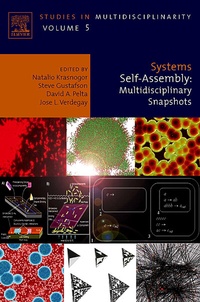
Systems Self-Assembly: Volume 5
Multidisciplinary Snapshots
Published on 14. March 2008
Book
Hardback
304 pages
978-0-444-52865-0 (ISBN)
Description
Systems Self-Assembly is the only book to showcase state-of-the-art self-assembly systems that arise from the computational, biological, chemical, physical and engineering disciplines. Written by world experts in each area, it provides a coherent, integrated view of both book practice examples and new trends with a clearly presented computational flavor. The unifying thread throughout the text is the computational nature of self-assembling systems.This book consists of 13 chapters dealing with a variety of topics such as the patterns of self-organised nanoparticle assemblies; biomimetic design of dynamic self-assembling systems; computing by self-assembly involving DNA molecules, polyominoes, and cells; evolutionary design of a model of self-assembling chemical structures; self-assembly as an engineering concept across size scales; and probabilistic analysis of self-assembled molecular networks. Other chapters focus on the programming language of dynamic self-assembly; self-assembled computer architectures; simulation of self-assembly processes using abstract reduction systems; computer aided search for optimal self-assembly systems; theoretical aspects of programmable self-assembly; emergent cooperativity in large-scale patterns; and automated self-assembling programming.Systems Self-Assembly is an ideal reference for scientists, researchers and post-graduate students; practitioners in industry, engineering and science; and managers, decision-makers and policy makers.
More details
Series
Language
English
Place of publication
Oxford
United Kingdom
Publishing group
Elsevier Science & Technology
Target group
Professional and scholarly
Scientists, researchers and post-graduate students, practitioners in industry, engineering and science, managers, decision-makers and policy makers
Dimensions
Height: 240 mm
Width: 165 mm
Weight
880 gr
ISBN-13
978-0-444-52865-0 (9780444528650)
Copyright in bibliographic data and cover images is held by Nielsen Book Services Limited or by the publishers or by their respective licensors: all rights reserved.
Schweitzer Classification
Other editions
Additional editions
Systems Self-Assembly
Multidisciplinary Snapshots
E-Book
09/2011
Elsevier
€137.00
Available for download
Persons
Edited by Natalio Krasnogor, Automated Scheduling, Optimisation, and Planning Research Group, School of Computer Science and IT, University of Nottingham, UK; Steve Gustafson, Automated Scheduling, Optimisation, and Planning Research Group, School of Computer Science and IT, University of Nottingham, UK; David A. Pelta, Depto. de Ciencias de la Computacion e Inteligencia Artificial, E.T.S. de Ingenieria Informatica, Universidad de Granada; and Jose L. Verdegay, Depto.de Ciencias de la Computacion e Inteligencia Artifical, E.T.S. de Ingenieria Informatica, Universidad de Granada
Volume editor
Automated Scheduling, Optimisation, and Planning Research Group, School of Computer Science and IT, University of Nottingham, UK
Automated Scheduling, Optimisation, and Planning Research Group, School of Computer Science and IT, University of Nottingham, UK
Depto. de Ciencias de la Computacion e Inteligencia Artificial, E.T.S. de Ingenieria Informatica, Universidad de Granada
Depto.de Ciencias de la Computacion e Inteligencia Artifical, E.T.S. de Ingenieria Informatica, Universidad de Granada
Content
1: Self-Organised Nanoparticle Assemblies: A Panoply of Patterns
2: Biomimetic Design of Dynamic Self-Assembling Systems
3: Computing by Self-Assembly: DNA Molecules, Polyominoes, Cells
4: Evolutionary Design of a Model of Self-Assembling Chemical Structures
5: Self-Assembly as an Engineering Concept across Size Scales
6: Probabilistic Analysis of Self-Assembled Molecular Networks
7: The "Programming Language" of Dynamic Self-Assembly
8: Self-Assembled Computer Architectures
9: Simulation of Self-Assembly Processes Using Abstract Reduction Systems
10: Computer Aided Search for Optimal Self-Assembly Systems
11: Programmable Self-Assembly-Theoretical Aspects and DNA-Linked Nanoparticles
12: From Microscopic Rules to Emergent Cooperativity in Large-Scale Patterns
13: Automated Self-Assembling Programming
2: Biomimetic Design of Dynamic Self-Assembling Systems
3: Computing by Self-Assembly: DNA Molecules, Polyominoes, Cells
4: Evolutionary Design of a Model of Self-Assembling Chemical Structures
5: Self-Assembly as an Engineering Concept across Size Scales
6: Probabilistic Analysis of Self-Assembled Molecular Networks
7: The "Programming Language" of Dynamic Self-Assembly
8: Self-Assembled Computer Architectures
9: Simulation of Self-Assembly Processes Using Abstract Reduction Systems
10: Computer Aided Search for Optimal Self-Assembly Systems
11: Programmable Self-Assembly-Theoretical Aspects and DNA-Linked Nanoparticles
12: From Microscopic Rules to Emergent Cooperativity in Large-Scale Patterns
13: Automated Self-Assembling Programming