

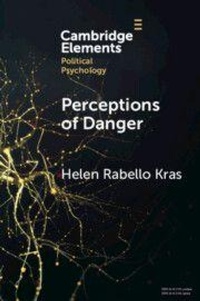
Perceptions of Danger
How Risk Assessments Underpin Attitudes on Crime and Intimate Partner Violence
Will be published approx. on 31. July 2026
Book
Paperback/Softback
75 pages
978-1-009-53704-9 (ISBN)
Description
This Element explores how citizens understand general crime and violence against women, especially intimate partner violence (IPV). Drawing on interdisciplinary literature, this Element makes the case that cognitive heuristics and risk assessments, in particular, shape the way people see crime versus IPV. The central argument is that cognitive heuristics that generate risk perceptions help us understand why the public worries excessively about crime, with important political consequences, while downplaying IPV. This fosters distinct attitudes toward IPV and general crime. Accordingly, this Element sheds light on why victim-blaming is so prevalent in the context of IPV. Using original survey experiments from Brazil and Mexico, the study shows that respondents attribute more responsibility for prevention to the victim for IPV than for general crimes, display optimism bias with acquaintance victimization, and approve different types of policy remedies to deal with general crime and IPV.
More details
Series
Language
English
Place of publication
Cambridge
United Kingdom
Product notice
Paperback (trade)
Illustrations
Worked examples or Exercises
ISBN-13
978-1-009-53704-9 (9781009537049)
Copyright in bibliographic data and cover images is held by Nielsen Book Services Limited or by the publishers or by their respective licensors: all rights reserved.
Schweitzer Classification
Other editions
Additional editions
Helen Rabello Kras
Perceptions of Danger
How Risk Assessments Underpin Attitudes on Crime and Intimate Partner Violence
Book
approx. 07/2026
Cambridge University Press
€68.50
Not yet published
Person
Content
1. Introduction; 2. Conceptual approach: Sexism and risk-assessment; 3. How risk and harm shape policy preferences; 4. Case studies; 5. Empirical approach; 6. Results; 7. Final remarks; References.