

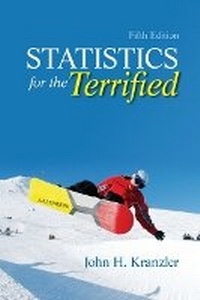
Statistics for the Terrified
5th Edition
Published on 25. January 2011
Book
Paperback/Softback
192 pages
978-0-205-00406-5 (ISBN)
Description
User-friendly and engaging introduction to elementary statistics.
Written in a personal and informal style, this book helps readers make the leap from apprehension to comprehension of elementary statistics. Statistics For The Terrified , 5e is intended as a supplemental text for undergraduate or graduate courses in statistics and research methods, as a refresher for students who have already taken a statistics course, or as a primer for new students of elementary statistics.
Millions of people have math anxiety- yet this is rarely taken into consideration in textbooks on statistics. This book presents self-help strategies that help people manage their math anxiety so they can relax and build confidence while learning statistics. After covering the essentials required for the journey into statistics, the remainder of the book presents an introduction to elementary statistics with a great deal of encouragement, support, step-by-step assistance, and numerous concrete examples, without lengthy theoretical discussions.
Written in a personal and informal style, this book helps readers make the leap from apprehension to comprehension of elementary statistics. Statistics For The Terrified , 5e is intended as a supplemental text for undergraduate or graduate courses in statistics and research methods, as a refresher for students who have already taken a statistics course, or as a primer for new students of elementary statistics.
Millions of people have math anxiety- yet this is rarely taken into consideration in textbooks on statistics. This book presents self-help strategies that help people manage their math anxiety so they can relax and build confidence while learning statistics. After covering the essentials required for the journey into statistics, the remainder of the book presents an introduction to elementary statistics with a great deal of encouragement, support, step-by-step assistance, and numerous concrete examples, without lengthy theoretical discussions.
More details
Edition
5th edition
Language
English
Place of publication
United States
Publishing group
Pearson Education (US)
Target group
College/higher education
Dimensions
Height: 226 mm
Width: 155 mm
Thickness: 9 mm
Weight
220 gr
ISBN-13
978-0-205-00406-5 (9780205004065)
Copyright in bibliographic data and cover images is held by Nielsen Book Services Limited or by the publishers or by their respective licensors: all rights reserved.
Schweitzer Classification
Other editions
Previous edition
Gerald Kranzler | Janet Moursund | John H. Kranzler
Statistics For The Terrified
International Edition
Book
10/2006
4th Edition
Pearson
€29.75
Article exhausted; check for reprint
Content
PREFACE
SECTION I
Essentials for Statistics
Chapter 1 - Effective Strategies for Studying Statistics
Self-assessment
Assumptions about the Reader
Effective Strategies for Studying Statistics
Chapter 2 - Overcoming Math Anxiety
What Causes Math Anxiety?
Overview of Rational Emotive Therapy
Irrational Beliefs
How to Deal with Math Anxiety
Chapter 3 - Basic Math Concepts
How to Use this Chapter
Positive and Negative Numbers
Fractions
Decimals and Percents
Exponents and Roots
Order of Computation
Summation
Answers to Example Problems
SECTION II Describing Univariate Data
Chapter 4 - Frequency Distributions
What are statistics?
Variables
Scales of Measurement
Frequency Distributions
Graphing Data
Normal Curve
Problems
Answers to Problems
Chapter 5 - Descriptive Statistics
What are statistics?
Measures of central tendency
Measures of variability
Problems
Answers to Problems
Chapter 6 - The Normal Curve
What is the Normal Curve?
Properties of the Normal Curve
Proportions of Scores Under the Normal Curve
Problems
Answers to Problems
Chapter 7 - Percentiles and Standard Scores
Percentiles
Standard Scores
Other Standard Scores
T Scores
Converting Standard Scores to Percentiles
A Word of Caution
Problems
Answers to Problems
SECTION III Correlation Coefficients and Linear Regression
Chapter 8 - Correlation Coefficients
Correlation Coefficients
Pearson Product-Moment Correlation Coefficient
Interpreting Correlation Coefficients
Other Methods of Correlation
Spearman Rank Correlation Coefficient
Problems
Answers to Problems
Chapter 9 - Linear Regression
Regression Equations
Standard Error of the Estimate
Problems
Answers to Problems
SECTION IV Inferential Statistics
Chapter 10 - Introduction to Inferential Statistics
Probability
The Sampling Experiment
Sample Values (Statistics) and Population Values (Parameters)
The Null Hypothesis
Type I and Type II Errors
Statistical Significance and Type I Error
Problems
Answers to Problems
Chapter 11 - The t Test
The t Test for Independent Samples
Formulas for the t Test for Independent Samples
The Critical Value of t
Requirements for Using the t Test for Independent Samples
The t Test for Dependent (Matched) Samples
Directional Versus Nondirectional Tests
Problems
Answers to Problems
Chapter 12 - Analysis of Variance
Analysis of Variance (ANOVA)
Computation Steps
Strength of Association
Post hoc Analyses
The Scheffe Method of Post-Hoc Analysis
Problems
Answers to Problems
SECTION V Additional Topics: Non-parametric Statistics and Using Statistical Software Programs
Chapter 13 - Non-parametric Statistics: Chi-square
Nonparametric Statistical Tests
One-way Test of Chi-square
Yates' Correction for Continuity
A Bit More
Problems
Answers to Problems
Chapter 14 - How to Use SPSS
What is SPSS?
Starting SPSS
Basic Steps in Data Analysis
Finding Help in SPSS
Chapter 15 - Postscript
APPENDICES
A Proportions of Area Under the Normal Curve
B Table of Random Numbers
C Critical Values of t
D Critical Values of F
E Critical Values of Chi-squared
F Glossary of Formulas
SECTION I
Essentials for Statistics
Chapter 1 - Effective Strategies for Studying Statistics
Self-assessment
Assumptions about the Reader
Effective Strategies for Studying Statistics
Chapter 2 - Overcoming Math Anxiety
What Causes Math Anxiety?
Overview of Rational Emotive Therapy
Irrational Beliefs
How to Deal with Math Anxiety
Chapter 3 - Basic Math Concepts
How to Use this Chapter
Positive and Negative Numbers
Fractions
Decimals and Percents
Exponents and Roots
Order of Computation
Summation
Answers to Example Problems
SECTION II Describing Univariate Data
Chapter 4 - Frequency Distributions
What are statistics?
Variables
Scales of Measurement
Frequency Distributions
Graphing Data
Normal Curve
Problems
Answers to Problems
Chapter 5 - Descriptive Statistics
What are statistics?
Measures of central tendency
Measures of variability
Problems
Answers to Problems
Chapter 6 - The Normal Curve
What is the Normal Curve?
Properties of the Normal Curve
Proportions of Scores Under the Normal Curve
Problems
Answers to Problems
Chapter 7 - Percentiles and Standard Scores
Percentiles
Standard Scores
Other Standard Scores
T Scores
Converting Standard Scores to Percentiles
A Word of Caution
Problems
Answers to Problems
SECTION III Correlation Coefficients and Linear Regression
Chapter 8 - Correlation Coefficients
Correlation Coefficients
Pearson Product-Moment Correlation Coefficient
Interpreting Correlation Coefficients
Other Methods of Correlation
Spearman Rank Correlation Coefficient
Problems
Answers to Problems
Chapter 9 - Linear Regression
Regression Equations
Standard Error of the Estimate
Problems
Answers to Problems
SECTION IV Inferential Statistics
Chapter 10 - Introduction to Inferential Statistics
Probability
The Sampling Experiment
Sample Values (Statistics) and Population Values (Parameters)
The Null Hypothesis
Type I and Type II Errors
Statistical Significance and Type I Error
Problems
Answers to Problems
Chapter 11 - The t Test
The t Test for Independent Samples
Formulas for the t Test for Independent Samples
The Critical Value of t
Requirements for Using the t Test for Independent Samples
The t Test for Dependent (Matched) Samples
Directional Versus Nondirectional Tests
Problems
Answers to Problems
Chapter 12 - Analysis of Variance
Analysis of Variance (ANOVA)
Computation Steps
Strength of Association
Post hoc Analyses
The Scheffe Method of Post-Hoc Analysis
Problems
Answers to Problems
SECTION V Additional Topics: Non-parametric Statistics and Using Statistical Software Programs
Chapter 13 - Non-parametric Statistics: Chi-square
Nonparametric Statistical Tests
One-way Test of Chi-square
Yates' Correction for Continuity
A Bit More
Problems
Answers to Problems
Chapter 14 - How to Use SPSS
What is SPSS?
Starting SPSS
Basic Steps in Data Analysis
Finding Help in SPSS
Chapter 15 - Postscript
APPENDICES
A Proportions of Area Under the Normal Curve
B Table of Random Numbers
C Critical Values of t
D Critical Values of F
E Critical Values of Chi-squared
F Glossary of Formulas