

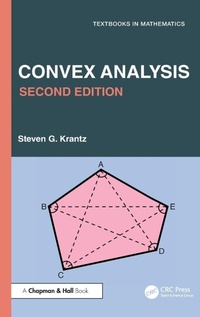
Convex Analysis
2nd Edition
Published on 19. May 2026
Book
Hardback
165 pages
978-1-041-25325-9 (ISBN)
Description
Convexity is an ancient idea going back to Archimedes. Used sporadically in mathematical literature over the centuries, today it is a flourishing area of research. Convexity is used in optimization theory, functional analysis, complex analysis, and other parts of mathematics.
This text, popular in its first edition, introduces analytic tools for studying convexity and provides analytical applications of the concept. It includes a general background on classical geometric theory, revealing a glimpse of how modern mathematics is developed and how geometric ideas may be studied analytically.
Convex Analysis, Second Edition contains copious examples, many applications, and plenty of figures. It also includes an appendix which offers the technical tools needed to understand certain arguments in the book, a table of notation, and a thorough glossary to help readers with unfamiliar terms.
The book presents an analytic way to think about convexity theory. Although this means of doing things is well known to the experts, it is not well documented in the literature. The reader with only a basic background in real analysis (and perhaps a little linear algebra) can get a lot out of this book. This book is a definitive introductory text to the concept of convexity in the context of mathematical analysis and a suitable resource for students and faculty alike.
This text, popular in its first edition, introduces analytic tools for studying convexity and provides analytical applications of the concept. It includes a general background on classical geometric theory, revealing a glimpse of how modern mathematics is developed and how geometric ideas may be studied analytically.
Convex Analysis, Second Edition contains copious examples, many applications, and plenty of figures. It also includes an appendix which offers the technical tools needed to understand certain arguments in the book, a table of notation, and a thorough glossary to help readers with unfamiliar terms.
The book presents an analytic way to think about convexity theory. Although this means of doing things is well known to the experts, it is not well documented in the literature. The reader with only a basic background in real analysis (and perhaps a little linear algebra) can get a lot out of this book. This book is a definitive introductory text to the concept of convexity in the context of mathematical analysis and a suitable resource for students and faculty alike.
More details
Series
Edition
2nd edition
Language
English
Place of publication
London
United Kingdom
Publishing group
Taylor & Francis Ltd
Target group
College/higher education
Undergraduate Advanced
Product notice
Laminated cover
Illustrations
64 s/w Zeichnungen, 1 s/w Tabelle, 64 s/w Abbildungen
1 Tables, black and white; 64 Line drawings, black and white; 64 Illustrations, black and white
Dimensions
Height: 234 mm
Width: 156 mm
Thickness: 11 mm
Weight
430 gr
ISBN-13
978-1-041-25325-9 (9781041253259)
Copyright in bibliographic data and cover images is held by Nielsen Book Services Limited or by the publishers or by their respective licensors: all rights reserved.
Schweitzer Classification
Other editions
Additional editions
Steven G. Krantz
Convex Analysis
E-Book
05/2026
2nd Edition
Chapman and Hall
€69.99
Available for download
Steven G. Krantz
Convex Analysis
E-Book
05/2026
2nd Edition
Chapman and Hall
€69.99
Available for download
Previous edition
Steven G. Krantz
Convex Analysis
Book
07/2017
1st Edition
CRC Press
€297.12
Article exhausted; check for reprint
Person
Steven G. Krantz is a professor at Washington University in St. Louis where he teaches mathematics. He has previously taught at UCLA, Princeton University, and Penn State University. He received his PhD from Princeton University in 1974. Prof. Krantz has directed 20 PhD students and 8 master's students. He has published over 130 books and over 300 scholarly articles. He is the holder of the Chauvenet Prize, the Beckenbach Book Award, and the Kemper Prize. He is a fellow of the American Mathematical Society.
Content
1. Basic Ideas 2. Functions 3. More on Functions 4. Applications 5. Sophisticated Ideas 6. The MiniMax Theorem 7. Concluding Remarks