


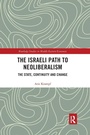
The Israeli Path to Neoliberalism
The State, Continuity and Change
1st Edition
Published on 29. January 2018
Book
Hardback
254 pages
978-1-138-72186-9 (ISBN)
Description
In recent years, Israel has deeply and quickly transformed itself from a self-perceived social-democratic regime into a privatized and liberalized "Start-Up Nation" and a highly divided society. This transition to neoliberalism has been coupled with the adoption of a hawkish and isolationist foreign policy. How can such a deep change be explained? How can a state presumably founded on the basis of socialist ideas, turn within a few decades into a country characterized by a level of inequality comparable to that of the United States?
By presenting a comprehensive and detailed analysis of the evolution of the Israeli economy from the 1930s to the 1990s, The Israeli Path to Neoliberalism seeks to explain the Israeli path to neoliberalism. It debunks the 'from-socialism-to-liberalization' narrative, arguing that the evolution of Israeli capitalism cannot be described or explained as a simple transplantation of imported economic models from advanced liberal democracies. Rather, it asserts that the Israeli variant of capitalism is the product of the encounter between imported Western institutional models and policy ideas, on the one hand, and domestic economic, social and security policy problems on the other. This mechanism of change enables us to understand the factors that gave rise to Israel's unique combination of liberalization and strong national sentiments.
Providing an in-depth analysis of Israel's transformation to neoliberalism, the book is a valuable resource for those studying the economic history of Israel, or the political economy of late-developing countries.
By presenting a comprehensive and detailed analysis of the evolution of the Israeli economy from the 1930s to the 1990s, The Israeli Path to Neoliberalism seeks to explain the Israeli path to neoliberalism. It debunks the 'from-socialism-to-liberalization' narrative, arguing that the evolution of Israeli capitalism cannot be described or explained as a simple transplantation of imported economic models from advanced liberal democracies. Rather, it asserts that the Israeli variant of capitalism is the product of the encounter between imported Western institutional models and policy ideas, on the one hand, and domestic economic, social and security policy problems on the other. This mechanism of change enables us to understand the factors that gave rise to Israel's unique combination of liberalization and strong national sentiments.
Providing an in-depth analysis of Israel's transformation to neoliberalism, the book is a valuable resource for those studying the economic history of Israel, or the political economy of late-developing countries.
More details
Series
Language
English
Place of publication
London
United Kingdom
Publishing group
Taylor & Francis Ltd
Target group
College/higher education
Illustrations
10 s/w Abbildungen, 10 s/w Zeichnungen, 4 s/w Tabellen
4 Tables, black and white; 10 Line drawings, black and white; 10 Illustrations, black and white
Dimensions
Height: 240 mm
Width: 161 mm
Thickness: 18 mm
Weight
552 gr
ISBN-13
978-1-138-72186-9 (9781138721869)
Copyright in bibliographic data and cover images is held by Nielsen Book Services Limited or by the publishers or by their respective licensors: all rights reserved.
Schweitzer Classification
Other editions
Additional editions
Book
08/2020
1st Edition
Routledge
€65.40
Shipment within 15-20 days
E-Book
01/2018
Routledge
€59.49
Available for download
Person
Arie Krampf is a Senior Lecturer in International Relations at the School of Government and Society, at the Academic College of Tel Aviv Yaffo, Israel. His research focuses on the political economy of Israel, International Political Economy, European monetary integration and Economic History.
Content
Introduction: Market Nationalism and the Israeli Capitalism 1. States and Markets in Late-Developing Economies Part One: The Formative Period: Economic Ideas and State Preferences 2. Towards an Industrial Revolution 3. Constructing State Capacities Part Two: From Full Employment to Economic Independence: Production and Finance 4. Economic Independence: Reality, Policy and Rhetoric 5. Establishing a Central Bank in a Late-Developing Country 6. Bank of Israel Independence 7. Developmental Central Banking 8. A Financial Revolution in Israel Part Three: The Path to Neoliberalism 9. The Stabilization Plan 10. Israel's Hawkish Neoliberalism