

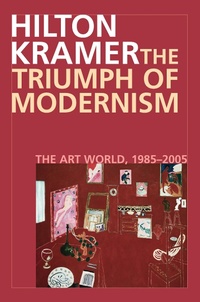
The Triumph of Modernism
The Art World, 1987-2005
Published on 26. December 2006
Book
Hardback
384 pages
978-1-56663-708-4 (ISBN)
Description
Widely acknowledged as the most authoritative art critic of his generation, Hilton Kramer advanced his comments and judgments largely in the form of essays and short pieces. Thus this first collection of his work to appear in twenty years is a signal event for the art world and for criticism generally.
The Triumph of Modernism not only traces the vicissitudes of the art scene but diagnoses the state of modernism and its vital legacy in the postmodern world. Mr. Kramer bracingly updates his incisive critique of the artists, critics, institutions, and movements that have formed the basis for modern art. Appearing for the first time in greatly expanded form is his consideration of the foundations of modern abstract painting and the future of abstraction.
The aesthetic intelligence that Mr. Kramer brings to bear on certain tired assumptions about modernism-many of them derived from methodologies and politics that have little to do with art-helps rescue the artwork itself and its appreciation from the very institutions, such as the art museum and the academy, that purport to foster it.
Always clear-eyed and vastly illuminating, Hilton Kramer's art criticism remains among the very finest written in the past hundred years. Readers of The Triumph of Modernism will be treated to an exhilarating experience.
The Triumph of Modernism not only traces the vicissitudes of the art scene but diagnoses the state of modernism and its vital legacy in the postmodern world. Mr. Kramer bracingly updates his incisive critique of the artists, critics, institutions, and movements that have formed the basis for modern art. Appearing for the first time in greatly expanded form is his consideration of the foundations of modern abstract painting and the future of abstraction.
The aesthetic intelligence that Mr. Kramer brings to bear on certain tired assumptions about modernism-many of them derived from methodologies and politics that have little to do with art-helps rescue the artwork itself and its appreciation from the very institutions, such as the art museum and the academy, that purport to foster it.
Always clear-eyed and vastly illuminating, Hilton Kramer's art criticism remains among the very finest written in the past hundred years. Readers of The Triumph of Modernism will be treated to an exhilarating experience.
Reviews / Votes
Bracing art criticism. . . . In his enlightening, stimulating, and uncompromising essays, Kramer accords art the serious and critical attention it deserves. -- Donna Seaman * Booklist * Delicious jeremiads attacking the meretricious, fad-obsessed art world of today. . . . Mr. Kramer packs his reviews and essays with telling anecdotes. -- Stephen Goode * The Washington Times * An event: The first collection of Hilton Kramer's art criticism to appear in twenty years displays his great command of subject and historical undergirding. Here is an incisive critique of the artists, critics, institutions, and movements that have formed the basis for modern art. * The New York Review Of Books * Splendid collection . . . Kramer is luminously intelligent when he discusses the great modernists. -- Jeffrey Hart * The American Conservative * Arresting and perceptive judgments displaying Kramer's Modernist tastes. * The New York Times * Kramer's book is erudite, principled, and well written. . . . This book would be especially valuable for anyone conducting a course in either aesthetics or art criticism . . . it should be on the 'must read' list for every museum director. -- Marie L. Meegan * Naea News * Everything Hilton Kramer writes is marked by his bracing intelligence and penetrating judgment. No one could doubt his distinction as an art critic-but he raises broad social and cultural issues too, and fearlessly confronts. -- John Gross A principled and discriminating champion of modern art. His hallmark as a critic is a scrupulous, often exquisite, concern for the aesthetic primacy of the object itself-that is, for the formal properties of a work of art-and secondarily for its place within the art of its time. -- Michael J. Lewis Consistently a pleasure to read . . . faithful to the tradition of high intellectuality which flourished in mid-century America. -- Kenneth Minogue * Times Literary Supplement * A vigorous intellect . . . broad taste and erudition. * Academic Questions * Kramer has a gift for writing about the history of ideas . . . It is when he turns to matters of art and aesthetics that his strengths as a thinker come most fully into play. Though a host of his ideological enemies have branded him a 'reactionary elitist' for his belief in objective aesthetic standards, Kramer is no Philistine. After half a century, he retains a qualified but genuine love for the achievements of modernism in art. -- Gregory Wolfe * First Things * More than any other critic of our time-more energetically, more relentlessly, more courageously-Hilton Kramer has stood out against the degradation of modernism in the arts and the symbiotic degradation of liberalism in politics and culture. -- Norman Podhoretz As sharp as a wasp's stinger. -- George Scialabba * Boston Review *More details
Language
English
Place of publication
Chicago
United States
Product notice
Laminated cover
Dimensions
Height: 235 mm
Width: 162 mm
Thickness: 36 mm
Weight
671 gr
ISBN-13
978-1-56663-708-4 (9781566637084)
Copyright in bibliographic data and cover images is held by Nielsen Book Services Limited or by the publishers or by their respective licensors: all rights reserved.
Schweitzer Classification
Other editions
Additional editions
E-Book
12/2013
1st Edition
Rowman & Littlefield Publishers
€15.49
Available for download
Person
Hilton Kramer was co-editor and co-publisher of The New Criterion, which he founded in 1982. He had also been editor of Arts Magazine, art critic for The Nation, chief art critic for the New York Times, and art critic for the New York Observer. His other books include The Twilight of the Intellectuals, The Age of the Avant-Garde, and The Revenge of the Philistines. He died in 2012.