

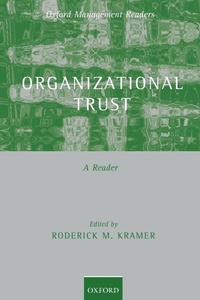
Organizational Trust
A Reader
Published on 30. November 2006
Book
Paperback/Softback
500 pages
978-0-19-928850-2 (ISBN)
Description
Over the past two decades, the topic of trust moved from bit player to center stage in organizational theory and research. Whereas previously it often had been treated as a mediating variable in empirical studies - a variable of secondary interest, at best - trust emerged in the 1990s as a subject deemed important and worthy of study in its own right.
Despite the importance of the topic, to date no single volume currently exists that provides the motivated reader with a sound introduction to, and reasonable overview of, this rapidly growing, widely dispersed, multi-disciplinary literature. Indeed, some of the most influential, foundational pieces remain scattered in obscure journals or books, some of which are not easily found or, in some instances, no longer even in print. Thus the individual scholar hoping to come up to speed with this literature currently had nowhere to turn.
This reader provides trust scholars and researchers with a handy reference volume, a broad guide for graduate students hoping to understand and possibly contribute to this significant and still-growing literature, and a resource for teachers at the undergraduate level of undergraduate anthropology, economics, political science, psychology, organizational sciences, and sociology courses.
Despite the importance of the topic, to date no single volume currently exists that provides the motivated reader with a sound introduction to, and reasonable overview of, this rapidly growing, widely dispersed, multi-disciplinary literature. Indeed, some of the most influential, foundational pieces remain scattered in obscure journals or books, some of which are not easily found or, in some instances, no longer even in print. Thus the individual scholar hoping to come up to speed with this literature currently had nowhere to turn.
This reader provides trust scholars and researchers with a handy reference volume, a broad guide for graduate students hoping to understand and possibly contribute to this significant and still-growing literature, and a resource for teachers at the undergraduate level of undergraduate anthropology, economics, political science, psychology, organizational sciences, and sociology courses.
More details
Series
Language
English
Place of publication
Oxford
United Kingdom
Target group
Professional and scholarly
Illustrations
tables and line drawings
Dimensions
Height: 234 mm
Width: 156 mm
Thickness: 27 mm
Weight
752 gr
ISBN-13
978-0-19-928850-2 (9780199288502)
Copyright in bibliographic data and cover images is held by Nielsen Book Services Limited or by the publishers or by their respective licensors: all rights reserved.
Schweitzer Classification
Other editions
Additional editions
Book
11/2006
Oxford University Press
€262.50
Shipment within 15-20 days
Person
Roderick M. Kramer is the William R. Kimball Professor of Organizational Behavoiur at the Stanford Business School, Stanford University. He has published a number of books on Organizational Behaviour and Psychology, including Trust and Distrust in Organizations: Dilemmas and Approaches (Russell Sage Foundation, 2004), written with Karen S. Cook, and Trust in Organizations (Sage, 1996), co-edited with Tom R. Tyler.
Content
1. Introduction: Why Trust, Why Now? ; FOUNDATIONS FOR ORGANIZATIONAL TRUST THEORY ; 2. The Street-Level Epistemology of Trust ; 3. Calculativeness, Trust, and Economic Organization ; 4. An Integrative Model of Organizational Trust ; TRUST DEVELOPMENT AND MAINTENANCE ; 5. Initial Trust Fromation in New Organizational Relationships ; 6. Managers as Initiators of Trust: An Exchange Relationship Framework for Understanding Managerial Trustworthy Behavior ; 7. The Emergence of Exchange Structures: An Experimental Study of Uncertainty, Commitment, and Trust ; BASES AND BENEFITS OF ORGANIZATIONAL TRUST ; 8. The Role of Trustworthiness in Reducing Transaction Costs and Improving Performance: Empirical Evidence from the United States, Japan, and Korea ; 9. Kinds of Third-Party Effects on Trust ; 10. Does Trust Improve Business Performance? ; FRAGILITY OF ORGANIZATIONAL TRUST ; 11. Explaining the Limited Effectiveness of Legalistic 'Remedies' for Trust/Distrust ; 12. Turst and Breach of the Psychological Contract ; 13. Paranoia and Self-Consciousness ; ORGANIZATIOANL TRUST IN CONTEMPORARY CONTEXTS ; 14. Secrecy, Trust, and Dangerous Leisure: Generating Group Cohesion in Vonultary Organizations ; 15. Swift Trust in Temporary Groups ; 16. Trust, Power, and Control in Trans-organizational Relations