

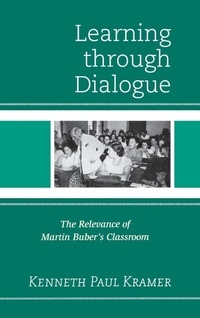
Learning Through Dialogue
The Relevance of Martin Buber's Classroom
Published on 11. April 2013
Book
Hardback
122 pages
978-1-4758-0438-6 (ISBN)
Description
Educational practice today often fails to make the crucial distinction between learning as an accumulation of information and learning as a dialogical interaction that elicits one's personal response to the material. Learning Through Dialogue offers an alternative approach to teaching and learning, which utilizes Martin Buber's dialogical principles: turning toward, addressing affirmatively, listening attentively, and responding responsibly. The book first presents Buber's educational theory and method and second presents specific examples of how Buber's dialogical philosophy can be applied in the classroom. Rather than imposing one's own views, this approach enables teachers and students to develop course content in uniquely appropriate ways. If you are a teacher, a student, an educator at any level, or anyone interested in furthering his or her ability to engage more meaningfully with the educational process, this book will challenge you with fresh perspectives.
Reviews / Votes
In his previous book, Martin Buber's I and Thou, Ken Kramer explains the complex thought of Buber to a lay audience better than anyone I have seen or read. In his new book, Learning Through Dialogue: Understanding Martin Buber's Classroom, Kramer shows himself as an experienced and first-rate teacher, reflecting on his thirty years of teaching, showing how to teach dialogically, and illuminating the processes of teaching and learning as well as the thought of Martin Buber. By describing his efforts to create a more dialogical climate in the classroom, he shows us all how to become more dialogical in our everyday lives. -- Kenneth Cissna, Professor Emeritus and Editor, Qualitative Communication Research, University of South Florida Kenneth Kramer breathes life into Martin Buber's educational philosophy in this well written, intellectually engaging, and pedagogically useful book. Learning Through Dialogue not only conveys complex ideas with clarity and vitality, it proposes practical ways to think about the fundamental role of dialogue in teaching and learning. Kramer has crafted a primer for current and future teachers to awaken them to the multiple relational opportunities present in classrooms. -- Susan Verducci Sandford, professor of Humanities at San Jose State University and editor of Democracy, Education and the Moral LifeMore details
Language
English
Place of publication
United States
Publishing group
Bloomsbury Publishing Plc
Illustrations
2 tables
Dimensions
Height: 235 mm
Width: 157 mm
Thickness: 11 mm
Weight
339 gr
ISBN-13
978-1-4758-0438-6 (9781475804386)
Copyright in bibliographic data and cover images is held by Nielsen Book Services Limited or by the publishers or by their respective licensors: all rights reserved.
Schweitzer Classification
Other editions
Additional editions
E-Book
04/2013
1st Edition
Rowman & Littlefield Education
€33.49
Available for download
E-Book
04/2013
1st Edition
Rowman & Littlefield Education
€33.49
Available for download
Person
Kenneth Paul Kramer is professor emeritus of comparative religious studies at San Jose (CA) State University, where he taught from 1978 to 2001. Among his works, he has published Martin Buber's I and Thou: Practicing Living Dialogue (2003) and Martin Buber's Spirituality: Hasidic Wisdom for Everyday Life (2012).
Content
Foreword
Preface
Introduction
Part ITHEORY/METHOD
Chapter 1 Buber's Two Ways of Learning
Chapter 2 Buber's Method of Inclusion
Chapter 3 Teaching as Unteaching
Chapter 4 The Broadest Frame: Dialogue as Meta-Methodology
Part IIAPPLICATION/PRACTICE
Chapter 5 Dialogues with Texts
Chapter 6 Dialogues with Students
Chapter 7 Interview Dialogues
Chapter 8 Journal Dialogues
Conclusion
Critical Terms
Works Cited
Notes
Index
Preface
Introduction
Part ITHEORY/METHOD
Chapter 1 Buber's Two Ways of Learning
Chapter 2 Buber's Method of Inclusion
Chapter 3 Teaching as Unteaching
Chapter 4 The Broadest Frame: Dialogue as Meta-Methodology
Part IIAPPLICATION/PRACTICE
Chapter 5 Dialogues with Texts
Chapter 6 Dialogues with Students
Chapter 7 Interview Dialogues
Chapter 8 Journal Dialogues
Conclusion
Critical Terms
Works Cited
Notes
Index