

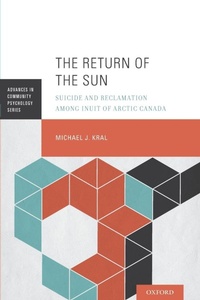
The Return of the Sun
Suicide and Reclamation Among Inuit of Arctic Canada
Published on 13. August 2019
Book
Paperback/Softback
208 pages
978-0-19-026933-3 (ISBN)
Description
Inuit have among the highest suicide rates in the world - ten times the national average. Inuit narratives of suicide provide clues as to what can and in some cases has been done to combat the problem, but until recently they have not circulated far beyond Inuit communities themselves. At the same time, academic researchers have studied suicide among Indigenous peoples, but have stopped short of analyzing narrative accounts for their themes of cultural survival.
Based on two decades of participatory action and ethnographic research, The Return of the Sun is a historical and anthropological examination of suicide among Inuit youth in Arctic Canada. Conceptualizing suicide among Inuit as a response to colonial disruption of family and interpersonal relationships and examining how the community has addressed the issue, Kral draws on research from psychology, anthropology, Indigenous studies, and social justice to understand and address this population. Central to the book are narrative accounts by Inuit of their experiences and perceptions of suicide, and the lives of youth and their community action for change. As these Indigenous community success stories have not previously been widely retold, The Return of the Sun gives voice to a historically ignored community. Kral also locates this community action within the larger Inuit movement toward self-determination and self-governance. This important volume will be of interest to a broad range of social scientists, as well as researchers and practitioners in the mental health fields.
Based on two decades of participatory action and ethnographic research, The Return of the Sun is a historical and anthropological examination of suicide among Inuit youth in Arctic Canada. Conceptualizing suicide among Inuit as a response to colonial disruption of family and interpersonal relationships and examining how the community has addressed the issue, Kral draws on research from psychology, anthropology, Indigenous studies, and social justice to understand and address this population. Central to the book are narrative accounts by Inuit of their experiences and perceptions of suicide, and the lives of youth and their community action for change. As these Indigenous community success stories have not previously been widely retold, The Return of the Sun gives voice to a historically ignored community. Kral also locates this community action within the larger Inuit movement toward self-determination and self-governance. This important volume will be of interest to a broad range of social scientists, as well as researchers and practitioners in the mental health fields.
Reviews / Votes
The author's decades-long experience and relationships with Inuit peoples coalesce with his community-based participatory action research methodology to consistently reflect the primacy of commitment to and by Inuit youth and the willingness of others to drive community action and empowerment...Highly recommended. * G. Bruyere, University of Lethbridge, CHOICE * The Return of the Sun: Suicide and Reclamation Among Inuit of Arctic Canada by Michael Kral, trace[s] the origins of the suicide crisis in Nunavut to the mid-twentieth century, when these traditionally nomadic people moved off the land into towns. [The book] contain[s] many statistics, as well as convincing descriptions of abstract changes such as "the dynamics of Inuit social transformation * Helen Epstein, Helen Epstein * Michael J. Kral has produced an important ethnographic study investigating the devastating problem of youth suicide in Inuit communities, and its complex cultural history. Writing with sensitivity and honesty, he draws on two decades of collaborative fieldwork to explain how the burden of colonialism persists, continuing to fragment communities, and shatter lifeworlds. Kral is at pains to show how from this emotional devastation, movements of cultural esistance, reclamation and hope still take hold. * Nancy Wachowich, PhD, University of Aberdeen * The Return of the Sun is a compassionate and comprehensive analysis of the traumas faced by indigenous peoples in the Canadian Arctic. Unpacking the impact of colonialism and cultural assimilation on Nunavut Inuit elders and youth, Kral patiently and skillfully reveals diverse and competing voices as individuals ponder the consequences of simultaneously inhabiting two worlds, the traditional Inuit world and the world of the Qallunaat ("white people"). The author prioritizes local conceptions of well-being and mental health, revealing an Inuit path toward the design and management of wellness and care in Nunavut. * Edmund Searles, PhD, Bucknell University * The Return of the Sun builds a compelling case for an understanding of Inuit suicide as symbol of social suffering and function of the undeniable impacts of colonialism. The work provides fresh insights into the critical importance of contemporary efforts reclaiming Inuit self-determination and culture, and crucial advocacy for locally controlled, strengths-based cultural approaches for prevention of Inuit suicide. * James Allen, PhD, University of Minnesota Medical School, Duluth Campus *More details
Series
Language
English
Place of publication
New York
United States
Target group
College/higher education
Dimensions
Height: 234 mm
Width: 156 mm
Thickness: 12 mm
Weight
327 gr
ISBN-13
978-0-19-026933-3 (9780190269333)
Copyright in bibliographic data and cover images is held by Nielsen Book Services Limited or by the publishers or by their respective licensors: all rights reserved.
Schweitzer Classification
Other editions
Additional editions
E-Book
07/2019
OUP eBook
€36.99
Available for download
E-Book
07/2019
OUP eBook
€36.99
Available for download
Person
Michael Kral, PhD, is a clinical/community/cultural psychologist and medical anthropologist working as an Associate Professor in the School of Social Work, Wayne State University. He has also taught at the universities of Manitoba, Windsor, Yale, and Illinois at Urbana-Champaign. He has been conducting community-based participatory action research with Inuit in Nunavut, Canada for over 20 years. His research has looked at suicide, kinship, culture change, and youth resilience.
Content
- 1. The Dynamics of Inuit Social Transformation
- 2. Colonial Impact on Family and Inuuqatigiingniq/Relatedness
- 3. "The Weight on Our Shoulders is Too Much, and We Are Falling": Suicide and Culture Change among Inuit Male Youth
- 4. Resistance and Reclamation
- 5. Communities Making a Difference: The Youth Take Action
- 6. Pikkunaqtuq and Footsteps into the Future
- References
- Index