

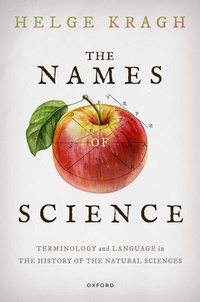
The Names of Science
Terminology and Language in the History of the Natural Sciences
Published on 4. July 2024
Book
Hardback
344 pages
978-0-19-891745-8 (ISBN)
Description
The history of science is echoed in the development of its language and the names chosen for its technical terms. The Names of Science examines in detail how, over time, new words have entered the scientific lexicon and how some of them, but far from all, have survived to the present. Why is a transistor called a transistor and not something else? Why was the term 'scientist' only coined in 1834, and why was the name regarded as controversial for a long time afterwards?
There is a story behind every scientific word we use today. In this work, Helge Kragh tells many of these stories, taking a broad historical perspective from the Renaissance to the present. By combining elements of linguistics with the history of the natural sciences including physics, chemistry, and astronomy, this book offers a new and innovative perspective on the historical development of the natural sciences.
Following an introductory list of useful linguistic terms, the book is structured in six chapters, which cover important phases in the history of science, dealing with a vast range of scientific terminology from physics, chemistry, geology, astronomy, to cosmology. It also considers, if only briefly, how English - and not, say, Latin or French - developed to become the internationally accepted language of science.
Contrary to other works dealing with the subject, The Names of Science pays serious attention to the historical dimension of scientific language, and to the way in which scientists have, sometimes unconsciously, acted as linguists and neologists in their research work.
There is a story behind every scientific word we use today. In this work, Helge Kragh tells many of these stories, taking a broad historical perspective from the Renaissance to the present. By combining elements of linguistics with the history of the natural sciences including physics, chemistry, and astronomy, this book offers a new and innovative perspective on the historical development of the natural sciences.
Following an introductory list of useful linguistic terms, the book is structured in six chapters, which cover important phases in the history of science, dealing with a vast range of scientific terminology from physics, chemistry, geology, astronomy, to cosmology. It also considers, if only briefly, how English - and not, say, Latin or French - developed to become the internationally accepted language of science.
Contrary to other works dealing with the subject, The Names of Science pays serious attention to the historical dimension of scientific language, and to the way in which scientists have, sometimes unconsciously, acted as linguists and neologists in their research work.
Reviews / Votes
An important contribution to the history of science, clearly written, informative, and thoroughly documented in extensive use of primary and secondary sources. * Theodore Arabatzis, University of Athens * A masterfully organized march through the dense terminological thickets of myriade scientific fields (astronomy, cosmology and other physical sciences, chemical, bio & geo-sciences), with a plethora of fascinating examples for how and by whom scientific terms were coined and how hard it often was to get them accepted. * Klaus Hentschel, author of Photons: The History of the Concept and Mental Models of Light Quanta (2018) * An important and welcome publication. * Allison Bigelow, University of Virginia * For anyone interested in the history of the physical sciences and in words and language, The Names of Science is a substantial buffet of treats. Its pages are replete with answers to questions about the origins of scientific terms and the evolution of their meaning over time. * Carmen J. Giunta, Bulletin for the History of Chemistry * Kragh (History of Science, Emeritus, Niels Bohr Institute, Univ. of Copenhagen) has written an erudite and necessarily selective history of the development of terms and names in the fields of physics (electricity, fundamental particles, quantum languages), chemistry, and astronomy. * J. L. Croissant, Choice *More details
Language
English
Place of publication
Oxford
United Kingdom
Target group
College/higher education
Product notice
sewn/stitched
Cloth over boards
Illustrations
10 b/w figures
Dimensions
Height: 236 mm
Width: 164 mm
Thickness: 25 mm
Weight
798 gr
ISBN-13
978-0-19-891745-8 (9780198917458)
Copyright in bibliographic data and cover images is held by Nielsen Book Services Limited or by the publishers or by their respective licensors: all rights reserved.
Schweitzer Classification
Other editions
Additional editions
E-Book
07/2024
1st Edition
OUP eBook
€121.99
Available for download
Book
07/2024
Oxford University Press
€50.00
Shipment within 15-20 days
Person
Helge Kragh has worked as Professor of History of Science at the University of Oslo, Norway, and Aarhus University, Denmark, and is presently Emeritus Professor at the University of Copenhagen. Since 2001 he has been a member of the Royal Danish Academy of Sciences and Letters, and 2008-2010 he served as President of the European Society for History of Science. Most of his research has focused on the historical development of post-1800 physics, chemistry, astronomy, and cosmology.
Content
Preface
Introduction: Some linguistic terms
1: Issues of science, history, and language
2: Electicity and electromagnetism
3: Fundamental particles
4: More physics names
5: Worlds and words of chemistry
6: Heavenly sciences
Bibliography
Index
Introduction: Some linguistic terms
1: Issues of science, history, and language
2: Electicity and electromagnetism
3: Fundamental particles
4: More physics names
5: Worlds and words of chemistry
6: Heavenly sciences
Bibliography
Index