

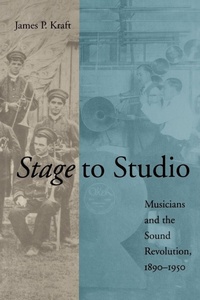
Stage to Studio
Musicians and the Sound Revolution, 1890-1950
Published on 14. January 2004
Book
Paperback/Softback
248 pages
978-0-8018-7742-1 (ISBN)
Description
Between the late nineteenth and mid-twentieth century, technology transformed the entertainment industry as much as it did such heavy industries as coal and steel. Among those most directly affected were musicians, who had to adapt to successive inventions and refinements in audio technology-from wax cylinders and gramophones to radio and sound films. In this groundbreaking study, James P. Kraft explores the intersection of sound technology, corporate power, and artistic labor during this disruptive period. Kraft begins in the late nineteenth century's "golden age" of musicians, when demand for skilled instrumentalists often exceeded supply, analyzing the conflicts in concert halls, nightclubs, recording studios, radio stations, and Hollywood studios as musicians began to compete not only against their local counterparts but also against highly skilled workers in national "entertainment factories." Kraft offers an illuminating case study in the impact of technology on industry and society-and a provocative chapter in the cultural history of America.
Reviews / Votes
Historians might not have answers to the questions of technology displacing and deskilling workers, but they can lay out the facts and be sympathetic to the victims. This Kraft has done. He writes clearly and without bias, [and] has an understanding of his subjects that comes from his own background as a musician. -- Andre Millard American Historical Review In Stage to Studio, James Kraft presents a concise, well-researched, and well-written historical account of the actions and reactions of unionized musicians as they faced new technologies and changing conditions of labor in early twentieth-century America... an important contribution to the literature on organized workers in America. -- Emily Thompson Technology and Culture Combining techniques from social history, labor history, and the history of technology, Kraft weaves together archival material, oral history data, and secondary sources to produce an accessible narrative and a rich analysis. -- Harris M. Berger AntennaMore details
Series
Language
English
Place of publication
Baltimore, MD
United States
Target group
College/higher education
Professional and scholarly
Product notice
Paperback (trade)
Illustrations
26 s/w Abbildungen
26 Illustrations, black and white
Dimensions
Height: 229 mm
Width: 152 mm
Thickness: 17 mm
Weight
446 gr
ISBN-13
978-0-8018-7742-1 (9780801877421)
DOI
10.1353/book.60326
Copyright in bibliographic data and cover images is held by Nielsen Book Services Limited or by the publishers or by their respective licensors: all rights reserved.
Schweitzer Classification
Other editions
Additional editions
E-Book
04/2020
Johns Hopkins University Press
€30.99
Available for download

Book
09/1996
Johns Hopkins University Press
€59.62
Article not available for order
Person
James P. Kraft is associate professor of history at the University of Hawaii.
Content
Acknowledgements
Introduction
Chapter 1. Working Scales in Industrial America
Chapter 2. Boom and Bust in Early Movie Theaters
Chapter 3. Encountering Records and Radio
Chapter 4. Playing in Hollywood Between the Wars
Chapter 5. Rising Militancy
Chapter 6. Recording Ban
Chapter 7. Balancing Success and Failure
Conclusion
Appendix. AFM Membership, 1896-1956
Notes
Essay on Sources
Index
Introduction
Chapter 1. Working Scales in Industrial America
Chapter 2. Boom and Bust in Early Movie Theaters
Chapter 3. Encountering Records and Radio
Chapter 4. Playing in Hollywood Between the Wars
Chapter 5. Rising Militancy
Chapter 6. Recording Ban
Chapter 7. Balancing Success and Failure
Conclusion
Appendix. AFM Membership, 1896-1956
Notes
Essay on Sources
Index