

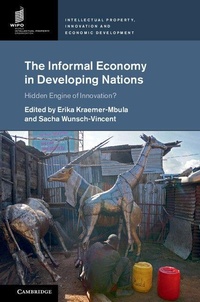
The Informal Economy in Developing Nations
Hidden Engine of Innovation?
Published on 20. October 2016
Book
Hardback
436 pages
978-1-107-15754-5 (ISBN)
Description
The informal economy represents a significant share of output and employment in many developing countries. Yet little is known about this hidden engine of innovation. This pioneering study addresses some crucial questions, including: what is the role of the informal sector in economic development? How does innovation occur in the informal economy? How does it spread, who are the key actors and what impacts does it have? How do inventors and entrepreneurs in the informal economy reap benefits from their innovations? What stops informal sector innovation from scaling up? How can informal sector innovation in developing countries be measured? And what policies might support informal sector innovation and improve its impacts? This book will stimulate further work on this crucial but under-researched subject. As well as rich empirical evidence from several groundbreaking studies, it includes conceptual and methodological tools and policy recommendations to help researchers and policy-makers understand innovation in the informal economy.
Reviews / Votes
'This book is timely and important. Developing countries need to build development strategies and design public policies on the basis of what they have.' Bengt-Ake Lundvall, Aalborg University, Denmark and Secretary General, Globelics 'This book encourages policy makers to better enable innovation in the informal sector. It is a meaningful contribution to the development of the South Africa's national strategic framework on Innovation for Inclusive Development.' Nonhlanhla Mkhize, Department of Science and Technology, South Africa 'This book will contribute to making innovation statistics and measurement work of the African Observatory for Science, Technology and Innovation more relevant to the African community.' Philippe Mawoko, Director of African Observatory of Science, Technology and Innovation 'Mainstream innovation and intellectual property debates have, for the most part, ignored what is commonly referred to as the 'informal' economy. This book aims to redress this deficit.' Shamnad Basheer, Honorary Research Chair of IP Law at Nirma University, India and Founder of SpicyIP (www.spicyip.com) 'This book's strong point is its emphasis on better measurement and evidence as essential pre-requisites to improved policy-making.' Mark Dutz, Lead Economist, Trade and Competitiveness, The World Bank Group 'Innovation may seem like a luxury; something countries can afford only once they have transcended issues of survival. But this attitude is outdated. Innovation can provide fundamental solutions to low-income countries and this book underlines this potential.' Xiaolan Fu, Founding Director of the Technology and Management Centre for Development, University of Oxford 'The divorce between informal endeavors and prevailing knowledge production practices developed in this book is immediately recognizable for all developing countries.' Judith Sutz, Universidad de la Republica, Uruguay and formerly Secretary of Science, Technology and Development, Latin American Commission of Social Sciences 'The democratisation of innovation, a wider participation of individuals and small firms in innovation, is a key factor for more inclusive growth. Considering the informal sector is critical in this regard, making this book an important contribution to this policy agenda.' Dominique Guellec and Caroline Paunov, Head of Division and Senior Economist, Directorate for Science, Technology and Innovation, Organisation for Economic Co-operation and Development 'The authors have managed to put into perspective the hitherto hidden and unexplored contribution of the informal sector to Kenya's modern economy and its industrialization process.' Joseph K. Kiplagat, Ministry of Industrialization and Enterprise Development, Kenya 'The Informal Economy in Developing Nations does an admirable job of detailing current thinking and mapping out the way forward in this area. Readers interested in broadening their understanding of innovation, ways to appropriate the returns to innovation with frugal resources, and potential policy support solutions will find the book useful. ... the book is commendable for drawing from a geographically diverse group of contributors.' Nicola Searle, IPKat (www.ipkitten.blogspot.co.uk) 'This book is part of Cambridge University Press and WIPO's Intellectual Property, Innovation and Economic Development series. [...] One commentator on the book has commended its contribution to innovation statistics and measurement work in Africa. It will be of great assistance for policy-makers building development strategies in countries where the informal economy plays an important role.' Michael Blakeney, European Intellectual Property ReviewMore details
Series
Language
English
Place of publication
Cambridge
United Kingdom
Target group
Professional and scholarly
Illustrations
41 Tables, black and white; 22 Halftones, black and white; 20 Line drawings, black and white
Dimensions
Height: 235 mm
Width: 157 mm
Thickness: 28 mm
Weight
790 gr
ISBN-13
978-1-107-15754-5 (9781107157545)
Copyright in bibliographic data and cover images is held by Nielsen Book Services Limited or by the publishers or by their respective licensors: all rights reserved.
Schweitzer Classification
Other editions
Additional editions
E-Book
10/2016
Cambridge University Press
€108.99
Available for download
Erika Kraemer-Mbula | Sacha Wunsch-Vincent
The Informal Economy in Developing Nations
Hidden Engine of Innovation?
E-Book
08/2016
Cambridge University Press
€130.99
Available for download
Persons
Erika Kraemer-Mbula is a Research Fellow at the Institute for Economic Research on Innovation at Tshwane University of Technology, South Africa. She is also a researcher at the DST-NRF Centre of Excellence in Scientometrics and STI Policy (SciSTIP). Kraemer-Mbula holds a PhD in Development Studies from the University of Oxford. Her research interests have focused on science and technology policy analysis, innovation systems, sustainable development, and various routes to the expansion of creative competencies in Africa. She is an active member of several academic networks (such as Globelics and Africalics) and an advisory member of international platforms advancing Africa-EU research collaboration in science and technology. Sacha Wunsch-Vincent is Senior Economist at the World Intellectual Property Organization (WIPO) and a lecturer in international economics at Sciences Po, Paris. He is one of the authors of the World Intellectual Property Report and editor of the Global Innovation Index. Wunsch-Vincent has served as an advisor to various governments, and to organizations such as the World Bank and the World Economic Forum. Before joining WIPO, he was an economist at the OECD Directorate for Science, Technology and Industry and a Fellow at the Berkeley Center for Law and Technology, University of California.
Content
1. The informal economy: definitions, size, contribution and main characteristics Jacques Charmes; Comment 1.1 Adriana Mata Greenwood; Comment 1.2 Johannes Juetting; 2. Innovation in the informal economy Jeremy de Beer, Kun Fu and Sacha Wunsch-Vincent; Comment 2.1 Colin C. Williams; Comment 2.2 Fred Gault; Comment 2.3 Xiaolan Fu; 3. A study of the informal metalworking sector in Nairobi Christopher Bull, Steve Daniels, Mary Kinyanjui and Barrett Hazeltine; Comment 3.1 Joseph K. Kiplagat; 4. Informal manufacturing of home and personal care products in South Africa Erika Kraemer-Mbula; Comment 4.1 Nonhlanhla Mkhize; 5. Herbal medicine in the informal sector of Ghana George Owusu Essegbey and Stephen Awuni; Comment 5.1 Peter Arhin; 6. Appropriation and intellectual property in the informal economy Jeremy de Beer and Sacha Wunsch-Vincent; Comment 6.1 Emmanuel Sackey; Comment 6.2 Dick Kawooya; Comment 6.3 Shamnad Basheer; 7. Innovation policy and the informal economy: toward a new policy framework Erika Kraemer-Mbula and Almamy Konte; Comment 7.1 Anneline Morgan; Comment 7.2 Judith Sutz; 8. Formulating an agenda for the measurement of innovation in the informal economy Jacques Charmes, Fred Gault and Sacha Wunsch-Vincent; Comment 8.1 Philippe Mawoko; Annex 1. Ad hoc interview guidelines and questionnaires; Annex 2. Extract 1 from the generic questionnaire of stage 2 of the 1-2-3 survey; Annex 3. Kenya 2014.