

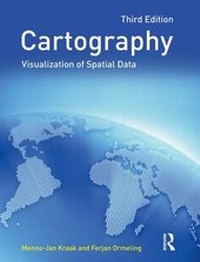
Cartography
Visualization of Spatial Data
3rd Edition
Published on 17. December 2015
Book
Hardback
204 pages
978-1-138-13826-1 (ISBN)
Description
This revised and updated edition integrates the latest in modern technology with traditional cartographic principles. While providing a solid conceptual foundation in cartographic methodology, the text also introduces the very latest advances that have greatly influenced cartographic techniques. The new edition reflects the increasing importance of cartography as the basis for further geographical study, the text has been updated throughout and chapters on the latest developments in cartography have been integrated. There is also a more widespread emphasis on multimedia and the web.
More details
Edition
3rd New edition
Language
English
Place of publication
London
United Kingdom
Publishing group
Taylor & Francis Ltd
Target group
College/higher education
Edition type
New edition
Dimensions
Height: 248 mm
Width: 191 mm
Weight
458 gr
ISBN-13
978-1-138-13826-1 (9781138138261)
Copyright in bibliographic data and cover images is held by Nielsen Book Services Limited or by the publishers or by their respective licensors: all rights reserved.
Schweitzer Classification
Other editions
New editions
Book
07/2020
4th Edition
CRC Press
€152.50
Shipment within 10-20 days
Additional editions
Book
11/2009
3rd Edition
Prentice-Hall
€60.75
Article exhausted; check for reprint
Persons
Kraak\, Menno-Jan; Ormeling\, F.J.
Content
Contents
Preface
Acknowledgements
Chapter 1 Georgraphic information science and maps
1.1 The map as an interface
1.2 Geospatial data
1.3 Geographic information systems
1.4 Geospatial analysis operations
1.5 The spatial infrastructure and maps
Chapter 2 Data acquisition
2.1 The need to know acquisition methods
2.2 Vector file characteristics
2.3 Raster file characteristics
2.4 Deriving data from existing maps
2.5 Working with digital data
2.6 Control and accuracy
Chapter 3 Map characteristics
3.1 Maps are unique
3.2 Definitions of cartography
3.3 The cartographic communication process
3.4 Map functions and map types
Chapter 4 GIS applications: which map to use?
4.1 Maps and the nature of GIS applications
4.2 Cadastre and utilitites: use of large-scale maps
4.3 Geospatial analysis in geography: use of small-scale maps
4.4 Geospatial, thematic and temporal comparisons
Chapter 5 Map design and production
5.1 Introduction
5.2 Symbols to portray data related to points, lines, areas and volumes
5.3 Graphic variables
5.4 Conceptual and design aspects of text on the map
5.5 Requiremenets for the cartographic component of GIS packages
Chapter 6 Topography
6.1 Georeferencing
6.2 Map projections
6.3 Geometric transformations
6.4 Generalization
6.5 Relief
6.6 Topographic data: mapping and charting organizations
6.7 Geographical names
Chapter 7 Statistical mapping
7.1 Statistical surveys
7.2 Data analysis
7.3 Data classification
7.4 Catographical data analysis
7.5 Mapping methods
Chapter 8 Mapping time
8.1 Introduction
8.2 Mapping change
8.3 Animation
8.4 Dynamic variables
Chapter 9 Maps at work: presenting and using geospatial data in maps and atlases
9.1 Introduction
9.2 Paper atlases
9.3 Electronic atlases
9.4 Maps at work: map use functions
9.5 Working with (web-based) electronic atlases
Chapter 10 Maps at work: analysis and geovisualisation
10.1
10.2 Geovisual analytics
Chapter 11 Cartography at work: maps as decision tools
11.1 Again: why maps?
11.2 Management and documentation of spatial information
11.3 Outdated data: at work with the Digital Chart of the World
11.4 Acessibility: Cartography, GIS and geospatial information policy
11.5 Copyright and liability
11.6 Map use and usability
11.7 Maps and GIScience revisited
References
Index
Preface
Acknowledgements
Chapter 1 Georgraphic information science and maps
1.1 The map as an interface
1.2 Geospatial data
1.3 Geographic information systems
1.4 Geospatial analysis operations
1.5 The spatial infrastructure and maps
Chapter 2 Data acquisition
2.1 The need to know acquisition methods
2.2 Vector file characteristics
2.3 Raster file characteristics
2.4 Deriving data from existing maps
2.5 Working with digital data
2.6 Control and accuracy
Chapter 3 Map characteristics
3.1 Maps are unique
3.2 Definitions of cartography
3.3 The cartographic communication process
3.4 Map functions and map types
Chapter 4 GIS applications: which map to use?
4.1 Maps and the nature of GIS applications
4.2 Cadastre and utilitites: use of large-scale maps
4.3 Geospatial analysis in geography: use of small-scale maps
4.4 Geospatial, thematic and temporal comparisons
Chapter 5 Map design and production
5.1 Introduction
5.2 Symbols to portray data related to points, lines, areas and volumes
5.3 Graphic variables
5.4 Conceptual and design aspects of text on the map
5.5 Requiremenets for the cartographic component of GIS packages
Chapter 6 Topography
6.1 Georeferencing
6.2 Map projections
6.3 Geometric transformations
6.4 Generalization
6.5 Relief
6.6 Topographic data: mapping and charting organizations
6.7 Geographical names
Chapter 7 Statistical mapping
7.1 Statistical surveys
7.2 Data analysis
7.3 Data classification
7.4 Catographical data analysis
7.5 Mapping methods
Chapter 8 Mapping time
8.1 Introduction
8.2 Mapping change
8.3 Animation
8.4 Dynamic variables
Chapter 9 Maps at work: presenting and using geospatial data in maps and atlases
9.1 Introduction
9.2 Paper atlases
9.3 Electronic atlases
9.4 Maps at work: map use functions
9.5 Working with (web-based) electronic atlases
Chapter 10 Maps at work: analysis and geovisualisation
10.1
10.2 Geovisual analytics
Chapter 11 Cartography at work: maps as decision tools
11.1 Again: why maps?
11.2 Management and documentation of spatial information
11.3 Outdated data: at work with the Digital Chart of the World
11.4 Acessibility: Cartography, GIS and geospatial information policy
11.5 Copyright and liability
11.6 Map use and usability
11.7 Maps and GIScience revisited
References
Index