

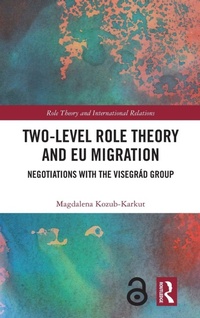
Two-Level Role Theory and EU Migration
Negotiations with the Visegrad Group
1st Edition
Published on 2. December 2024
Book
Hardback
200 pages
978-1-032-78626-1 (ISBN)
Description
Applying role theory and Putnam's two-level game framework to the European migration crisis of 2015, Magdalena Kozub-Karkut expertly shows how the Czech Republic, Slovakia, Hungary, and Poland used the crisis to contest their roles in the European Union (EU) and how each country and the V4, as a group, subsequently used their new contested roles in the bargaining process within the EU structures. In doing so, Kozub-Karkut demonstrates how international negotiations might be used by the chief negotiators as a way of triggering contestation and enhancing their position at the domestic level as well as how role contestation processes from the domestic level might be used at the international one.
Two-Level Role Theory and EU Migration is an excellent resource for scholars and students of Foreign Policy Analysis, International Relations Theory, European Studies, and Migrations Studies.
Chapter 3 and 7 of this book is freely available as a downloadable Open Access PDF at http://www.taylorfrancis.com under a Creative Commons Attribution-Non Commercial-No Derivatives (CC-BY-NC-ND) 4.0 license.
Two-Level Role Theory and EU Migration is an excellent resource for scholars and students of Foreign Policy Analysis, International Relations Theory, European Studies, and Migrations Studies.
Chapter 3 and 7 of this book is freely available as a downloadable Open Access PDF at http://www.taylorfrancis.com under a Creative Commons Attribution-Non Commercial-No Derivatives (CC-BY-NC-ND) 4.0 license.
Reviews / Votes
Two-Level Role Theory and EU Migration addresses the migration crisis with game models from binary role theory and Putnam's two-level games framework. It identifies horizontal and vertical role contestation patterns that illuminate the dynamics of political discourse over the migration crisis and illustrate a theoretical synthesis linking levels of analysis in world politics. It is an important addition for scholars to read with interests in role theory and world politics.Stephen G. Walker, Arizona State University
More details
Series
Language
English
Place of publication
London
United Kingdom
Publishing group
Taylor & Francis Ltd
Target group
College/higher education
Postgraduate and Undergraduate Advanced
Illustrations
28 s/w Tabellen, 43 s/w Zeichnungen, 43 s/w Abbildungen
28 Tables, black and white; 43 Line drawings, black and white; 43 Illustrations, black and white
Dimensions
Height: 235 mm
Width: 157 mm
Thickness: 16 mm
Weight
459 gr
ISBN-13
978-1-032-78626-1 (9781032786261)
Copyright in bibliographic data and cover images is held by Nielsen Book Services Limited or by the publishers or by their respective licensors: all rights reserved.
Schweitzer Classification
Other editions
Additional editions
E-Book
12/2024
1st Edition
Routledge
€55.49
Available for download
E-Book
12/2024
1st Edition
Routledge
€55.49
Available for download
Person
Magdalena Kozub-Karkut is Assistant Professor at Jagiellonian University in Krakow, Poland. Her main research interests include global governance, IR theory, foreign policy analysis, and political theory. She is a member of the International Studies Association and a governing board member of the European International Studies Association.
Content
Introduction. 1. The Migration Crisis in Europe (2015-2018): Main Causes and Characteristics 2. The Visegrad Group States and the Migration Crisis in Europe 3. Two-Level Role Theory: A Synthesis of Putnam's Assumptions and Role Theory Concepts 4. Research Methods and Sources 5. Three Levels of Horizontal Role Contestation Processes in the V4 States: Poland and Hungary 6. Three Levels of Horizontal Role Contestation Processes in the V4 States: The Czech Republic and Slovakia 7. EU Role Conceptions and Role Expectations towards the V4 8. Vertical Role Contestation Process between the V4 and the EU. Conclusion