

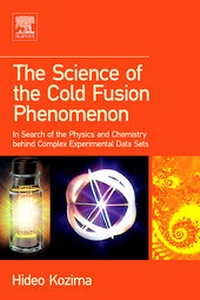
The Science of the Cold Fusion Phenomenon
In Search of the Physics and Chemistry behind Complex Experimental Data Sets
Published on 27. July 2006
Book
Hardback
208 pages
978-0-08-045110-7 (ISBN)
Description
Broken up in to three sections, The Science of the Cold Fusion Phenomenon gives a unified explanation of all the significant data on the Cold Fusion Phenomena to date. It presents a history of the Cold Fusion Phenomenon (CFP), gives the fundamental experimental results of the CFP and presents a quantum mechanical treatment of physical problems associated with cold fusion.
More details
Language
English
Place of publication
Oxford
United Kingdom
Publishing group
Elsevier Science & Technology
Target group
Professional and scholarly
Physicists, energy researchers, mechanical engineers
Dimensions
Height: 234 mm
Width: 156 mm
Weight
450 gr
ISBN-13
978-0-08-045110-7 (9780080451107)
Copyright in bibliographic data and cover images is held by Nielsen Book Services Limited or by the publishers or by their respective licensors: all rights reserved.
Schweitzer Classification
Other editions
Additional editions
Hideo Kozima
The Science of the Cold Fusion Phenomenon
In Search of the Physics and Chemistry behind Complex Experimental Data Sets
E-Book
09/2006
Elsevier
€170.00
Available for download
Person
Content
1 Discovery of the Cold Fusion Phenomenon (CFP)
1.1 The First Experiments
1.2 The Experiment by Fleischmann et al.
1.3 Confirmation of the Experiment by Fleischmann et al.
1.4 Experiment by Jones et al. and De Ninno et al.
1.5 Scandals
1.6 Experiments with Light Water H2O
1.7 Facts and Truth
2 Facts of the Cold Fusion Phenomenon (CFP)
2.1 How the Experiments are conducted?
2.2 Where and How the Cold Fusion Phenomenon occurs?
2.3 Number of Reactions Nx producing an Observable x
2.4 Outline of TNCF Model and Neutron Drop Model - Basis of Data Analysis
2.5 Nuclear Transmutations (NT's)
2.6 Tritium T (or triton 31H=t)
2.7 Neutron
2.8 Helium-3 (32He) and Helium-4 (42He)
2.9 Excess Heat
2.10 Absence of Gamma Ray
2.11 The Stability Effect in Nuclear Transmutation
2.12 The Inverse Power Law for Occurrence of Events in Cold Fusion Phenomenon
2.13 After Effect and Aging Effect
2.14 The Qualitative Reproducibility
2.15 Summary of Experimental Results of the Cold Fusion Phenomenon
3 Science of the Cold Fusion Phenomenon
3.1 Potency of a Model - Examples in Modern Physics
3.2 The TNCF Model - A Phenomenological Approach
3.3 Explanation of the Cold Fusion Phenomenon by the TNCF Model
3.4 Nuclear Reactions in Free Space and in Solids
3.5 Quantum States of Neutrons and Properties of Lattice Nuclei
3.6 Hydrogen Isotopes in Transition Metals
3.7 CF-Matter and Neutron Drop Model
Drops in Thin Neutron Gas Formed in Solids
3.8 The Cold Fusion Phenomenon as a Science of Complexity revealed by the Stability Effect and the Inverse Power Law
1.1 The First Experiments
1.2 The Experiment by Fleischmann et al.
1.3 Confirmation of the Experiment by Fleischmann et al.
1.4 Experiment by Jones et al. and De Ninno et al.
1.5 Scandals
1.6 Experiments with Light Water H2O
1.7 Facts and Truth
2 Facts of the Cold Fusion Phenomenon (CFP)
2.1 How the Experiments are conducted?
2.2 Where and How the Cold Fusion Phenomenon occurs?
2.3 Number of Reactions Nx producing an Observable x
2.4 Outline of TNCF Model and Neutron Drop Model - Basis of Data Analysis
2.5 Nuclear Transmutations (NT's)
2.6 Tritium T (or triton 31H=t)
2.7 Neutron
2.8 Helium-3 (32He) and Helium-4 (42He)
2.9 Excess Heat
2.10 Absence of Gamma Ray
2.11 The Stability Effect in Nuclear Transmutation
2.12 The Inverse Power Law for Occurrence of Events in Cold Fusion Phenomenon
2.13 After Effect and Aging Effect
2.14 The Qualitative Reproducibility
2.15 Summary of Experimental Results of the Cold Fusion Phenomenon
3 Science of the Cold Fusion Phenomenon
3.1 Potency of a Model - Examples in Modern Physics
3.2 The TNCF Model - A Phenomenological Approach
3.3 Explanation of the Cold Fusion Phenomenon by the TNCF Model
3.4 Nuclear Reactions in Free Space and in Solids
3.5 Quantum States of Neutrons and Properties of Lattice Nuclei
3.6 Hydrogen Isotopes in Transition Metals
3.7 CF-Matter and Neutron Drop Model
Drops in Thin Neutron Gas Formed in Solids
3.8 The Cold Fusion Phenomenon as a Science of Complexity revealed by the Stability Effect and the Inverse Power Law