

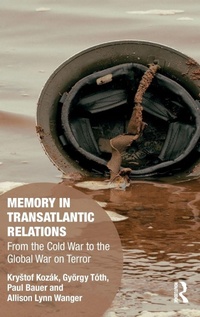
Memory in Transatlantic Relations
From the Cold War to the Global War on Terror
1st Edition
Published on 21. February 2019
Book
Hardback
268 pages
978-0-415-78854-0 (ISBN)
Description
This volume focuses on the uses of collective memory in transatlantic relations between the United States, and Western and Central European nations in the period from the Cold War to the present day. Sitting at the intersection of international relations, history, memory studies and various "area" studies, Memory in Transatlantic Relations examines the role of memory in an international context, including the ways in which policy and decision makers utilize memory; the relationship between trauma, memory and international politics; the multiplicity of actors who shape memory; and the role of memory in the conflicts in post-Cold War Europe.
Thematically organized and presenting studies centered on the U.S., Hungary, France, the Czech Republic and Slovakia, the authors explore the built environment (memorials) and performances of memory (commemorations), shedding light on the ways in which memories are mobilized to frame relations between the U.S. and nations in Western and Central Europe. As such, it will appeal to scholars across the social sciences and historians with interests in memory studies, foreign policy and international relations.
Thematically organized and presenting studies centered on the U.S., Hungary, France, the Czech Republic and Slovakia, the authors explore the built environment (memorials) and performances of memory (commemorations), shedding light on the ways in which memories are mobilized to frame relations between the U.S. and nations in Western and Central Europe. As such, it will appeal to scholars across the social sciences and historians with interests in memory studies, foreign policy and international relations.
More details
Series
Language
English
Place of publication
London
United Kingdom
Publishing group
Taylor & Francis Ltd
Target group
College/higher education
Illustrations
5 s/w Abbildungen, 5 s/w Photographien bzw. Rasterbilder
5 Halftones, black and white; 5 Illustrations, black and white
Dimensions
Height: 240 mm
Width: 161 mm
Thickness: 20 mm
Weight
587 gr
ISBN-13
978-0-415-78854-0 (9780415788540)
Copyright in bibliographic data and cover images is held by Nielsen Book Services Limited or by the publishers or by their respective licensors: all rights reserved.
Schweitzer Classification
Other editions
Additional editions
Krystof Kozak | Gyoergy Toth | Paul Bauer
Memory in Transatlantic Relations
From the Cold War to the Global War on Terror
Book
09/2020
1st Edition
Routledge
€68.60
Shipment within 15-20 days
Krystof Kozak | Gyoergy Toth | Paul Bauer
Memory in Transatlantic Relations
From the Cold War to the Global War on Terror
E-Book
02/2019
Routledge
€61.99
Available for download
Krystof Kozak | Gyoergy Toth | Paul Bauer
Memory in Transatlantic Relations
From the Cold War to the Global War on Terror
E-Book
02/2019
1st Edition
Routledge
€61.99
Available for download
Persons
Krystof Kozak is Head of the Department of North American Studies at the Institute of International Studies, Charles University, Prague, Czech Republic and author of Facing Asymmetry: Bridging the Peripheral Gap in U.S.-Mexican Relations.
Gyoergy Toth is Lecturer in Post-1945 US History and Transatlantic Relations at the University of Stirling, U.K., and author of From Wounded Knee to Checkpoint Charlie: The Alliance for Sovereignty between American Indians and Central Europeans in the Late Cold War.
Paul Bauer is Assistant Professor at the Institute for International Studies, Faculty of Social Sciences, Charles University Prague, Czech Republic.
Allison Lynn Wanger is Visiting Assistant Professor in the American Studies Program at Miami University, Ohio, U.S.
Gyoergy Toth is Lecturer in Post-1945 US History and Transatlantic Relations at the University of Stirling, U.K., and author of From Wounded Knee to Checkpoint Charlie: The Alliance for Sovereignty between American Indians and Central Europeans in the Late Cold War.
Paul Bauer is Assistant Professor at the Institute for International Studies, Faculty of Social Sciences, Charles University Prague, Czech Republic.
Allison Lynn Wanger is Visiting Assistant Professor in the American Studies Program at Miami University, Ohio, U.S.
Content
Introduction: Toward A Study Of Memory Policy In Transatlantic Relations
Part I: The Politics Of Memory On Two Sides Of The Atlantic
1. The Politics of Public Memory in the United States: An Overview
2. The Politics of History in Europe: National Myths, Musealization and Social Memory
Part II: 'Lafayette, We Are Here': Memory In Us Transatlantic Relations
3: "Time Will Not Dim the Glory of Their Deeds": The Memorial Roots and Transatlantic Legacies of the U.S. Military Cemeteries Abroad
4: Public Memory in US Transatlantic Relations from the Late Cold War through the 1990s
5. Memory in U.S. Transatlantic Relations since 9/11
6: The Aesthetic of War Commemorations in France. The D-Day Celebration in 2014
Part III: Memory In Central European Transatlantic Relations
7. Memory in Czech-U.S. Relations Since the End of the Cold War
8: Memory Unravelling: The 50th Anniversary of the 1956 Hungarian Uprising in U.S.-Hungarian Relations
Conclusions: A Memory Strategy/Policy for the Future?
Part I: The Politics Of Memory On Two Sides Of The Atlantic
1. The Politics of Public Memory in the United States: An Overview
2. The Politics of History in Europe: National Myths, Musealization and Social Memory
Part II: 'Lafayette, We Are Here': Memory In Us Transatlantic Relations
3: "Time Will Not Dim the Glory of Their Deeds": The Memorial Roots and Transatlantic Legacies of the U.S. Military Cemeteries Abroad
4: Public Memory in US Transatlantic Relations from the Late Cold War through the 1990s
5. Memory in U.S. Transatlantic Relations since 9/11
6: The Aesthetic of War Commemorations in France. The D-Day Celebration in 2014
Part III: Memory In Central European Transatlantic Relations
7. Memory in Czech-U.S. Relations Since the End of the Cold War
8: Memory Unravelling: The 50th Anniversary of the 1956 Hungarian Uprising in U.S.-Hungarian Relations
Conclusions: A Memory Strategy/Policy for the Future?