

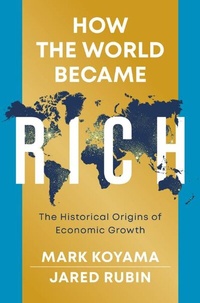
How the World Became Rich
The Historical Origins of Economic Growth
1st Edition
Published on 24. March 2022
Book
Paperback/Softback
240 pages
978-1-5095-4023-5 (ISBN)
Description
Most humans are significantly richer than their ancestors. Humanity gained nearly all of its wealth in the last two centuries. How did this come to pass? How did the world become rich?
Mark Koyama and Jared Rubin dive into the many theories of why modern economic growth happened when and where it did. They discuss recently-advanced theories rooted in geography, politics, culture, demography, and colonialism. Pieces of each of these theories help explain key events on the path to modern riches. Why did the Industrial Revolution begin in 18th-century Britain? Why did some European countries, the USA, Canada, and Japan catch up in the 19th century? Why did it take until the late 20th and 21st centuries for other countries? Why have some still not caught up?
Koyama and Rubin show that the past can provide a guide for how countries can escape poverty. There are certain prerequisites that all successful economies seem to have. But there is also no panacea. A society's past and its institutions and culture play a key role in shaping how it may--or may not--develop.
Mark Koyama and Jared Rubin dive into the many theories of why modern economic growth happened when and where it did. They discuss recently-advanced theories rooted in geography, politics, culture, demography, and colonialism. Pieces of each of these theories help explain key events on the path to modern riches. Why did the Industrial Revolution begin in 18th-century Britain? Why did some European countries, the USA, Canada, and Japan catch up in the 19th century? Why did it take until the late 20th and 21st centuries for other countries? Why have some still not caught up?
Koyama and Rubin show that the past can provide a guide for how countries can escape poverty. There are certain prerequisites that all successful economies seem to have. But there is also no panacea. A society's past and its institutions and culture play a key role in shaping how it may--or may not--develop.
More details
Language
English
Place of publication
Oxford
United Kingdom
Target group
Professional and scholarly
Dimensions
Height: 224 mm
Width: 150 mm
Thickness: 22 mm
Weight
400 gr
ISBN-13
978-1-5095-4023-5 (9781509540235)
Copyright in bibliographic data and cover images is held by Nielsen Book Services Limited or by the publishers or by their respective licensors: all rights reserved.
Schweitzer Classification
Other editions
Additional editions
Book
03/2022
1st Edition
Polity Press
€71.00
Shipment within 15-20 days
E-Book
03/2022
1st Edition
Wiley
€18.99
Available for download
Persons
Mark Koyama is Associate Professor of Economics at George Mason University.
Jared Rubin is Associate Professor of Economics at Chapman University.
Jared Rubin is Associate Professor of Economics at Chapman University.
Content
Preface
1 Why, When, and How Did the World Become Rich?
2 Did Some Societies Win the Geography Lottery?
3 Is it all Just Institutions?
4 Did Culture Make Some Rich and Others Poor?
5 Fewer Babies?
6 Was it Just a Matter of Colonization and Exploitation?
7 Why Did Northwestern Europe Become Rich First?
8 Britain's Industrial Revolution
9 The Rise of the Modern Economy
10 Industrialization and the World it Created
11 The World is Rich
Bibliography
1 Why, When, and How Did the World Become Rich?
2 Did Some Societies Win the Geography Lottery?
3 Is it all Just Institutions?
4 Did Culture Make Some Rich and Others Poor?
5 Fewer Babies?
6 Was it Just a Matter of Colonization and Exploitation?
7 Why Did Northwestern Europe Become Rich First?
8 Britain's Industrial Revolution
9 The Rise of the Modern Economy
10 Industrialization and the World it Created
11 The World is Rich
Bibliography