

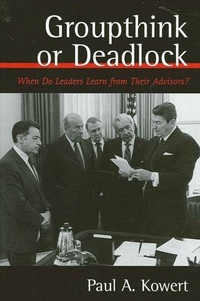
Groupthink or Deadlock
When Do Leaders Learn from Their Advisors?
Published on 24. January 2002
Book
Paperback/Softback
275 pages
978-0-7914-5250-9 (ISBN)
Description
Argues that too much advice can lead to policy deadlock depending on leadership style.
The danger of groupthink is now standard fare in leadership training programs and a widely accepted explanation, among political scientists, for policy-making fiascoes. Efforts to avoid groupthink, however, can lead to an even more serious problem-deadlock. Groupthink or Deadlock explores these dual problems in the Eisenhower and Reagan administrations and demonstrates how both presidents were capable of learning and consequently changing their policies, sometimes dramatically, but at the same time doing so in characteristically different ways. Kowert points to the need for leaders to organize their staff in a way that fits their learning and leadership style and allows them to negotiate a path between groupthink and deadlock.
The danger of groupthink is now standard fare in leadership training programs and a widely accepted explanation, among political scientists, for policy-making fiascoes. Efforts to avoid groupthink, however, can lead to an even more serious problem-deadlock. Groupthink or Deadlock explores these dual problems in the Eisenhower and Reagan administrations and demonstrates how both presidents were capable of learning and consequently changing their policies, sometimes dramatically, but at the same time doing so in characteristically different ways. Kowert points to the need for leaders to organize their staff in a way that fits their learning and leadership style and allows them to negotiate a path between groupthink and deadlock.
Reviews / Votes
"This book raises an important theoretical point that has not been well explored in the literature on presidential decision-making. Kowert has made a genuine contribution not only with his discussion of how 'open' leaders fare in closed groups, but how 'closed' leaders fare in open groups." - John P. Burke, author of Presidential Transitions: From Politics to Practice"This is a solid contribution to the well-established genre of case-based explorations of presidential decision-making. The author's pairing of Eisenhower and Reagan provides a new twist. I commend Kowert for tackling a theoretically rich research question." - Brian D. Ripley, Mercyhurst College
More details
Series
Language
English
Place of publication
Albany, NY
United States
Target group
College/higher education
US School Grade: College Graduate Student and over
Product notice
Paperback (trade)
Dimensions
Height: 226 mm
Width: 149 mm
Thickness: 20 mm
Weight
382 gr
ISBN-13
978-0-7914-5250-9 (9780791452509)
Copyright in bibliographic data and cover images is held by Nielsen Book Services Limited or by the publishers or by their respective licensors: all rights reserved.
Schweitzer Classification
Other editions
Additional editions
E-Book
02/2012
1st Edition
De Gruyter
€35.99
Available for download
Person
Paul A. Kowert is Assistant Professor of International Relations at Florida International University, and coeditor of International Relations in a Constructed World.
Content
Abbreviations
Tables and Figures
Acknowledgments
1. Introduction
Matching Advisors to Leaders
Does Leadership Really Matter?
What Is Learning?
Conclusion
2. Who Learns, and When?
Learning Style
Managing Advisors
A Theory of Leader-Group Relations
Conclusion
3. Eisenhower and Reagan: Comparing Learning Styles
The Eisenhower Administration
Learning Style
Advisors
The Reagan Administration
Learning Style
Advisors
Conclusion
4. Learning
Learning In an Open Administration
The Fall of Dien Bien Phu
Alaskan Statehood
Learning In a Closed Administration
The International Debt Shock
The Withdrawal from Lebanon
Conclusion
5. Groupthink
Balance of Payments Deficits
McCarthyism
Conclusion
6. Deadlock
The Budget Deficit
The Iran-Contra Affair
Conclusion
7. Conclusion
The Politics of Advice
Why Learn?
Notes
Bibliography
Index
Tables and Figures
Acknowledgments
1. Introduction
Matching Advisors to Leaders
Does Leadership Really Matter?
What Is Learning?
Conclusion
2. Who Learns, and When?
Learning Style
Managing Advisors
A Theory of Leader-Group Relations
Conclusion
3. Eisenhower and Reagan: Comparing Learning Styles
The Eisenhower Administration
Learning Style
Advisors
The Reagan Administration
Learning Style
Advisors
Conclusion
4. Learning
Learning In an Open Administration
The Fall of Dien Bien Phu
Alaskan Statehood
Learning In a Closed Administration
The International Debt Shock
The Withdrawal from Lebanon
Conclusion
5. Groupthink
Balance of Payments Deficits
McCarthyism
Conclusion
6. Deadlock
The Budget Deficit
The Iran-Contra Affair
Conclusion
7. Conclusion
The Politics of Advice
Why Learn?
Notes
Bibliography
Index