

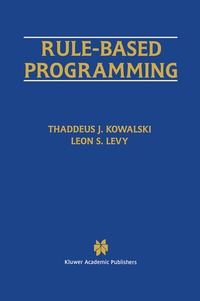
Rule-Based Programming
Published on 5. October 2011
Book
Paperback/Softback
XVI, 306 pages
978-1-4612-8624-0 (ISBN)
Description
Rule-Based Programming
is a broad presentation of the rule-based programming method with many example programs showing the strengths of the rule-based approach. The rule-based approach has been used extensively in the development of artificial intelligence systems, such as expert systems and machine learning. This rule-based programming technique has been applied in such diverse fields as medical diagnostic systems, insurance and banking systems, as well as automated design and configuration systems.
Rule-based programming is also helpful in bridging the semantic gap between an application and a program, allowing domain specialists to understand programs and participate more closely in their development.
Over sixty programs are presented and all programs are available from an ftp site. Many of these programs are presented in several versions allowing the reader to see how realistic programs are elaborated from `back of envelope' models. Metaprogramming is also presented as a technique for bridging the `semantic gap'.
Rule-Based Programming will be of interest to programmers, systems analysts and other developers of expert systems as well as to researchers and practitioners in artificial intelligence, computer science professionals and educators.
Rule-based programming is also helpful in bridging the semantic gap between an application and a program, allowing domain specialists to understand programs and participate more closely in their development.
Over sixty programs are presented and all programs are available from an ftp site. Many of these programs are presented in several versions allowing the reader to see how realistic programs are elaborated from `back of envelope' models. Metaprogramming is also presented as a technique for bridging the `semantic gap'.
Rule-Based Programming will be of interest to programmers, systems analysts and other developers of expert systems as well as to researchers and practitioners in artificial intelligence, computer science professionals and educators.
More details
Series
Edition
Softcover reprint of the original 1st ed. 1996
Language
English
Place of publication
New York
United States
Target group
Professional and scholarly
Research
Illustrations
XVI, 306 p.
Dimensions
Height: 235 mm
Width: 155 mm
Thickness: 18 mm
Weight
493 gr
ISBN-13
978-1-4612-8624-0 (9781461286240)
DOI
10.1007/978-1-4613-1435-6
Schweitzer Classification
Other editions
Additional editions
Thaddeus J. Kowalski | Leon S. Levy
Rule-Based Programming
E-Book
12/2012
Springer
€149.79
Available for download
Thaddeus J. Kowalski | Leon S. Levy
Rule-Based Programming
Book
09/1996
Kluwer Academic Publishers
€160.49
Shipment within 15-20 days
Content
Getting Started in Rule-Based Programming.- Caveat.- C5.- Summary.- Old Friends Revisited.- The Euclidean Algorithm.- Fibonacci Sequence - Iterative.- Fibonacci Sequence - Recursive.- Towers of Hanoi.- Transitive Closure.- Summary.- Search and Backtracking.- Depth First Search.- Problems as Graphs.- Generate and Test.- Backtracking.- Generators.- Summary.- Ai Paradigms.- Proofs.- Forward Chaining Proofs.- Backward Chaining Proofs.- How and Why.- The System as a Shell.- Embedding-Frames.- The Dijkstra-Lee Program.- Semantic Nets and Conceptual Graphs.- Frames.- Converting Semantic Nets to Frames.- Object Oriented Programming.- Summary.- Language Processing.- Semi-Thue Systems.- Metaprogramming.- Context -Free Grammars.- Tree Evaluation - Synthesized Attributes.- Tree Evaluation - Inherited Attributes.- Tree Grammars.- Summary.- Parts of Prolog and Lisp.- Database Retrieval.- Simple User Interfacing.- State Machine Simulation.- Symbolic Simplification.- Symbolic Differentiation.- Programming in the Large.- Summary.- Machine Learning.- Classification.- Generating Abstractions.- Locating a New Object in a Hierarchy.- The Complete Learning Demonstration Module.- Summary.- References.- Appendix - Quick Reference on C5-R2.0.