

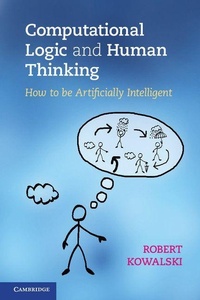
Computational Logic and Human Thinking
How to Be Artificially Intelligent
Published on 21. July 2011
Book
Paperback/Softback
332 pages
978-0-521-12336-5 (ISBN)
Description
The practical benefits of computational logic need not be limited to mathematics and computing. As this book shows, ordinary people in their everyday lives can profit from the recent advances that have been developed for artificial intelligence. The book draws upon related developments in various fields from philosophy to psychology and law. It pays special attention to the integration of logic with decision theory, and the use of logic to improve the clarity and coherence of communication in natural languages such as English. This book is essential reading for teachers and researchers who may be out of touch with the latest developments in computational logic. It will also be useful in any undergraduate course that teaches practical thinking, problem solving or communication skills. Its informal presentation makes the book accessible to readers from any background, but optional, more formal, chapters are also included for those who are more technically oriented.
Reviews / Votes
'[This book] is a superb introduction both to AI from within a computational logic framework and to its application to human rationality and reasoning. Nothing else comes close. Kowalski writes with philosophical insight and just the right level of technical expertise. He puts the excitement back in AI. This sets [this book] apart from the technically overwhelming, and all too often largely unintuitive and uninspiring, encyclopedic introductions that currently dominate the field.' Thomas A. Blackson, Arizona State University 'Artificial Intelligence (or AI) tries to program computers so that they can think intelligently like humans. In this book, one of the pioneers of AI suggests something new and original, namely to use the results of AI to improve human thinking ... Anyone who wants to reason better and more effectively in everyday life should study Robert Kowalski's book.' Donald Gillies, University College LondonMore details
Language
English
Place of publication
Cambridge
United Kingdom
Target group
Professional and scholarly
College/higher education
Product notice
Paperback (trade)
Illustrations
20 Halftones, unspecified; 15 Line drawings, unspecified
Dimensions
Height: 229 mm
Width: 152 mm
Thickness: 18 mm
Weight
485 gr
ISBN-13
978-0-521-12336-5 (9780521123365)
Copyright in bibliographic data and cover images is held by Nielsen Book Services Limited or by the publishers or by their respective licensors: all rights reserved.
Schweitzer Classification
Other editions
Additional editions
E-Book
12/2011
1st Edition
Cambridge University Press
€35.49
Available for download
Book
07/2011
Cambridge University Press
€150.60
Shipment within 15-20 days
Person
Robert Kowalski is Emeritus Professor and Research Investigator in the Department of Computing at Imperial College London. He recently received the IJCAI 2011 Award for Research Excellence for his contributions to logic for knowledge representation and problem solving, including his pioneering work on automated theorem proving and logic programming.
Content
Preface; Summary and plan of the book; 1. Logic on the Underground; 2. The psychology of logic; 3. The fox and the crow; 4. Search; 5. Negation as failure; 6. How to become a British citizen; 7. The louse and the Mars explorer; 8. Maintenance goals as the driving force of life; 9. The meaning of life; 10. Abduction; 11. The prisoner's dilemma; 12. Motivations matter; 13. The changing world; 14. Logic and objects; 15. Biconditionals; 16. Computational logic and the selection task; 17. Meta-logic; Conclusions of the book; References; Index.