

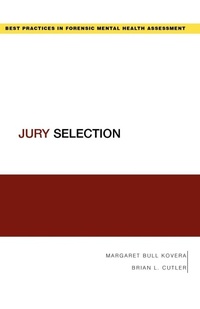
Jury Selection
1st Edition
Published on 29. November 2012
Book
Paperback/Softback
266 pages
978-0-19-532301-6 (ISBN)
Description
Forensic mental health assessment (FMHA) has grown into a specialization informed by research and professional guidelines. This series presents up-to-date information on the most important and frequently conducted forms of FMHA. The 19 topical volumes address best approaches to practice for particular types of evaluation in the criminal, civil and juvenile/family areas. Each volume contains a thorough discussion of the relevant legal and psychological concepts, followed by a step-by-step description of the assessment process from preparing for the evaluation to writing the report and testifying in court.
Volumes include the following helpful features:
- Boxes that zero in on important information for use in evaluations
- Tips for best practice and cautions against common pitfalls
- Highlighting of relevant case law and statutes
- Separate list of assessment tools for easy reference
- Helpful glossary of key terms for the particular topic
In making recommendations for best practice, authors consider empirical support, legal relevance, and consistency with ethical and professional standards. These volumes offer invaluable guidance for anyone involved in conducting or using forensic evaluations.
Jury selection is the process by which attorneys remove people from the jury pool whom they judge to be undesirable, presumably because they fear that the potential juror would be biased against their side. In Jury Selection, Kovera and Cutler review the law governing attorneys' decisions to remove potential jurors from jury service, including laws prohibiting the systematic removal of particular categories of people from the jury. The book provides an overview of standardized tools for assessing personality traits and attitudes that may be related to jurors' verdicts as well as the research establishing the validity of these measures. The authors review the studies that evaluate the effectiveness of both traditional and scientific methods of jury selection, including the methods used to conduct a community survey to guide a change of venue motion and the selection of potential jurors to excuse. Kovera and Cutler also discuss the ethical principles to be followed when assisting attorneys with jury selection issues.
Volumes include the following helpful features:
- Boxes that zero in on important information for use in evaluations
- Tips for best practice and cautions against common pitfalls
- Highlighting of relevant case law and statutes
- Separate list of assessment tools for easy reference
- Helpful glossary of key terms for the particular topic
In making recommendations for best practice, authors consider empirical support, legal relevance, and consistency with ethical and professional standards. These volumes offer invaluable guidance for anyone involved in conducting or using forensic evaluations.
Jury selection is the process by which attorneys remove people from the jury pool whom they judge to be undesirable, presumably because they fear that the potential juror would be biased against their side. In Jury Selection, Kovera and Cutler review the law governing attorneys' decisions to remove potential jurors from jury service, including laws prohibiting the systematic removal of particular categories of people from the jury. The book provides an overview of standardized tools for assessing personality traits and attitudes that may be related to jurors' verdicts as well as the research establishing the validity of these measures. The authors review the studies that evaluate the effectiveness of both traditional and scientific methods of jury selection, including the methods used to conduct a community survey to guide a change of venue motion and the selection of potential jurors to excuse. Kovera and Cutler also discuss the ethical principles to be followed when assisting attorneys with jury selection issues.
More details
Series
Language
English
Place of publication
New York
United States
Target group
Professional and scholarly
Psychologists, attorneys, trial consultants, and students of forensic psychology
Dimensions
Height: 216 mm
Width: 140 mm
Thickness: 14 mm
Weight
339 gr
ISBN-13
978-0-19-532301-6 (9780195323016)
Copyright in bibliographic data and cover images is held by Nielsen Book Services Limited or by the publishers or by their respective licensors: all rights reserved.
Schweitzer Classification
Other editions
Additional editions
Brian L. Cutler Margaret Bull Kovera
Jury Selection
E-Book
10/2012
1st Edition
Oxford University Press, USA
€65.69
Available for download
Persons
Margaret Kovera is a Professor of Psychology at the John Jay College of Criminal Justice of the City University of New York. She is a Fellow of the Association for Psychological Science, the American Psychological Association, the American Psychology-Law Society (APLS), the Society for Experimental Social Psychology, and the Society for the Psychological Study of Social Issues (SPSSI). She is a Past-President of APLS and regularly serves as a trial consultant and as an expert witness in cases involving eyewitness identification.
Brian L. Cutler is a Professor of Social Science and Humanities at the University of Ontario Institute of Technology. He is a Fellow of the Association for Psychological Science and Distinguished Member of the American Psychology-Law Society. He served as President of APLS and is Past Editor-in-Chief of Law and Human Behavior. He previously served as a trial consultant and continues to serve as an expert witness in cases involving eyewitness identification.
Brian L. Cutler is a Professor of Social Science and Humanities at the University of Ontario Institute of Technology. He is a Fellow of the Association for Psychological Science and Distinguished Member of the American Psychology-Law Society. He served as President of APLS and is Past Editor-in-Chief of Law and Human Behavior. He previously served as a trial consultant and continues to serve as an expert witness in cases involving eyewitness identification.
Content
FOUNDATIONS ; 1. The Legal Context ; 2. Measuring Potential Predictors of Verdict ; 3. Empirical Foundations and Limits ; APPLICATION ; 4. Conducting Community Surveys ; 5. Report Writing ; 6. Consultation During Voir Dire ; Appendix A Sample Jury Selection Survey ; Appendix B Sample Jury Selection Report ; Appendix C Phone Survey to Support Change of Venue Motion and Jury Selection ; Appendix D Report Supporting a Change of Venue Motion ; Appendix E Memo Reporting Results of Jury Selection Analysis Based on Change of Venue Survey ; References ; Tests and Specialized Tools ; Cases and Statutes ; Key Terms ; Index ; About the Authors