

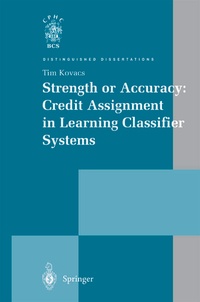
Strength or Accuracy: Credit Assignment in Learning Classifier Systems
Published on 4. October 2012
Book
Paperback/Softback
XVI, 307 pages
978-1-4471-1058-3 (ISBN)
Description
Classifier systems are an intriguing approach to a broad range of machine learning problems, based on automated generation and evaluation of condi tion/action rules. Inreinforcement learning tasks they simultaneously address the two major problems of learning a policy and generalising over it (and re lated objects, such as value functions). Despite over 20 years of research, however, classifier systems have met with mixed success, for reasons which were often unclear. Finally, in 1995 Stewart Wilson claimed a long-awaited breakthrough with his XCS system, which differs from earlier classifier sys tems in a number of respects, the most significant of which is the way in which it calculates the value of rules for use by the rule generation system. Specifically, XCS (like most classifiersystems) employs a genetic algorithm for rule generation, and the way in whichit calculates rule fitness differsfrom earlier systems. Wilson described XCS as an accuracy-based classifiersystem and earlier systems as strength-based. The two differin that in strength-based systems the fitness of a rule is proportional to the return (reward/payoff) it receives, whereas in XCS it is a function of the accuracy with which return is predicted. The difference is thus one of credit assignment, that is, of how a rule's contribution to the system's performance is estimated. XCS is a Q learning system; in fact, it is a proper generalisation of tabular Q-learning, in which rules aggregate states and actions. In XCS, as in other Q-learners, Q-valuesare used to weightaction selection.
Reviews / Votes
From the reviews:
"This book is a monograph on learning classifier systems . . The main objective of the book is to compare strength-based classifier systems with accuracy-based systems. . The book is equipped with nine appendices. . The biggest advantage of the book is its readability. The book is well written and is illustrated with many convincing examples." (Jerzy W. Grzymal-Busse, Mathematical Reviews, Issue 2005 k)
More details
Series
Edition
Softcover reprint of the original 1st ed. 2004
Language
English
Place of publication
London
United Kingdom
Target group
Professional and scholarly
Research
Illustrations
XVI, 307 p.
Dimensions
Height: 235 mm
Width: 155 mm
Thickness: 18 mm
Weight
499 gr
ISBN-13
978-1-4471-1058-3 (9781447110583)
DOI
10.1007/978-0-85729-416-6
Schweitzer Classification
Other editions
Additional editions
Book
01/2004
Springer
€160.49
Shipment within 15-20 days
Content
Introduction.- Learning Classifier Systems.- How Strength and Accuracy Differ.- What Should a Classifier System Learn?- Prospects for Adaption.- Classifier Systems and Q-Learning.- Conclusion.- Appendices.- Evaluation of Macroclassifiers.- Example XCS Cycle.- Learning from Reinforcement.- Generalisation Problems.- Value Estimation Algorithms.- Generalised Policy Iteration Algorithms.- Evolutionary Algorithms.- The Origins of Sarsa.- Notation.- References.