

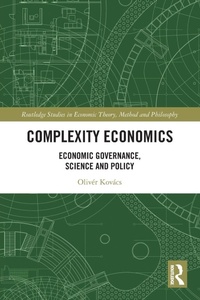
Complexity Economics
Economic Governance, Science and Policy
1st Edition
Published on 29. January 2024
Book
Paperback/Softback
362 pages
978-1-032-26456-1 (ISBN)
Description
Our socio-economic innovation ecosystem is riddled with ever-increasing complexity, as we are faced with more frequent and intense shocks, such as COVID-19. Unfortunately, addressing complexity requires a different kind of economic governance. There is increasing pressure on economics to not only going beyond its traditional mainstream boundaries but also to tackle real-world problems, such as fostering structural change, enhancing sustained growth, promoting inclusive development in the era of the digital economy, and boosting green growth, while addressing the divide between the financial sector and the real economy.
This book demonstrates how to apply complexity science to economics in an effective and instructive way, in the interest of life-enhancing policies. The book revolves around the non-negligible problem of why economics, to date, seems to be inadequate in guiding economic governance to navigate through real and ever-intensifying complex socio-economic and environmental challenges. With its interdisciplinary approach, the book scans the nuanced nexus between complexity and economics by incorporating, as well as transcending, the state-of-the-art literature. It identifies ways to trigger opportunities for behavioural change in the economic profession with respect to how and what to teach, introducing and developing further complexity economics taking into account the configuration of its main principles and outlining the silhouette of next-generation economic governance.
The book deciphers recommendations for economic theory, practice, education and economic governance. It will be of interest to students, scholars, academics, think-tank researchers and economic policy practitioners at the national and/or supranational levels.
This book demonstrates how to apply complexity science to economics in an effective and instructive way, in the interest of life-enhancing policies. The book revolves around the non-negligible problem of why economics, to date, seems to be inadequate in guiding economic governance to navigate through real and ever-intensifying complex socio-economic and environmental challenges. With its interdisciplinary approach, the book scans the nuanced nexus between complexity and economics by incorporating, as well as transcending, the state-of-the-art literature. It identifies ways to trigger opportunities for behavioural change in the economic profession with respect to how and what to teach, introducing and developing further complexity economics taking into account the configuration of its main principles and outlining the silhouette of next-generation economic governance.
The book deciphers recommendations for economic theory, practice, education and economic governance. It will be of interest to students, scholars, academics, think-tank researchers and economic policy practitioners at the national and/or supranational levels.
More details
Series
Language
English
Place of publication
London
United Kingdom
Publishing group
Taylor & Francis Ltd
Target group
College/higher education
Postgraduate
Illustrations
81 s/w Zeichnungen, 1 s/w Tabelle, 81 s/w Abbildungen
1 Tables, black and white; 81 Line drawings, black and white; 81 Illustrations, black and white
Dimensions
Height: 234 mm
Width: 156 mm
Thickness: 20 mm
Weight
570 gr
ISBN-13
978-1-032-26456-1 (9781032264561)
Copyright in bibliographic data and cover images is held by Nielsen Book Services Limited or by the publishers or by their respective licensors: all rights reserved.
Schweitzer Classification
Other editions
Additional editions
E-Book
07/2022
1st Edition
Routledge
€59.49
Available for download
E-Book
07/2022
1st Edition
Routledge
€59.49
Available for download
Book
07/2022
1st Edition
Routledge
€263.00
Shipment within 10-20 days
Person
Oliver Kovacs is a senior research fellow in the Department of Economics and International Economics at the University of Public Service, Budapest, Hungary.
Content
Introduction 1 Complacency Economics: Tectonic Fault Lines 2 Complexonomics - Towards a New Paradigm 3 Contingency Economic Governance Powered by Complexonomics 4 Illustrative Application of Complex Missions 5 Conclusion