

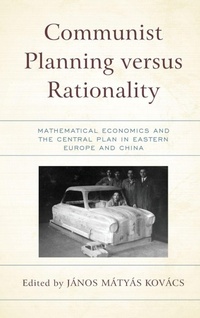
Communist Planning versus Rationality
Mathematical Economics and the Central Plan in Eastern Europe and China
Published on 14. April 2022
Book
Hardback
424 pages
978-1-7936-3177-0 (ISBN)
Description
This volume examines concepts of central planning, a cornerstone of political economy in Soviet-type societies. It revolves around the theory of "optimal planning" which promised a profound modernization of Stalinist-style verbal planning. Encouraged by cybernetic dreams in the 1950s and supporting the strategic goals of communist leaders in the Cold War, optimal planners offered the ruling elites a panacea for the recurrent crises of the planned economy. Simultaneously, their planning projects conveyed the pride of rational management and scientific superiority over the West. The authors trace the rise and fall of the research program in the communist era in eight countries of Eastern Europe, including the Soviet Union, and China, describing why the mission of optimization was doomed to fail and why the failure was nevertheless very slow. The theorists of optimal planning contributed to the rehabilitation of mathematical culture in economic research in the communist countries, and thus, to a neoclassical turn in economics all over the ex-communist world). However, because they have not rejected optimal planning as "computopia," there is a large space left behind for future generations to experiment with Big Optimal Plans anew-based, at this time, on artificial intelligence and machine learning.
Reviews / Votes
To what extent did theories of optimality and techniques for optimization improve economic allocation under Communist rule? The basic ideas turned out to have little practical application-under Communism, at least. Yet, at the time, the idea of an optimally planned Socialist economy attracted huge attention and intellectual efforts from East Germany and other Central and Eastern European countries to Russia and China. What was it all about? This excellent collection provides many fascinating insights from a nearly forgotten chapter in the economic thought and history of eight Communist countries. There are important lessons for public policy everywhere. -- Mark Harrison, professor emeritus, University of Warwick Central planning was a defining quality of state socialism, yet we know little about how it actually worked (or did not). Communist Planning versus Rationality is thus a much-desired addition to the comparative history of state socialism, presenting richly researched case studies about grand plans that suffered from their disconnect from reality. This makes this intriguing book a very timely warning about the costs of pursuing imagined truths while academic freedom and intellectual curiosity are curtailed. -- Ulf Brunnbauer, Leibniz Institute for East and Southeast European Studies Can mathematics make economic planning more rational; can it save planning from its previous failures? The contributors to Janos Matyas Kovacs's volume-each eminently qualified-explore this question by taking deep dives into former Communist countries that attempted to plan their economies centrally and comprehensively. The lesson that emerges is clear: the problem with planning is not something that mathematics and econometrics can rehabilitate. The problem is one of knowledge that cannot, in principle, be formalized and distributed through some sort of comprehensive plan. Rationality-as-optimality is an illusion. Both critics and contemporary proponents of optimal planning should read this important book. -- David L. Prychitko, Northern Michigan University This book is a genuine contribution to the history of economic thought, where the global context, the interactions between institutional and theoretical developments on both sides of the Cold War are investigated. After a stimulating volume following a similar comparative approach on the concept of ownership, this important collective book extends the historical research on the great questions of economic planning which were so significant and controversial in the twentieth century. They completely receded but may well come back under different ways and objectives in our current capitalist era. -- Bernard Chavance, emeritus professor, University of Paris Diderot This is a book with many virtues. The analytical framework articulated by Kovacs compellingly amalgamates insights from various scholarly literatures that touch upon the question of economic planning, including the history of economic ideas, general studies of Soviet-type economies, and in-depth explorations of the various practices and methods deployed in the process of planning in the former 'second world.; The case studies carry a distinct local flavor, but also cohere remarkably well into a volume that never loses its narrative focus. There is a big picture that comes out of the volume?-the ongoing efforts to optimize the process of central planning ultimately failed. But the book is also rich in fascinating details about the intellectual debates that enlivened the community of professional economists in Eastern Europe during the second half of the last century, the evolution of the various research and political institutions that constituted the natural habitat of this community, and the tensions that inevitably marked its relationship with the leadership of the ruling communist parties. This edited collection will undoubtedly become the point of departure for any future conversation about the idea of central planning and the array of problems which efforts to implement this idea in practice are destined to encounter -- Venelin I. Ganev, Miami University of OhioMore details
Series
Language
English
Place of publication
United States
Publishing group
Bloomsbury Publishing Plc
Target group
Professional and scholarly
Illustrations
3 b/w illustrations; 3 tables;
Dimensions
Height: 235 mm
Width: 157 mm
Thickness: 29 mm
Weight
839 gr
ISBN-13
978-1-7936-3177-0 (9781793631770)
Copyright in bibliographic data and cover images is held by Nielsen Book Services Limited or by the publishers or by their respective licensors: all rights reserved.
Schweitzer Classification
Other editions
Additional editions
Communist Planning versus Rationality
Mathematical Economics and the Central Plan in Eastern Europe and China
E-Book
04/2022
1st Edition
Lexington Books
€111.99
Available for download
Janos Matyas Kovacs
Communist Planning versus Rationality
Mathematical Economics and the Central Plan in Eastern Europe and China
E-Book
04/2022
1st Edition
Lexington Books
€111.99
Available for download
Persons
Janos Matyas Kovacs is honorary professor at Eoetvoes Lorand University, senior member at Research Center for the History of Transformations (RECET) at University of Vienna, permanent fellow emeritus at Institute for Human Sciences, and visiting professor at Central European University.
Content
Introduction: Another "Grand Illusion" - Optimizing the Central Plan
Chapter One: To Command or to Understand? Planning Concepts and Economic Research in Communist Bulgaria
Chapter Two: Quantitative Economics in China. From Planned Economy to Socialist Market Economy
Chapter Three: Mathematical Economics and Central Planning. Economic Research in Czechoslovakia under Communism
Chapter Four: Theory and Political Economy of Central Planning in East Germany
Chapter Five: Mathematical Economics outside the Neoclassical Paradigm? Evolution of Planning Concepts in Hungary under Communism
Chapter 6: Between Rationality and Reality. Economics and Central Planning in Poland (1945-1989)
Chapter Seven: The Failure of Communist Planning: A Perspective from Romania
Chapter Eight: Communism = Soviet Power + Planning. Planning and Mathematical Economics in the Soviet Union
Chapter Nine: Mathematical Economics, Economic Modeling, and Planning in Yugoslavia
Conclusion: Rationality Found and Lost? In Search of a New
Chapter One: To Command or to Understand? Planning Concepts and Economic Research in Communist Bulgaria
Chapter Two: Quantitative Economics in China. From Planned Economy to Socialist Market Economy
Chapter Three: Mathematical Economics and Central Planning. Economic Research in Czechoslovakia under Communism
Chapter Four: Theory and Political Economy of Central Planning in East Germany
Chapter Five: Mathematical Economics outside the Neoclassical Paradigm? Evolution of Planning Concepts in Hungary under Communism
Chapter 6: Between Rationality and Reality. Economics and Central Planning in Poland (1945-1989)
Chapter Seven: The Failure of Communist Planning: A Perspective from Romania
Chapter Eight: Communism = Soviet Power + Planning. Planning and Mathematical Economics in the Soviet Union
Chapter Nine: Mathematical Economics, Economic Modeling, and Planning in Yugoslavia
Conclusion: Rationality Found and Lost? In Search of a New