

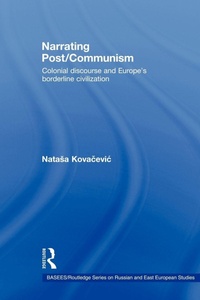
Narrating Post/Communism
Colonial Discourse and Europe's Borderline Civilization
1st Edition
Published on 12. May 2009
Book
Paperback/Softback
224 pages
978-0-415-54642-3 (ISBN)
Description
The transition of communist Eastern Europe to capitalist democracy post-1989 and in the aftermath of the Yugoslav wars has focused much scholarly attention - in history, political science and literature - on the fostering of new identities across Eastern European countries in the absence of the old communist social and ideological frameworks. This book examines an important, but hitherto largely neglected, part of this story: the ways in which the West has defined its own identity and ideals via the demonization of communist regimes and Eastern European cultures as a totalitarian, barbarian and Orientalist "other". It describes how old Orientalist prejudices resurfaced during the Cold War period, and argues that the establishment of this discourse helped to justify transitions of Eastern European societies to market capitalism and liberal democracy, suppressing Eastern Europe's communist histories and legacies, whilst perpetuating its dependence on the West as a source of its own sense of identity. It argues that this process of Orientalization was reinforced by the literary narratives of Eastern European and Russian anti-communist dissidents and exiles, including Vladimir Nabokov, Czeslaw Milosz and Milan Kundera, in their attempts to present themselves as native, Eastern European experts and also emancipate themselves - and their homelands - as civilized, enlightened and Westernized. It goes on to suggest that the greatest potential for recognizing and overcoming this self-Orientalization lies in post-communist literary and visual narratives, with their themes of disappointment in the social, economic, or political changes brought on by the transitions, challenge of the unequal discursive power in East-West dialogues where the East is positioned as a disciple or a mimic of the West, and the various guises of nostalgia for communism.
More details
Series
Language
English
Place of publication
London
United Kingdom
Publishing group
Taylor & Francis Ltd
Target group
College/higher education
Dimensions
Height: 234 mm
Width: 156 mm
Thickness: 13 mm
Weight
365 gr
ISBN-13
978-0-415-54642-3 (9780415546423)
Copyright in bibliographic data and cover images is held by Nielsen Book Services Limited or by the publishers or by their respective licensors: all rights reserved.
Schweitzer Classification
Other editions
Additional editions
Book
05/2008
1st Edition
Routledge
€231.60
Shipment within 15-20 days
E-Book
05/2008
Routledge
€77.99
Available for download
E-Book
05/2008
Routledge
€77.99
Available for download
Person
Natasa Kovacevic is assistant professor in Global Literature and Postcolonial Theory at Eastern Michigan University. She has published research on linguistic imperialism, Eastern European dissident authors, colonial discourses on the Balkans, and English modernism. Her work engages with transforming postcolonial studies in the postcommunist era.
Content
1. Introduction 2. 'Doubly Obscure' Dissident Narrative: Vladimir Nabokov's Pale Fire 3. Shifting Topographies of Eastern/Central/Europe in Joseph Brodsky's and Czeslaw Milosz's Prose Writing 4. Deviant Stepchild of European History: Communist Eastern Europe in Milan Kundera and Guenter Grass 5. Primitive Accumulation and Neanderthal Liberalism: Victor Pelevin, Gary Shteyngart and Criminal Eastern Europe 6. Ethnicizing Guilt: Humanitarian Imperialism and the Case of (for) Yugoslavia 7. Conclusion 8. Bibliography