

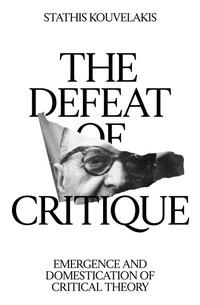
The Defeat of Critique
Emergence and Domestication of Critical Theory
Will be published approx. on 7. July 2026
Book
Paperback/Softback
304 pages
978-1-80429-529-8 (ISBN)
Description
This book brings a new perspective on the formation and evolution of Critical Theory, tracing the intellectual trajectory of three of its major representatives: Horkheimer, Habermas and Honneth. It demonstrates how a theoretical project that started as a radical rethinking of Marxism, responding to the defeat of the Left in the face of Nazism, disintegrated from within and lost its initial radical potential.
Faced with the isolation of exile and the failure of the anti-fascist fronts, Horkheimer broke with his founding project and turned towards a negative philosophy of history. The coming of the next generations of the Frankfurt School allowed for a renewal of the theoretical ambition but at a high price: critique had to adapt to the order of post-war West Germany. With Habermas, critique aims to expand a public space, ignoring the contradictions of social relations; with Honneth, it becomes a therapy of the social, aiming at repairing a world instead of transforming it. From one generation to the next, Critical Theory has turned its back on the analysis of the regressive potential inherent in capitalist modernity. But its initial project has still significant resources to offer for an understanding of the present and for the emancipatory struggles of our time. To recapture its revolutionary potential, critical theory needs to return to its initial project and cross-fertilize it with other currents within Marxism and radical thought.
Faced with the isolation of exile and the failure of the anti-fascist fronts, Horkheimer broke with his founding project and turned towards a negative philosophy of history. The coming of the next generations of the Frankfurt School allowed for a renewal of the theoretical ambition but at a high price: critique had to adapt to the order of post-war West Germany. With Habermas, critique aims to expand a public space, ignoring the contradictions of social relations; with Honneth, it becomes a therapy of the social, aiming at repairing a world instead of transforming it. From one generation to the next, Critical Theory has turned its back on the analysis of the regressive potential inherent in capitalist modernity. But its initial project has still significant resources to offer for an understanding of the present and for the emancipatory struggles of our time. To recapture its revolutionary potential, critical theory needs to return to its initial project and cross-fertilize it with other currents within Marxism and radical thought.
Reviews / Votes
Stathis Kouvelakis's book is a highly successful example of a Marxist history of philosophy, focusing not only on the socio-economic determinants of thought but also on the political issues it raises. -- Guillaume Fondu * Le Monde diplomatique * Axel Honneth, a representative of the 'third generation' of Critical Theory, recently asked: 'What do those who still speak of revolution have in mind? Stathis Kouvelakis intends to respond to this question by reconstructing the trajectory of the Frankfurt School, in an effort to reconnect with the revolutionary ambition that originally inspired this theoretical project. -- Mathurin Schweyer * La vie des idees * Stathis Kouvelakis has just written a book that should be of interest to all fighting for emancipation. -- Pascale Fautrier * L'Humanite *More details
Language
English
Place of publication
London
United Kingdom
Dimensions
Height: 234 mm
Width: 153 mm
Weight
367 gr
ISBN-13
978-1-80429-529-8 (9781804295298)
Copyright in bibliographic data and cover images is held by Nielsen Book Services Limited or by the publishers or by their respective licensors: all rights reserved.
Schweitzer Classification
Person
Stathis Kouvelakis taught political theory at King's College London from 2002 to 2020. He's now an independent researcher based in Paris. A lifelong militant of the radical left in France and Greece, he is member of the editorial board of the French on-line Marxist journal Contretemps. His previous publications include of Philosophy and Revolution. From Kant to Marx and Lenin Reloaded: Toward a Politics of Truth (co-edited with Sebastian Budgen and Slavoj Zizek).