

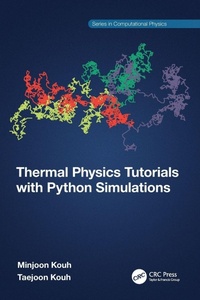
Thermal Physics Tutorials with Python Simulations
1st Edition
Published on 19. December 2024
Book
Paperback/Softback
224 pages
978-1-032-26343-4 (ISBN)
Description
This book provides an accessible introduction to thermal physics with computational approaches that complement the traditional mathematical treatments of classical thermodynamics and statistical mechanics. It guides readers through visualizations and simulations in the Python programming language, helping them to develop their own technical computing skills (including numerical and symbolic calculations, optimizations, recursive operations, and visualizations). Python is a highly readable and practical programming language, making this book appropriate for students without extensive programming experience.
This book may serve as a thermal physics textbook for a semester-long undergraduate thermal physics course or may be used as a tutorial on scientific computing with focused examples from thermal physics. This book will also appeal to engineering students studying intermediate-level thermodynamics as well as computer science students looking to understand how to apply their computer programming skills to science.
Key features
Major concepts in thermal physics are introduced cohesively through computational and mathematical treatments.
Computational examples in Python programming language guide students on how to simulate and visualize thermodynamic principles and processes for themselves.
This book may serve as a thermal physics textbook for a semester-long undergraduate thermal physics course or may be used as a tutorial on scientific computing with focused examples from thermal physics. This book will also appeal to engineering students studying intermediate-level thermodynamics as well as computer science students looking to understand how to apply their computer programming skills to science.
Key features
Major concepts in thermal physics are introduced cohesively through computational and mathematical treatments.
Computational examples in Python programming language guide students on how to simulate and visualize thermodynamic principles and processes for themselves.
More details
Series
Language
English
Place of publication
London
United Kingdom
Publishing group
Taylor & Francis Ltd
Target group
College/higher education
Professional and scholarly
Academic, Postgraduate, Undergraduate Advanced, and Undergraduate Core
Illustrations
70 s/w Abbildungen, 6 s/w Photographien bzw. Rasterbilder, 64 s/w Zeichnungen
64 Line drawings, black and white; 6 Halftones, black and white; 70 Illustrations, black and white
Dimensions
Height: 234 mm
Width: 156 mm
Thickness: 13 mm
Weight
368 gr
ISBN-13
978-1-032-26343-4 (9781032263434)
Copyright in bibliographic data and cover images is held by Nielsen Book Services Limited or by the publishers or by their respective licensors: all rights reserved.
Schweitzer Classification
Other editions
Additional editions
Minjoon Kouh | Taejoon Kouh
Thermal Physics Tutorials with Python Simulations
E-Book
03/2023
1st Edition
CRC Press
€64.49
Available for download
Minjoon Kouh | Taejoon Kouh
Thermal Physics Tutorials with Python Simulations
Book
03/2023
1st Edition
CRC Press
€116.20
Shipment within 10-20 days
Minjoon Kouh | Taejoon Kouh
Thermal Physics Tutorials with Python Simulations
E-Book
03/2023
1st Edition
CRC Press
€64.49
Available for download
Persons
Taejoon Kouh is a Professor of Nano and Electronic Physics at Kookmin University, Republic of Korea.
Minjoon Kouh is a Professor of Physics and Neuroscience at Drew University, USA.
Minjoon Kouh is a Professor of Physics and Neuroscience at Drew University, USA.
Content
Chapter 1. Calculating ?. Chapter 2. Kinetic Theory of Gas. Chapter 3. Velocity Distribution. Chapter 4. Thermal Processes. Chapter 5. Premise of Statistical Mechanics. Chapter 6. Revisiting Ideal Gas. Chapter 7. Revisiting Thermal Processes. Chapter 8. Entropy, Temperature, Energy, and Other Potentials. Chapter 9. Two-State System. Chapter 10. Specific Heat. Chapter 11. Random and Guided Walks. Appendix. Epilogue.