

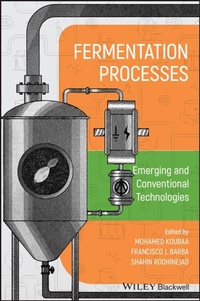
New Challenges and Opportunities in Fermentation Processes
Application of Conventional and Emerging Technologies
1st Edition
Published on 25. February 2021
Book
Hardback
324 pages
978-1-119-50585-3 (ISBN)
Description
Fermentation Processes: Emerging and Conventional Technologies is focused on enhancing fermentation processes under conventional and non conventional conditions.
The application of emerging technologies (e.g. ultrasounds, pulsed electric fields, microwaves, etc.) to increase the accessibility and bioavailability of the substrates by microorganisms during fermentation has been demonstrated
through numerous research works. These technologies have the advantages over conventional ones (e.g. grinding) of consuming less energy, reducing the processing time, along with using less and "green" solvents. Increasing the
accessibility of the substrates has as a consequence an improved availability for the microorganisms and therefore enhanced productivity. The application of these non-conventional (emerging) technologies could be at sub-lethal levels before (inoculum) or during the fermentation process, also called as microbial stimulation, which increases the assimilation of substrates, release of enzymes in the medium for substrate hydrolysis, and other benefits. All
together, lead to promote the microbial growth, and enhance the fermentation process. In addition to the application of emerging technologies, enhancing fermentation at conventional conditions by changing the medium composition, processing parameters, etc. are also discussed.
More details
Other editions
Additional editions
Mohamed Koubaa | Francisco J. Barba | Shahin Roohinejad
Fermentation Processes: Emerging and Conventional Technologies
E-Book
02/2021
1st Edition
Wiley-ISTE
€182.99
Available for download
Mohamed Koubaa | Francisco J. Barba | Shahin Roohinejad
Fermentation Processes: Emerging and Conventional Technologies
E-Book
02/2021
1st Edition
Wiley-ISTE
€182.99
Available for download
Persons
Dr Mohamed Koubaa, Assistant Professor, Ecole Supérieure de Chimie Organique et Minérale, Compiègne, France. His research focus is on non-conventional processing (use of pulsed electric fields, ultrasounds, microwaves, etc) for the extraction of bioactive compounds and enhancing fermentation processes.
Dr Francisco J. Barba, Assistant Professor, University of Valencia, Spain. His research focus is on non-thermal processing for preservation and/or extraction of bioactive compounds from liquid and solid foods.
Dr Shahin Roohinejad, Alexander von Humboldt Foundation Postdoctoral Research Fellow, Max Rubner-Institut, Karlsruhe, Germany. In the last 10 years he has worked on different food areas such as emulsion-based systems, emerging food processing, nanotechnology, and functional foods.
Content
Introduction
Chapter 1: Conventional fermentation
1.1. Introduction
1.2. Cell division and growth kinetic
1.3. Performance of a fermentation process
1.4. Parameters and modes of fermentation
1.5. Technologies of fermentation
1.6. Conclusion
Chapter 2: Current developments in industrial fermentation processes
2.1. Introduction
2.2. Main achievements in industrial fermentation
2.3. Current development in industrial fermentation
2.4. Conclusion
Chapter 3: Culture condition changes for enhancing fermentation processes
3.1. Introduction
3.2. Culture media used for fermentation
3.3. Impact of culture conditions on fermentation processes
3.4. Conclusion
Chapter 4: Emerging technologies and their mechanisms of action
4.1. Introduction
4.2. Pulsed electric fields
4.3. Ultrasound
4.4. High-hydrostatic pressure
4.5. Microwave irradiation
4.6. Conclusion
Chapter 5: Biomass fractionation using emerging technologies
5.1. Introduction
5.2. Ultrasound application for biomass fractionation
5.3. Microwave irradiation for biomass fractionation
5.4. Conclusion
Chapter 6: Enhancing microbial growth using emerging technologies
6.1. Introduction
6.2. Microbial stimulation using pulsed electric fields
6.3. Microbial stimulation using ultrasounds
6.4. Microbial stimulation using high-hydrostatic pressure
6.5. Conclusion
Concluding remarks and future directions