

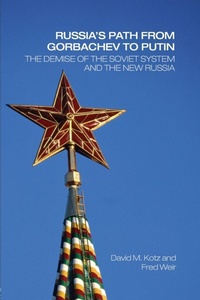
Russia's Path from Gorbachev to Putin
The Demise of the Soviet System and the New Russia
1st Edition
Published on 15. February 2007
Book
Paperback/Softback
400 pages
978-0-415-70147-1 (ISBN)
Description
Over the past few years, many of the former Communist-rule countries of Central and Eastern Europe have taken a steady path toward becoming more or less normal capitalist countries - with Poland and Hungary cases in point.
Russia, on the other hand, has experienced extreme difficulties in its attempted transition to capitalism and democracy. The pursuit of Western-endorsed policies of privatization, liberalization and fiscal austerity have brought Russia growing crime and corruption, a distorted economy and a trend toward authoritarian government.
In their 1996 book - Revolution from Above - David Kotz and Fred Weir shed light on the underlying reasons for the 1991 demise of the Soviet Union and the severe economic and political problems of the immediate post-Soviet period in Russia.
In this new book, the authors bring the story up-to-date, showing how continuing misguided policies have entrenched a group of super-rich oligarchs, in alliance with an all-powerful presidency, while further undermining Russia's economic potential. New topics include the origins of the oligarchs, the deep penetration of crime and corruption in Russian society, the financial crisis that almost destroyed the regime, the mixed blessing of an oil-dependent economy, the atrophy of democracy in the Yeltsin years, and the recentralization of political power in the Kremlin under President Putin.
Russia, on the other hand, has experienced extreme difficulties in its attempted transition to capitalism and democracy. The pursuit of Western-endorsed policies of privatization, liberalization and fiscal austerity have brought Russia growing crime and corruption, a distorted economy and a trend toward authoritarian government.
In their 1996 book - Revolution from Above - David Kotz and Fred Weir shed light on the underlying reasons for the 1991 demise of the Soviet Union and the severe economic and political problems of the immediate post-Soviet period in Russia.
In this new book, the authors bring the story up-to-date, showing how continuing misguided policies have entrenched a group of super-rich oligarchs, in alliance with an all-powerful presidency, while further undermining Russia's economic potential. New topics include the origins of the oligarchs, the deep penetration of crime and corruption in Russian society, the financial crisis that almost destroyed the regime, the mixed blessing of an oil-dependent economy, the atrophy of democracy in the Yeltsin years, and the recentralization of political power in the Kremlin under President Putin.
More details
Language
English
Place of publication
London
United Kingdom
Publishing group
Taylor & Francis Ltd
Target group
College/higher education
Illustrations
26 s/w Zeichnungen, 7 s/w Tabellen, 26 s/w Abbildungen
7 Tables, black and white; 26 Line drawings, black and white; 26 Illustrations, black and white
Dimensions
Height: 234 mm
Width: 156 mm
Thickness: 22 mm
Weight
608 gr
ISBN-13
978-0-415-70147-1 (9780415701471)
Copyright in bibliographic data and cover images is held by Nielsen Book Services Limited or by the publishers or by their respective licensors: all rights reserved.
Schweitzer Classification
Other editions
Additional editions
David Kotz | Fred Weir
Russia's Path from Gorbachev to Putin
The Demise of the Soviet System and the New Russia
E-Book
05/2007
1st Edition
Routledge
€89.99
Available for download
David Kotz | Fred Weir
Russia's Path from Gorbachev to Putin
The Demise of the Soviet System and the New Russia
E-Book
05/2007
1st Edition
Routledge
€89.99
Available for download
David Kotz | Fred Weir
Russia's Path from Gorbachev to Putin
The Demise of the Soviet System and the New Russia
Book
02/2007
1st Edition
Routledge
€263.20
Shipment within 15-20 days
Persons
Content
1. Introduction Part 1: The Soviet System 2. Socialism and the Soviet System 3. Growth, Stagnation, and the Origins of Perestroika Part 2: Perestroika and the Demise of the Soviet System 4. Glasnost and the Intelligentsia 5. Economic Reform 6. Democratization 7. The Party-state Elite and the Pro-capitalist Coalition 8. The Struggle for Power Part 3: The Socioeconomic and Political Evolution of Post-Soviet Russia 9. The Neoliberal Transition Strategy 10. The Emergence of a Quasi-capitalist System in Russia 11. A New Authoritarian Political System 12. Lessons from the Demise of the Soviet System