

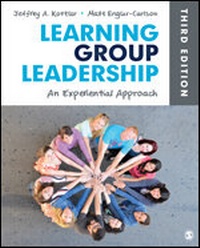
Learning Group Leadership
An Experiential Approach
3rd Edition
Published on 19. August 2015
Book
Paperback/Softback
568 pages
978-1-4522-5668-9 (ISBN)
Description
Focusing on how to conduct and lead groups in a variety of therapeutic settings, Learning Group Leadership: An Experiential Approach, Third Edition covers theory, process, leadership, techniques, ethics, special populations, and challenges as they relate to group work in a positive, realistic, and knowledgeable way. The authors introduce important conceptual and practical information and then use activities, exercises, field study assignments, and personal application questions to help students apply concepts to their work and lives. The fully updated Third Edition brings concepts to life through "student voices" in every chapter, examples drawn from the authors' over 25 years of experience, and demonstration video content that contains scripted sessions corresponding with every chapter.
Reviews / Votes
"This is the best book out there for introducing students to the complex world of groups. The text delivers what it promises in the title. It teaches counseling graduate students how to become solid group leaders (or-to be more precise-how to begin their journey in that direction), and it does this in a way that is positive, knowledgeable, and realistic....The most impressive aspect of the material is the authors' focus on the experiential approach (training students to be group leaders), combined with an accessible writing style, a lot of knowledge, and an enthusiastic attitude." -- Marilyn MacGregor, Western New Mexico UniversityMore details
Edition
3rd Revised edition
Language
English
Place of publication
Thousand Oaks
United States
Target group
Adult education
Professional and scholarly
Edition type
Revised edition
Dimensions
Height: 232 mm
Width: 187 mm
Weight
944 gr
ISBN-13
978-1-4522-5668-9 (9781452256689)
Copyright in bibliographic data and cover images is held by Nielsen Book Services Limited or by the publishers or by their respective licensors: all rights reserved.
Schweitzer Classification
Other editions
Previous edition
Book
02/2009
2nd Edition
SAGE Publications Inc
€126.28
Article exhausted; check for reprint
Persons
Jeffrey A. Kottler is one of the most prolific authors in the fields of counseling, psychotherapy, and education, having written more than 90 books about a wide range of subjects. He has authored a dozen texts for counselors and therapists that are used in universities around the world and a dozen books each for practicing therapists and educators. Some of his most highly regarded works include Creative Breakthroughs in Therapy, The Mummy at the Dining Room Table: Eminent Therapists Reveal Their Most Unusual Cases and What They Teach Us About Human Behavior, Bad Therapy, The Client Who Changed Me, Divine Madness, Change: What Leads to Personal Transformation, Stories We've Heard, Stories We've Told: Life-Changing Narratives in Therapy and Everyday Life, and Therapy Over 50. He has been an educator for 40 years, having worked as a teacher, counselor, and therapist in preschool, middle school, mental health center, crisis center, nongovernmental organization, university, community college, private practice, and disaster relief settings. He has served as a Fulbright scholar and senior lecturer in Peru and Iceland, as well as worked as a visiting professor in New Zealand, Australia, Hong Kong, Singapore, and Nepal. He is professor of counseling at California State University, Fullerton.
Matt Englar-Carlson, PhD, is an associate professor of counseling at California State University, Fullerton. He received a master's degree in health psychology education from Stanford University, a master's degree in counselor education from the Pennsylvania State University, and a doctoral degree in counseling psychology from the Pennsylvania State University. He completed his APA accredited pre-doctoral internship in psychology at the University of Southern California Student Counseling Center. Matt co-edited In the Room with Men: A Casebook of Therapeutic Change (2006) and Counseling Troubled Boys (2008) and is the co-editor of the book series, Theories of Psychotherapy, published by American Psychological Association Books. Matt has taught group counseling and process to hundreds of students across the United States and has facilitated groups in schools, community settings, work sites, and in university settings.
Matt Englar-Carlson, PhD, is an associate professor of counseling at California State University, Fullerton. He received a master's degree in health psychology education from Stanford University, a master's degree in counselor education from the Pennsylvania State University, and a doctoral degree in counseling psychology from the Pennsylvania State University. He completed his APA accredited pre-doctoral internship in psychology at the University of Southern California Student Counseling Center. Matt co-edited In the Room with Men: A Casebook of Therapeutic Change (2006) and Counseling Troubled Boys (2008) and is the co-editor of the book series, Theories of Psychotherapy, published by American Psychological Association Books. Matt has taught group counseling and process to hundreds of students across the United States and has facilitated groups in schools, community settings, work sites, and in university settings.
Content
Part I: Foundations of Group Work
Chapter 1: The World of Groups
Chapter 2: Your Behavior in Groups
Chapter 3: Understanding Group Dynamics and Systems
Chapter 4: Stages of Group Development
Chapter 5: Multicultural Dimensions of Group Work
Chapter 6: Theories of Group Intervention
Part II: Skills of the Group Leader
Chapter 7: Assessment and Group Diagnostics
Chapter 8: Specialized Leadership Skills
Chapter 9: When to Intervene in Groups
Chapter 10: Group Techniques and Structures
Part III: Applications and Significant Issues
Chapter 11: Coleadership
Chapter 12: Critical Incidents
Chapter 13: Ethical Issues Unique to Group Work
Part IV: Advanced Group Structures
Chapter 14: Advanced Group Leadership
Chapter 15: Adjunct Structures to Group Work
Chapter 16: Group Leadership Applied to Social Justice and Social Action
Chapter 17: The End of Our Journey: Where to Go Next?
Chapter 1: The World of Groups
Chapter 2: Your Behavior in Groups
Chapter 3: Understanding Group Dynamics and Systems
Chapter 4: Stages of Group Development
Chapter 5: Multicultural Dimensions of Group Work
Chapter 6: Theories of Group Intervention
Part II: Skills of the Group Leader
Chapter 7: Assessment and Group Diagnostics
Chapter 8: Specialized Leadership Skills
Chapter 9: When to Intervene in Groups
Chapter 10: Group Techniques and Structures
Part III: Applications and Significant Issues
Chapter 11: Coleadership
Chapter 12: Critical Incidents
Chapter 13: Ethical Issues Unique to Group Work
Part IV: Advanced Group Structures
Chapter 14: Advanced Group Leadership
Chapter 15: Adjunct Structures to Group Work
Chapter 16: Group Leadership Applied to Social Justice and Social Action
Chapter 17: The End of Our Journey: Where to Go Next?