

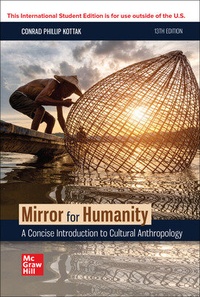
Mirror for Humanity ISE
13th Edition
Will be published approx. on 30. March 2022
Book
Paperback/Softback
432 pages
978-1-265-18313-4 (ISBN)
Description
Mirror for Humanity is a brief introduction to sociocultural anthropology, also covering linguistic and applied anthropology. Its shorter length increases the instructor's options for assigning additional reading-case studies, readers, and other supplements-within a one semester course. Mirror For Humanity can also work well in a quarter system, for which traditional texts may be too long. While presenting cultural anthropology's core concepts and topics, Mirror also aims to demonstrate anthropology's relevance to the 21st-century world we inhabit. The text aims to instill an appreciation of cultural diversity, of cultural anthropology as a field, and of how an anthropological approach can build on, and help make sense of, the experience that students bring to the classroom.
More details
Edition
13th edition
Language
English
Place of publication
OH
United States
Target group
College/higher education
US School Grade: From College Freshman to College Graduate Student
Illustrations
21 Illustrations
ISBN-13
978-1-265-18313-4 (9781265183134)
Copyright in bibliographic data and cover images is held by Nielsen Book Services Limited or by the publishers or by their respective licensors: all rights reserved.
Schweitzer Classification
Person
Conrad Phillip Kottak (A.B. Columbia, 1963; Ph.D. Columbia, 1966) is Professor and Chair of Anthropology at the University of Michigan, where he has taught since 1968. In 1991 he was honored for his teaching by the University and the state of Michigan. In 1992 he received an excellence in teaching award from the College of Literature, Sciences, and the Arts of the University of Michigan. Professor Kottak has done fieldwork in cultural anthropology in Brazil (since 1962), Madagascar (since 1966), and the United States. In current research projects, Kottak and his colleagues have investigated the emergence of ecological awareness in Brazil, the social context of deforestation in Madagascar, and popular participation in economic development planning in northeastern Brazil.
Content
Chapter 1 - What Is Anthropology?
Chapter 2 - Culture
Chapter 3 - Doing Anthropology
Chapter 4 - Language and Communication
Chapter 5 - Making a Living
Chapter 6 - Political Systems
Chapter 7 - Families, Kinship, and Marriage
Chapter 8 - Gender
Chapter 9 - Religion
Chapter 10 - Ethnicity and Race
Chapter 11 - Applying Anthropology
Chapter 12 - The World System, Colonialism, and Inequality
Chapter 13 - Anthropology's Role in a Globalizing World
Glossary
Bibliography
Index
Chapter 2 - Culture
Chapter 3 - Doing Anthropology
Chapter 4 - Language and Communication
Chapter 5 - Making a Living
Chapter 6 - Political Systems
Chapter 7 - Families, Kinship, and Marriage
Chapter 8 - Gender
Chapter 9 - Religion
Chapter 10 - Ethnicity and Race
Chapter 11 - Applying Anthropology
Chapter 12 - The World System, Colonialism, and Inequality
Chapter 13 - Anthropology's Role in a Globalizing World
Glossary
Bibliography
Index