

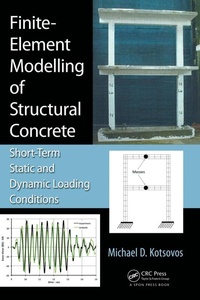
Finite-Element Modelling of Structural Concrete
Short-Term Static and Dynamic Loading Conditions
1st Edition
Published on 20. May 2015
Book
Hardback
382 pages
978-1-4987-1230-9 (ISBN)
Description
A Powerful Tool for the Analysis and Design of Complex Structural Elements
Finite-Element Modelling of Structural Concrete: Short-Term Static and Dynamic Loading Conditions presents a finite-element model of structural concrete under short-term loading, covering the whole range of short-term loading conditions, from static (monotonic and cyclic) to dynamic (seismic and impact) cases. Experimental data on the behavior of concrete at both the material and structural levels reveal the unavoidable development of triaxial stress conditions prior to failure which dictate the collapse and ductility of structural concrete members. Moreover, and in contrast with generally accepted tenets, it can be shown that the post-peak behavior of concrete as a material is realistically described by a complete and immediate loss of load-carrying capacity. Hence rational analysis and design of concrete components in accordance with the currently prevailing limit-state philosophy requires the use of triaxial material data consistent with the notion of a fully brittle material, and this approach is implemented in the book by outlining a finite-element method for the prediction of the strength, deformation, and cracking patterns of arbitrary structural concrete forms.
Presents a Unified Approach to Structural Modeling
Numerous examples are given that show both the unifying generality of this proposed approach and the reliability of the ensuing numerical procedure for which the sole input is the specified uniaxial cylinder compressive strength of concrete and the yield stress of the steel. This not only offers a better understanding of the phenomenology of structural concrete behavior but also illustrates, by means of suitable examples, the type of revision required for improving design methods in terms of both safety and economy.
This book:
Highlights the significance of valid experimental information on the behavior of concrete under triaxial stress conditions for interpreting structural behavior
Describes the techniques used for obtaining valid test data and modeling concrete behavior
Discusses the modeling of steel properties as well as the interaction between concrete and steel
Presents numerical techniques for incorporating the material models into nonlinear finite-element analysis for the case of short-term static loading
Provides numerical techniques adopted for extending the use of the numerical analysis scheme for the solution of dynamic problems
Predicts the response of a wide range of structural-concrete configurations to seismic and impact excitations
Using relevant case studies throughout, Finite-Element Modelling of Structural Concrete: Short-Term Static and Dynamic Loading Conditions focuses on the realistic modeling of structural concrete on the basis of existing and reliable material data and aids in the research and study of structural concrete and concrete materials.
Finite-Element Modelling of Structural Concrete: Short-Term Static and Dynamic Loading Conditions presents a finite-element model of structural concrete under short-term loading, covering the whole range of short-term loading conditions, from static (monotonic and cyclic) to dynamic (seismic and impact) cases. Experimental data on the behavior of concrete at both the material and structural levels reveal the unavoidable development of triaxial stress conditions prior to failure which dictate the collapse and ductility of structural concrete members. Moreover, and in contrast with generally accepted tenets, it can be shown that the post-peak behavior of concrete as a material is realistically described by a complete and immediate loss of load-carrying capacity. Hence rational analysis and design of concrete components in accordance with the currently prevailing limit-state philosophy requires the use of triaxial material data consistent with the notion of a fully brittle material, and this approach is implemented in the book by outlining a finite-element method for the prediction of the strength, deformation, and cracking patterns of arbitrary structural concrete forms.
Presents a Unified Approach to Structural Modeling
Numerous examples are given that show both the unifying generality of this proposed approach and the reliability of the ensuing numerical procedure for which the sole input is the specified uniaxial cylinder compressive strength of concrete and the yield stress of the steel. This not only offers a better understanding of the phenomenology of structural concrete behavior but also illustrates, by means of suitable examples, the type of revision required for improving design methods in terms of both safety and economy.
This book:
Highlights the significance of valid experimental information on the behavior of concrete under triaxial stress conditions for interpreting structural behavior
Describes the techniques used for obtaining valid test data and modeling concrete behavior
Discusses the modeling of steel properties as well as the interaction between concrete and steel
Presents numerical techniques for incorporating the material models into nonlinear finite-element analysis for the case of short-term static loading
Provides numerical techniques adopted for extending the use of the numerical analysis scheme for the solution of dynamic problems
Predicts the response of a wide range of structural-concrete configurations to seismic and impact excitations
Using relevant case studies throughout, Finite-Element Modelling of Structural Concrete: Short-Term Static and Dynamic Loading Conditions focuses on the realistic modeling of structural concrete on the basis of existing and reliable material data and aids in the research and study of structural concrete and concrete materials.
Reviews / Votes
"This book provides a comprehensive and reliable treatment of the finite element analysis of reinforced concrete structures on the basis of well-founded material properties adopted on the basis of experimental results after a critical evaluation by the author according to his personal research. The strictness of the approach regarding the effective triaxial concrete behaviour forms a safe basis for the development of the finite element procedure in analyzing various reinforced concrete structures under static and dynamic loading including the seismic design."Leonidas Stavridis, National Technical University of Athens "This book provides a comprehensive and reliable treatment of the finite element analysis of reinforced concrete structures on the basis of well-founded material properties adopted on the basis of experimental results after a critical evaluation by the author according to his personal research. The strictness of the approach regarding the effective triaxial concrete behaviour forms a safe basis for the development of the finite element procedure in analyzing various reinforced concrete structures under static and dynamic loading including the seismic design."
-Leonidas Stavridis, National Technical University of Athens
More details
Language
English
Place of publication
Bosa Roca
United States
Publishing group
Taylor & Francis Inc
Target group
College/higher education
Illustrations
307 s/w Abbildungen, 7 s/w Tabellen
7 Tables, black and white; 307 Illustrations, black and white
Dimensions
Height: 260 mm
Width: 183 mm
Thickness: 25 mm
Weight
912 gr
ISBN-13
978-1-4987-1230-9 (9781498712309)
Copyright in bibliographic data and cover images is held by Nielsen Book Services Limited or by the publishers or by their respective licensors: all rights reserved.
Schweitzer Classification
Other editions
Additional editions
Michael D. Kotsovos
Finite-Element Modelling of Structural Concrete
Short-Term Static and Dynamic Loading Conditions
Book
07/2017
1st Edition
CRC Press
€119.90
Shipment within 10-20 days
Michael D. Kotsovos
Finite-Element Modelling of Structural Concrete
Short-Term Static and Dynamic Loading Conditions
E-Book
05/2015
1st Edition
CRC Press
€115.99
Available for download
Michael D. Kotsovos
Finite-Element Modelling of Structural Concrete
Short-Term Static and Dynamic Loading Conditions
E-Book
05/2015
CRC Press
€115.99
Available for download
Person
Michael Kotsovos is a senior research fellow, and former professor and head of the Structures Department, at the National Technical University of Athens. He was formerly a consultant to Jan Bobrowski and Partners; Rendel, Parmer and Tritton; and Taywood Engineering in London; followed by several years as a lecturer at Imperial College London, UK.
Content
Need for a reappraisal. Main behavioural characteristics of concrete. Modelling of concrete behaviour. Structure modelling for static problems. Finite-element solutions of static problems. Extension of finite element modelling to dynamic problems. Reinforced concrete structural members under earthquake loading. Structural concrete under impact loading. A: Octahedral formulation of stresses and strains. B: Coordinate transformations.