

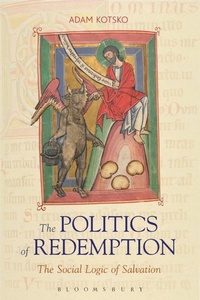
The Politics of Redemption
The Social Logic of Salvation
Published on 30. October 2010
Book
Paperback/Softback
224 pages
978-0-567-18566-2 (ISBN)
Description
Reviews / Votes
In this wonderfully readable and provocative book Adam Kotsko carefully examines the major texts of the tradition to demonstrate that the coherence of atonement theories depends upon a social-relational view of the human being. On this basis he offers a rethinking of atonement that fruitfully engages the contemporary controversies about this doctrine and opens up new paths for theological reflection. -- Theodore W. Jennings, Jr, Professor of Biblical and Constructive Theology, Chicago Theological Seminary, IL, USA. An indispensable contribution to the thorny theory of atonement. Hip to the feminist critique, inflected by the postmodern return to political theology, and steeped in the depths and potentialities of the doctrinal tradition, Kotsko's relational ontology for the doctrine of redemption offers a lucid and erudite resource for a wide spectrum of Christian theology. -- Catherine Keller, Professor of Constructive Theology, Author of Face of the Deep and On the Mystery. Kotsko does offer a very intriguing perspective on atonement. * Studies in Religion/ Sciences Religieuses * ...Kotsko has the makings of a constructive perspective replete with connections, not only to the theological past and present but to the recent conclusions of other disciplines as well. * Journal of Religion * This book stands to contribute greatly to church growth scholarship as it represents a much-needed demystification of planting churches and offers a more foundational look at the motivation and method behind church planting. * Religious Studies Review, Vol. 37, Issue 4 * The text is not only eminently readable, but makes a genuinely interesting and creative theological argument. -- Adonis Vidu, Gordon-Conwell Theological Seminary * Reviews in Religion and Theology * Kotsko's writing is quite clear, concise, and engaging. His writing style makes the argument of the book easy to follow while allowing its profundity to break through...The Politics of Redemption is a text that should be read by all theologians in order to gain a better understanding of the atonement while also seeing where the doctrine may open new avenues of thought: thus, Kotsko offers a major theological achievement. -- Nathan Crawford * Anglican Theological Review *More details
Language
English
Place of publication
Edinburgh
United Kingdom
Publishing group
Bloomsbury Publishing PLC
Target group
College/higher education
Dimensions
Height: 234 mm
Width: 156 mm
Thickness: 12 mm
Weight
351 gr
ISBN-13
978-0-567-18566-2 (9780567185662)
DOI
CBID157985
Copyright in bibliographic data and cover images is held by Nielsen Book Services Limited or by the publishers or by their respective licensors: all rights reserved.
Schweitzer Classification
Other editions
Additional editions
E-Book
10/2010
1st Edition
T.& T.Clark Ltd
€39.99
Available for download
Person
Adam Kotsko is Visiting Assistant Professorof Religions at Kalamazoo College (USA). His current research interests include 20th century European philosophy and early Christian thought.
Content
Acknowledgments
Chapter 1: Thinking relationally
'Religionless Christianity' and community
Ontology and 'being-with'
A social-relational reading of atonement theory
Chapter 2: Questioning atonement
Feminist and womanist perspectives
Theology and social theory
A case study: The question of redemptive suffering
Chapter 3: Reclaiming the tradition
Violent hospitality: Boersma
Narrative, not ontology: Weaver
Divine unilateralism: Aulen
Chapter 4: Irenaeus
Redemption as recapitulation
One human race
The principle of persuasion
The togetherness of God and creation
Chapter
5: Gregory of Nyssa
Birth and resurrection
Sensible and intelligible
Dealing with the devil
Chapter 6: Anselm
Variations on a theme
Displacing the devil
Original sin and its avoidance
Making the payment
'Out of love of the debtor?'
Chapter 7: Abelard
What is Abelard's atonement theory?
Implications: Publicity and han
Predestination and free will
Chapter 8: Community and related questions
An outstanding question
Predestination and community: Karl Barth
Representation and community: Dorothee Soelle
Religionless vs. demythologizing interpretation
Chapter 9: Politics of redemption
The ontology
The problem: Possession and rule
The solution: A persuasive fearlessness
Bibliography
Chapter 1: Thinking relationally
'Religionless Christianity' and community
Ontology and 'being-with'
A social-relational reading of atonement theory
Chapter 2: Questioning atonement
Feminist and womanist perspectives
Theology and social theory
A case study: The question of redemptive suffering
Chapter 3: Reclaiming the tradition
Violent hospitality: Boersma
Narrative, not ontology: Weaver
Divine unilateralism: Aulen
Chapter 4: Irenaeus
Redemption as recapitulation
One human race
The principle of persuasion
The togetherness of God and creation
Chapter
5: Gregory of Nyssa
Birth and resurrection
Sensible and intelligible
Dealing with the devil
Chapter 6: Anselm
Variations on a theme
Displacing the devil
Original sin and its avoidance
Making the payment
'Out of love of the debtor?'
Chapter 7: Abelard
What is Abelard's atonement theory?
Implications: Publicity and han
Predestination and free will
Chapter 8: Community and related questions
An outstanding question
Predestination and community: Karl Barth
Representation and community: Dorothee Soelle
Religionless vs. demythologizing interpretation
Chapter 9: Politics of redemption
The ontology
The problem: Possession and rule
The solution: A persuasive fearlessness
Bibliography