

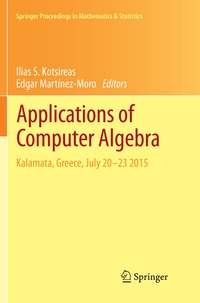
Applications of Computer Algebra
Kalamata, Greece, July 20-23 2015
Published on 2. August 2018
Book
Paperback/Softback
XIV, 515 pages
978-3-319-86038-1 (ISBN)
Description
The Applications of Computer Algebra (ACA) conference covers a wide range of topics from Coding Theory to Differential Algebra to Quantam Computing, focusing on the interactions of these and other areas with the discipline of Computer Algebra. This volume provides the latest developments in the field as well as its applications in various domains, including communications, modelling, and theoretical physics. The book will appeal to researchers and professors of computer algebra, applied mathematics, and computer science, as well as to engineers and computer scientists engaged in research and development.
More details
Series
Edition
Softcover reprint of the original 1st ed. 2017
Language
English
Place of publication
Cham
Switzerland
Publishing group
Springer International Publishing
Target group
Professional and scholarly
Illustrations
53 s/w Abbildungen, 73 farbige Abbildungen
XIV, 515 p. 126 illus., 73 illus. in color.
Dimensions
Height: 23.5 cm
Width: 15.5 cm
Weight
807 gr
ISBN-13
978-3-319-86038-1 (9783319860381)
DOI
10.1007/978-3-319-56932-1
Schweitzer Classification
Other editions
Additional editions
Ilias S. Kotsireas | Edgar Martínez-Moro
Applications of Computer Algebra
Kalamata, Greece, July 20-23 2015
Book
07/2017
Springer
€160.49
Shipment within 10-15 days
Persons
Content
An algebraic method to compute the mobility of closed-loop overconstrained mechanisms (Ali, Moinet, Serre).- Simplicial topological coding and homology of spin networks (Berec).- Trial set and Groebner bases for binary codes (Borges-Quintana, Borges-Trenard, Martiınez-Moro).- Automated Study of Envelopes of 1-parameter Families of Surfaces (Dana-Picard, Zehavi).- Complex Roots of Quaternion Polynomials (Dospra, Poulakis).- Mathematical renormalization in quantum electrodynamics via noncommutative generating series (Duchamp, Ngoc Minh, Quoc Hoan, Penson, Simonnet).- The root lattice A2 in the construction of substitution tilings and singular hypersurfaces (Escudero).- Finding eigenvalues of self-maps with the Kronecker canonical form (Ethier, Jablonski, Mrozek).- Algorithm for Predicting Mathematical Formulae from Linear Strings for Mathematical Inputs (Fukui).- Algebraic Modelling of Covering Arrays (Garn, Simos).- Applications of Signatures Curves to Characterize Melanomas and Moles (Grim, Shakiban).- Contemporary interpretation of a historical locus problem with the use of computer algebra (Hasek, Kovacs, Zahradnik).- Computing the Chern-Schwartz-MacPherson Class of Complete Simplical Toric Varieties (Helmer).- The Generalized Rabinowitsch Trick (Kapur, Sun, Wang, Zhou).- A Web-based Quantum Computer Simulator with Symbolic Extensions (Karamitrou, Tsimpouris, Mavridi, Sgarbas).- Dixon-EDF: The Premier Method for Solution of Parametric Polynomial Systems ( Lewis).- Visualization of Orthonormal Triads in Cylindrical and Spherical Coordinates (Lopez-Garcia, Jimenez Zamudio, Diaz V.).- Geometric and Computational Approach to Classical and Quantum Secret Sharing (Matsumoto, Ruano).- Computing the Dixon Resultant with the Maple Package DR (Minimair).- Collaborative Computer Algebra (Minimair).- States and channels in quantum mechanics without complex numbers (Miszczak).- Double Hough transform for estimating the position of the mandibular canal in dental radiographs (Onchis-Moaca, Zappala, Gotja, Real).- Simple and Nearly Optimal Polynomial Root- nding by Means of Root Radii Approximation (Pan).- A Fast Schur-Euclid-type Algorithm for Quasiseparable Polynomials (Perera, Olshevsky).- The use of CAS Piranha for the construction of motion equations of the planetary system problem (Perminov, Kuznetsov).- Code-Based Cryptosystems Using Generalized Concatenated Codes (Puchinger, Muelich, Ishak, Bossert).- Univariate real root isolation over a single logarithmic extension of real algebraic numbers (Strzebonski, Tsigaridas).- On the complexity of multivariate polynomial division (van der Hoeven).- Preserving syntactic correctness while editing mathematical formulas (van der Hoeven, Lecerf, Raux).- About balanced application of CAS in undergraduate mathematics (Varbanova).- Some remarks on Taylor's polynomials visualization using Mathematica in context of function approximation (Wojas, Krupa).- Zooming algorithms for accurate plotting of functions of two realvariables (Zeitoun, Dana-Picard).