

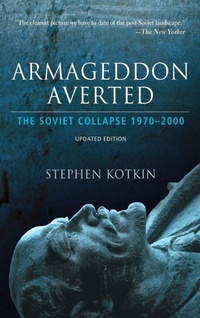
Armageddon Averted
Soviet Collapse since 1970 Updated Edition
2nd Edition
Published on 5. March 2009
Book
Hardback
304 pages
978-0-19-536864-2 (ISBN)
Description
Featuring extensive revisions to the text as well as a new introduction and epilogue-bringing the book completely up to date on the tumultuous politics of the previous decade and the long-term implications of the Soviet collapse-this compact, original, and engaging book offers the definitive account of one of the great historical events of the last fifty years.
Combining historical and geopolitical analysis with an absorbing narrative, Kotkin draws upon extensive research, including memoirs by dozens of insiders and senior figures, to illuminate the factors that led to the demise of Communism and the USSR. The new edition puts the collapse in the context of the global economic and political changes from the 1970s to the present day. Kotkin creates a compelling profile of post Soviet Russia and he reminds us, with chilling immediacy, of what could not have been predicted-that the world's largest police state, with several million troops, a doomsday arsenal, and an appalling record of violence, would liquidate itself with barely a whimper. Throughout the book, Kotkin also paints vivid portraits of key personalities. Using recently released archive materials, for example, he offers a fascinating picture of Gorbachev, describing this virtuoso tactician and resolutely committed reformer as "flabbergasted by the fact that his socialist renewal was leading to the system's liquidation"-and more or less going along with it.
At once authoritative and provocative, Armageddon Averted illuminates the collapse of the Soviet Union, revealing how "principled restraint and scheming self interest brought a deadly system to meek dissolution."
Acclaim for the First Edition:
"The clearest picture we have to date of the post-Soviet landscape."
--The New Yorker
"A triumph of the art of contemporary history. In fewer than 200 pagesKotkin elucidates the implosion of the Soviet empire-the most important and startling series of international events of the past fifty years-and clearly spells out why, thanks almost entirely to the 'principal restraint' of the Soviet leadership, that collapse didn't result in a cataclysmic war, as all experts had long forecasted."
--The Atlantic Monthly
"Concise and persuasive The mystery, for Kotkin, is not so much why the Soviet Union collapsed as why it did so with so little collateral damage."
--The New York Review of Books
Combining historical and geopolitical analysis with an absorbing narrative, Kotkin draws upon extensive research, including memoirs by dozens of insiders and senior figures, to illuminate the factors that led to the demise of Communism and the USSR. The new edition puts the collapse in the context of the global economic and political changes from the 1970s to the present day. Kotkin creates a compelling profile of post Soviet Russia and he reminds us, with chilling immediacy, of what could not have been predicted-that the world's largest police state, with several million troops, a doomsday arsenal, and an appalling record of violence, would liquidate itself with barely a whimper. Throughout the book, Kotkin also paints vivid portraits of key personalities. Using recently released archive materials, for example, he offers a fascinating picture of Gorbachev, describing this virtuoso tactician and resolutely committed reformer as "flabbergasted by the fact that his socialist renewal was leading to the system's liquidation"-and more or less going along with it.
At once authoritative and provocative, Armageddon Averted illuminates the collapse of the Soviet Union, revealing how "principled restraint and scheming self interest brought a deadly system to meek dissolution."
Acclaim for the First Edition:
"The clearest picture we have to date of the post-Soviet landscape."
--The New Yorker
"A triumph of the art of contemporary history. In fewer than 200 pagesKotkin elucidates the implosion of the Soviet empire-the most important and startling series of international events of the past fifty years-and clearly spells out why, thanks almost entirely to the 'principal restraint' of the Soviet leadership, that collapse didn't result in a cataclysmic war, as all experts had long forecasted."
--The Atlantic Monthly
"Concise and persuasive The mystery, for Kotkin, is not so much why the Soviet Union collapsed as why it did so with so little collateral damage."
--The New York Review of Books
Reviews / Votes
The clearest picture we have to date of the post-Soviet landscape. * The New Yorker *More details
Edition
2nd Revised edition
Language
English
Place of publication
New York
United States
Edition type
Revised edition
Illustrations
34 line illustrations
Dimensions
Height: 235 mm
Width: 157 mm
Thickness: 22 mm
Weight
630 gr
ISBN-13
978-0-19-536864-2 (9780195368642)
Copyright in bibliographic data and cover images is held by Nielsen Book Services Limited or by the publishers or by their respective licensors: all rights reserved.
Schweitzer Classification
Other editions
Additional editions
Book
12/2008
2nd Edition
Oxford University Press Inc
€20.00
Shipment within 15-20 days
E-Book
12/2008
OUP eBook
€12.99
Available for download
E-Book
12/2008
OUP eBook
€9.99
Available for download
Previous edition
Book
12/2001
Oxford University Press
€21.03
Article exhausted; check for reprint
Person
Stephen Kotkin is Professor of European and Asian History at Princeton University, where he also directs the Russian-Eurasian Studies Program. He is the author of nine books.
Content
PREFACE TO THE SECOND PAPERBACK EDITION ; NOTE ON THE TEXT ; LIST OF PLATES ; LIST OF MAPS ; INTRODUCTION ; 1. Historys cruel tricks ; 2. Reviving the dream ; 3. The drama of reform ; 4. Waiting for the end of the world ; 5. Survival and cannibalism in the rust belt ; 6. Democracy without liberalism? ; 7. Idealism and treason ; EPILOGUE ; NOTES ; FURTHER READING ; INDEX